
Thuong Tho, Land of Learning
(Baonghean) - Located on the left bank of the Lam River, Thuong Tho village (Thanh Van commune - Thanh Chuong district) appears with a strip of lush green land and surrounding small fields. The village has a history of about 600 years, closely associated with the pioneering and development of the Nguyen Tai family - a rather famous scholarly family in Nghe An province. Through the flow of time, the ancient traditions have been continuously preserved and nurtured, and today's generation is continuing to write new chapters in the history of their homeland.
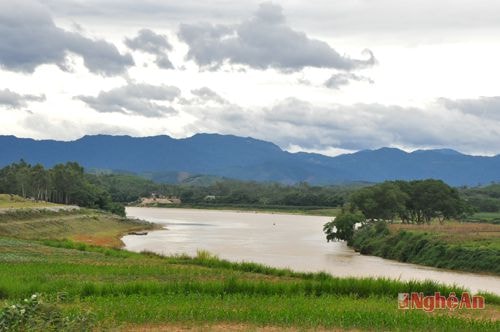 |
| The Lam River section passing through Thuong Tho village, Thanh Van commune (Thanh Chuong district). |
We've visited Thuong Tho village twice. The first time was over four years ago, when we accompanied a professor from the Institute of Literature to the funeral of Professor Nguyen Tai Can – an outstanding son of the Nguyen Tai family and of Nghe An province. That time, we didn't have much time to learn about the village's traditions, only to admire the ancient beauty of the area. This time, with the summer-autumn rice crops refreshed by the rains, some rice fields have begun to bloom. From the dike overlooking the fields, the village's beauty unfolds with towering coconut and betel nut trees, lush and green. Ancient houses with yin-yang tiled roofs are nestled beneath the trees, and the surrounding roads, now paved with concrete, look even cleaner and more beautiful. The Lam River, flowing here, seems somewhat different, its waters winding and gently flowing as if reluctant to linger, wanting to enrich the land with its alluvial soil. With its fields, rivers, and proximity to the national highway, this geographical location has provided Thuong Tho village with many opportunities to interact and connect with the outside world. The village's children have the chance to "take flight" and reach further, often returning with pride for their homeland and family.
We met with Mr. Nguyen Tai Thieu, the clan leader of the Nguyen Tai family, who briefly recounted the traditions of the land and people of Thuong Tho. According to the clan leader, the founders of the Nguyen Tai family in Thuong Tho village were Nguyen Hien and Nguyen Trung Ngan – two young men of exceptional talent who quickly achieved great success under the Tran dynasty. Their ancestors settled here, reclaiming land and establishing Thuong Tho village approximately 600 years ago. Upon settling in this area, their forefathers recognized that the terrain and the shape of the river would ensure the family's longevity, a bright future for their descendants, and a flourishing tradition of learning and scholarship, as vibrant as the river and fields before them.
During the feudal era, villages and clans were closely intertwined. Large clans often clustered together to form villages, and in some places, people named their villages after their clans. The village of Thuong Tho was formerly home to the Nguyen Tai clan; mentioning this clan was synonymous with mentioning Thuong Tho village, and vice versa. Over time, as social relationships formed and established, Thuong Tho village underwent some changes, with 4-5 other clans settling there. Today, administratively, Thuong Tho village is called Hamlet 4, Thanh Van Commune, with nearly 150 households, of which about 70% belong to the Nguyen Tai clan, and the remainder belong to other clans that have recently moved there.
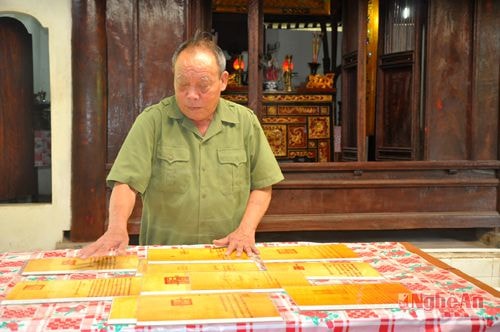 |
| The imperial decrees and edicts of the Nguyen dynasty are currently preserved at the ancestral temple of the second branch of the Nguyen Tai family. |
Members of the Nguyen Tai family often remind their descendants that this land is harsh, with relentless rains and scorching sun, and the land is scarce and barren. Without the will to overcome adversity, people will forever be trapped in poverty and hardship. To overcome poverty, education is the most sustainable and promising path to a bright future. In the past, education was for passing exams and becoming officials; today, it is for acquiring knowledge and securing stable employment. Therefore, education must be prioritized. Parents, even if they have to subsist on cassava and sweet potatoes, are determined not to let their children be uneducated. Grandparents and parents often use the examples of studiousness and academic success of their ancestors and predecessors as guidance and inspiration for their children's pursuit of academic pursuits and learning.
Respecting and caring for education, the Nguyen Tai family has produced many highly accomplished individuals who have achieved high honors, returned home in glory, and been promoted to high positions, contributing to the prestige of their homeland. The first to mention is Nguyen Tai Tuyen (1837-1884), who passed the doctoral examination in the Dinh Suu year, the 30th year of the Tu Duc reign (1877), in the same year as the patriotic scholar Phan Dinh Phung. Nguyen Tai Tuyen's name is inscribed on a stele erected at the Temple of Literature... At the ancestral temple of the second branch of the Nguyen Tai family, many imperial decrees and edicts granted by the Nguyen dynasty to the family's descendants are still preserved. These "treasures" are carefully guarded and only brought out during ancestral ceremonies for descendants to admire, further strengthening their resolve in their studies and careers.
Continuing the family's scholarly history and tradition, Professor Nguyen Tai Can (1926 - 2011), a descendant of Dr. Nguyen Tai Tuyen, was considered one of the leading experts in Vietnamese linguistics. He laid the foundation for the study of Vietnamese grammar, was invited to lecture at prestigious universities in the United States and France, and was admired by the international linguist community. The Nguyen Tai family also boasts a recipient of the Ho Chi Minh Prize: musician Nguyen Tai Tue, author of timeless songs such as "Xa Khoi" (Far from Shore) and "Tieng Hat Giua Rung Pac Bo" (Singing in the Pac Bo Forest). In Thuong Tho village, people often mention teacher Nguyen Tai Dai, who worked at the General Headquarters of the Vietnam People's Army, served as Chief of Staff to General Vo Nguyen Giap, and later as Head of the Education Department of Nghe Tinh province. Beyond his professional field, Nguyen Tai Dai was also a talented poet and couplet writer, and had a wide circle of friends.
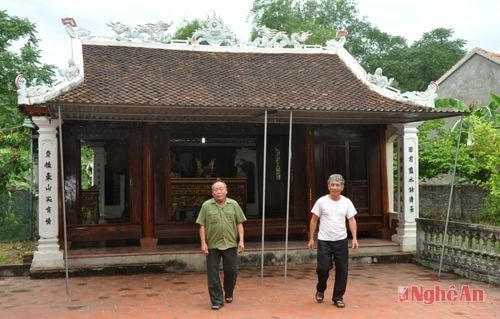 |
| The ancestral temple of the second branch of the Nguyen Tai family in Thuong Tho village, Thanh Van commune (Thanh Chuong district). |
Continuing the tradition, the Nguyen Tai family has produced highly accomplished individuals in every generation, working in education and other fields, contributing to the country's integration and development. According to the clan leader, Nguyen Tai Thieu, the Nguyen Tai family in Thuong Tho village currently boasts over 10 PhD holders, over 30 Master's degree holders, and countless university graduates. In their student years, every year, members of the family receive the title of outstanding student at the provincial and district levels. For the Nguyen Tai family, education and the care given to their children's education have always been a top priority and have become a deeply ingrained tradition.
In Thuong Tho village, many families face hardship and struggle, yet parents are determined to provide their children with a good education, ensuring they don't fall behind their peers. One such example is Mr. and Mrs. Nguyen Tai Thi, a severely disabled war veteran who lost a leg but still worked hard to support their children's education. Touched by their parents' tireless efforts, their four children repaid their parents' kindness with academic achievements. Nguyen Tai Van, Nguyen Tai Tien, Nguyen Tai Toan, and Nguyen Thi Hau successively entered university. To date, all have graduated, some becoming university lecturers, some doctors, and some court officials. They all deeply appreciate their parents' sacrifices and promise to raise their children and grandchildren to be successful, continuing the family tradition and not disappointing their parents. Mr. Nguyen Tai Tien's family also has four children who have all received a good education and are now civil servants. In the early 1990s, when life was still difficult and education was not a priority, Mr. and Mrs. Tien did not hesitate to invest in their children's education, and their success in passing exams was a miracle. Then, the families of Mr. Nguyen Tai Thuong, Mr. Nguyen Tai Thieu, and many others saw their children and grandchildren receive a good education and become exemplary officials, teachers, and military and police officers.
Mr. Nguyen Tai Thieu added: "To motivate and encourage our descendants to focus on their studies and continue the ancestral traditions, the Family Council has launched a scholarship fund. On the ancestral worship day (the 13th day of the first lunar month every year), descendants from all over the country come together, perform the rituals, and then award prizes to children with high academic achievements."
Now, anyone who has the opportunity to visit Thuong Tho will surely be deeply impressed by a midland countryside with its own unique character, the very soul of a village in Nghe An province that has produced many talented people.
Tuong Anh


