
Land of learning along the Bung River
(Baonghean) - I've traveled back and forth to the ancient land of Dong Thanh dozens of times, and each time I've been captivated by the crimson sunset pouring down on the Bung River, as if coating the vast expanse of the river with warm colors. Each time, I'm amazed by the enchanting beauty of nature. This river, considered one of the "eight most beautiful sights" in Dong Yen district, curves gracefully like a young woman's waist, flowing through the rural banks, then gently narrowing at a bend just a few kilometers from the open sea...
(Baonghean) - I've traveled back and forth to the ancient land of Dong Thanh dozens of times, and each time I've been captivated by the crimson sunset pouring down on the Bung River, as if coating the vast expanse of the river with warm colors. Each time, I'm amazed by the enchanting beauty of nature. This river, considered one of the "eight most beautiful sights" in Dong Yen district, curves gracefully like a young woman's waist, flowing through the rural banks, then gently narrowing at a bend just a few kilometers from the open sea...
Right at the bend of the Bùng River, where the waves gently flow, lies the heart-stirring land of one of Vietnam's most renowned scholarly families – the Ngô family of the ancient Lý Trai region. The Ngô-Lý Trai family's historical complex stands as a tranquil, peaceful note on the bustling main road. As the heavy, lim wood gate opens, a space imbued with the scent of ancient tales rushes in for visitors. One may have heard of this famous historical complex for a long time, but only by visiting and witnessing it firsthand can one truly see that the passage of time seems to have little effect on the sacred beauty of this place of worship.
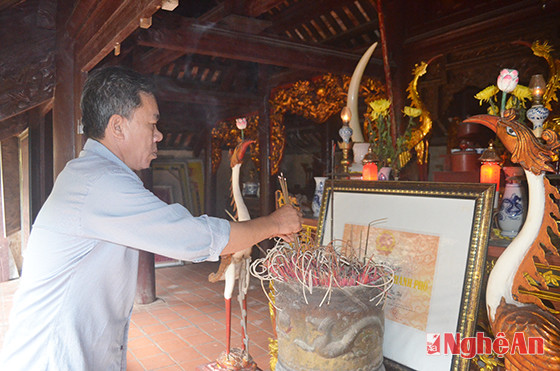 |
| Mr. Ngo Sy Hop respectfully offered incense at the family altar. |
Mr. Ngo Sy Hop, a member of the Ngo family council, spoke simply, solemnly, and openly expressed his pride in his family's historical complex. Currently, the Ngo family's ancestral temple complex is dedicated to three ancestors: Ngo Tri Tri, Ngo Tri Hoa, and Ngo Sy Vinh, in order from grandfather to grandson. The Ngo family temple, now 386 years old, is entirely made of ironwood, with exquisite carvings reaching the pinnacle of 17th-century architectural art. Through the vicissitudes of time, its splendor and grandeur have not faded, but have only been enhanced by the devotion of descendants from all directions, who, on the first day of the lunar month, remember their roots and add more golden canopies and precious cranes. This gratitude and pride are well-deserved, as only the Ngo - Ly Trai family in Vietnam enjoys the honor of father and son both achieving high ranks in the same examination (the Nham Thin examination in the 15th year of Quang Hung, i.e., 1592).
Lost in thought, Mr. Ngo Sy Hop enthusiastically pointed towards the lower hall – where a brightly framed plaque was displayed, its meaning unclear to me from afar. Ah, it turned out that the descendants of the Ngo family ancestors were joyfully showing me the Guinness Vietnam record certificate for "Honoring the record of a father and son both passing the doctoral exam in the same examination" for the father, the renowned Ngo Tri Tri, and the son, the renowned Ngo Tri Hoa. I had learned about this famous event through the media around the beginning of September last year. I heard it was a grand and impressive event, attended by many famous historians nationwide, as well as provincial and central government leaders. A good reputation spreads naturally; the Ngo family, over generations, has contributed many renowned generals and meritorious officials to Vietnam. Even today, names like Major General Ngo Sy Quan, Lieutenant General Ngo Van Son, Major General Ngo Sy Hien, Mr. Ngo Quang Xuan - Chairman of the National Assembly's Foreign Affairs Committee..., and even "a great-grandson, Ngo Phuong Lan, Miss World Vietnam 2007," are all descendants of the Ngo family. Every year, during ancestral worship ceremonies, festivals, and holidays, no matter how far away they are, descendants still gather on their ancestral land along the Bung River to offer incense and remember their roots.
In that sacred space, I ventured to quietly ask Mr. Ngo Sy Hop, even though he was a descendant, if he had heard anything about the prophetic legends that foretold the eternal glory of his family lineage. After a moment of contemplation, he replied, "I'm not very knowledgeable about the prophetic stories. Across the road from the main gate of the historical site is the house of Mr. Ngo Sy Linh. Mr. Linh is much weaker these days, but he's the only one who still understands the origins of the ancient stories. Whether it's official history or unofficial accounts, written or oral traditions, just ask him and you'll find out!"
Following a valuable tip from Mr. Ngo Sy Hop, I visited Mr. Linh's house. This year, he is 96 years old. Having lived through centuries and countless changes in the times, he spoke slowly, partly due to his declining health, and partly because it was easy to "read" the underlying caution and seriousness when he spoke about his family lineage. He said that the founder of the Ngo family in Dien Chau was Mr. Ngo Nhat Dai. He was a local chieftain living in the Cua Sot region (Ha Tinh province), and had participated in Mai Thuc Loan's rebellion against the Tang Dynasty invaders in 722. His descendants, through many upheavals, migrated to various places. In the 22nd generation, there was Mr. Ngo Nguyen in Vong Nguyet commune, Yen Phong district, Bac Ninh province. Mr. Ngo Nguyen's wife, Mrs. Chu Thi Bot, was compassionate and, seeing the famine in the area, emptied her family's granary to give alms, eventually losing all her possessions.
The couple had two sons, Ngo Ngoc and Ngo Dinh. After their parents passed away, the family was impoverished. The eldest son, Ngo Ngoc, was adopted by his uncle in Bac Ninh and given a good education to continue the family line. The younger son, Ngo Dinh, later migrated to Ly Trai village, Ly Trai commune, Dong Thanh district (now Dien Ky commune, Dien Chau district). This Ngo Dinh became the progenitor of the Ngo family in Dien Chau in particular and Nghe An in general, considered a secondary branch of the Ngo family. At that time, a folk poem circulated: “One root, a hundred branches sprout the Ngo family / The story of the woman who gave away rice for eternity / Pity those who eat rice porridge in crop failure / Doing good deeds until the sack is empty / The two words 'glory' are woven into a memorial / Five generations consecutively receive the blessing / As long as heaven, earth, and mountains remain / The ancestral rice is plentiful, there is no need to worry.”
Grandfather Linh read me the orally transmitted prophecy, then gently analyzed it: People interpreted the phrase "Five generations consecutively passed the imperial examinations" to mean that five generations of the eldest branch of the Ngo family in Bac Ninh had successively earned doctorates, and the concluding phrase "The ancestral rice is still plentiful, no need to worry" alluded to the next five generations of the second branch of the Ngo family - Ly Trai - continuing that glorious tradition. Whether it's true or not, no one can be sure, but the prophecy remains in folklore as a valuable lesson about humanity, goodness, studiousness, and the perseverance to overcome difficulties of a scholarly family in Vietnam.
A moment of silence passed... Old Man Linh paused, clearing his throat softly. The sun was setting, and the first winds of the season carried the chill from the Bung River into the small room. He gestured towards the river, saying, "The Ngo-Ly Trai family, blessed by their ancestors, deeply rooted in the land and the river of this ancient region at the mouth of the sea, thousands of years old, surpass others in their pursuit of learning and advancement." His words resonated deeply. Reflecting on the illustrious doctoral degrees recorded in history, they were examples of overcoming hardship, escaping poverty, and prioritizing learning throughout their lives. For instance, the renowned Ngo Tri Tri, according to the Dong Yen district's examination records, passed the Huong Cong examination in the Mau Ngo year of Thien Huu 2 (1558) during the reign of King Le Anh Tong. Thirty-four years later, in the Nham Thin year of Quang Hung 15 (1592), he passed the Tam Giap Dong Tien Sy examination, ranking first. At that time, he was 56 years old. His grandson, Ngo Si Vinh, also achieved a prestigious title in the imperial examinations when he was in his fifties…
Today, within the complex of the Ngo Tri Hoa and Ngo Sy Vinh ancestral temples, many valuable royal decrees bestowed by the imperial court of various periods are still preserved. Ngo Tri Hoa himself was a man of vast learning and remarkable memory, a distinguished official under three emperors: The Tong, Kinh Tong, and Than Tong. Particularly noteworthy are the ten golden words bestowed by the emperor: "Fame and fortune exist in the world / Father and son passing the same examinations are not," which most concisely encapsulates the meaning of honor and academic achievement stemming from the family's humanistic foundation. Ngo Sy Linh said that while the golden words bestowed by the emperor are precious, for the descendants of the family, even more valuable is the traditional couplet passed down through generations in the countryside, simple yet profound: "Early morning potatoes, noon potatoes, evening potatoes, potatoes for three meals / Father passes, son passes, son passes, grandson passes, the whole family passes."
The tradition of valuing education has been maintained and continued through generations. Even though the days of meager meals are gone and the lives of the younger generation have improved significantly, the flame of learning remains bright in the family's consciousness. The Ngo-Ly Trai family continues to uphold its reputation as a family of studious individuals, evidenced by the impressive statistics on the achievements of its descendants in academic competitions at all levels, high graduation rates, university admissions, and success in various fields of life. The family's scholarship fund is also a commendable feature, maintained for many years with a stable source of funds. Besides providing rewards and encouragement for descendants to excel in their studies and careers, it also provides long-term support to children from disadvantaged families. From this small land along the picturesque Bung River, many studious birds of the family have soared to the four corners of the earth. Grandpa Linh and I gazed wistfully at the ancient persimmon trees spreading their branches across the moss-covered courtyard of the church grounds. We heard that just last month, the Vietnam Green Heritage Association came to collect samples for analysis, and the results confirmed that those three majestic persimmon trees are over 300 years old, roughly the same age as the entire Ngo-Ly Trai family church complex. Thus, the echoes of a century, embodied in these enduring historical relics, once again instill a sense of pride and honor in future generations, inspiring them to continue the tradition of preservation...
Text and photos:Phuong Chi


