
The mark of the green military uniform
(Baonghean) - During the past term, in addition to successfully fulfilling the task of firmly protecting the sovereignty and security of the border and sea areas, the Nghe An Border Guard also left a strong mark in foreign affairs and participated in helping ethnic minorities eradicate hunger and reduce poverty.
Building the borderpeace and friendship
For the past two months, regularly on Mondays, Tuesdays, and Wednesdays, Senior Lieutenant Nguyen Van Trinh, an interpreter at the Thong Thu Border Guard Post, has been directly teaching Vietnamese to 40 students, including officials, civilians, and students in Nam Tay village, Vieng Phan cluster, Sam To district, Hua Phan province (Laos). Captain Ngo Van Thien, Deputy Political Officer of the unit, said: The Vietnamese language class aims to concretize the content of the twinning agreement between Nam Tay village and Muong Phu village, Thong Thu commune, Que Phong district (Nghe An); and between Border Guard Company 216, Hua Phan (Laos) and Thong Thu Border Guard Post, Nghe An Border Guard Command. The class will facilitate relations, trade, and visits between residents on both sides of the border for both sides.
Nam Tay is the first village in the Lao provinces bordering Nghe An province to establish a sister village relationship with Muong Phu village, Thong Thu commune, Que Phong district. Nam Tay village has 135 households of the Mong ethnic minority living in difficult conditions, both materially and spiritually. In April 2015, the Nghe An Border Guard Command supported the construction of a village cultural center with a total cost of 1 billion VND, funded by contributions from Border Guard officers and soldiers, the Nghe An Provincial People's Committee, and other agencies, units, and benefactors. The Nghe An Border Guard Command also supported the construction of three charitable houses for poor households in Nam Tay village with a total cost of 180 million VND, along with the labor assistance of officers and soldiers from the Thong Thu Border Guard Post. Mr. Xay Va Tho, head of Nam Tay village, happily said: "On behalf of the villagers, I would like to thank our neighboring brothers and sisters for their valuable support and assistance, especially the Vietnam Border Guard."
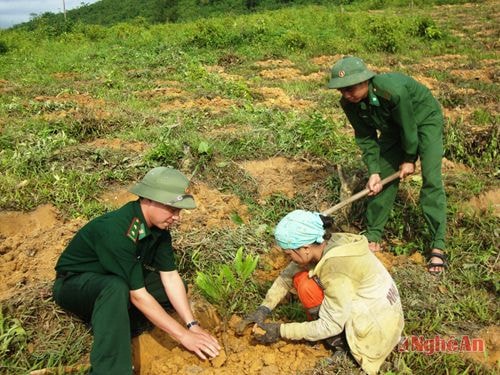 |
| Nghe An Border Guard helps people develop economic models. |
To date, along the Vietnam-Laos border in Nghe An province, 18 out of 18 pairs of villages have established sister-village relationships, yielding many practical results. The people on both sides of the border are more united, respecting the law and regulations of the border agreement; security and social order are consistently maintained... To date, the Party committees and authorities of the localities and villages in Nghe An have assisted their sister-villages in Laos with livestock and crop farming techniques to develop household economies, improve ponds and livestock pens; and provided 50 kg of fish fry. The villages in Laos have provided the people of their sister-villages in Vietnam with over 1.3 tons of cassava seeds and various vegetable and fruit seeds. Through coordinated patrol and control activities, 68 households/358 Hmong people were found to have illegally migrated to Laos, 6 cases/15 individuals involved in trafficking women were uncovered, and 15 victims who had been trafficked to China were rescued… Notably, during major holidays and traditional festivals of both countries, the villagers in the sister villages on both sides organize celebrations and share joy. Cultural, physical, and sports exchanges between the villages are also regularly organized.
Along with establishing sister-village relationships, six border guard posts under the Nghe An Border Guard Command have also established sister-village relationships with border protection units on the opposite side of Laos to build a peaceful, friendly, stable, cooperative, and developing border. Colonel Tran Minh Cong, Deputy Political Commissar of the Nghe An Border Guard Command, affirmed: The sister-village relationships and those between border protection units of the two countries have contributed to promoting the common task of managing and protecting border sovereignty and security; maintaining security and order in villages on both sides; and jointly building a peaceful, friendly, cooperative, and sustainable border, contributing to further strengthening the special friendship between Vietnam and Laos.
Helping our compatriots rise out of poverty.
To share the difficulties faced by people in border areas and create opportunities for them to escape poverty, the Border Guard's "Cattle Breeding Program to Help Poor Households" has assisted dozens of poor households. The family of Mr. Pit Pho Tam (born in 1983), a disadvantaged family in Huoi Cang 1 village, is one of seven poor households in Bac Ly commune (Ky Son district) that received a breeding cow from the Border Guard in 2014, worth 15 million VND. After the donation, officers and soldiers of My Ly Border Guard Post "rolled up their sleeves" to help the families build barns and guide them on how to grow grass to feed the cows. To date, Mr. Tam's cow, along with those of other families, has given birth to another litter of calves. Mr. Cụt Phò Dương, Chairman of the People's Committee of Bắc Lý commune, shared: "Besides helping with house construction and rice farming, the Border Guard also donated breeding cows to develop livestock farming and production towards a commercial direction... Therefore, the lives of the people have undergone many positive changes, and people are now less poor and less suffering."
To date, the Provincial Border Guard Command has donated 21 breeding cows to 21 poor households in three communes: Mon Son (Con Cuong), Tam Hop (Tuong Duong), and Bac Ly (Ky Son), totaling over 200 million VND. The money for purchasing the cows was sourced from donations from officers and soldiers. Annually, the Party Committee and Command of the Provincial Border Guard Command assign each unit the target of directly assisting 2 to 3 households in developing their family economy. They also effectively implement the plan to assist the three poor communes of Mon Son, Tam Hop, and Bac Ly as assigned by the Provincial People's Committee. In addition, officers and soldiers from the units have contributed over 4,050 man-days to help people build and repair nearly 200 km of rural roads and over 105 km of irrigation canals; and guided people in borrowing capital to develop models for raising shrimp for export and cage fish farming. 7/22 units helped people reclaim paddy fields, converting from one rice crop per year to two rice crops per year. Besides mobilizing officers and soldiers within the unit, the Provincial Border Guard also mobilized political and social organizations, agencies, businesses, and philanthropists inside and outside the province to provide gifts and cash worth tens of billions of VND to help poor households in border areas develop their economy and alleviate poverty; coordinated the construction of 237 "Shelter for the Poor in Border Areas"; and 13 public works projects… contributing to resolving housing needs for poor households and public works projects in border areas.
The actions of the officers and soldiers in green uniforms have left a positive mark and brought practical results to the border regions. Through this, they have contributed to the stability and socio-economic development, the firm protection of national sovereignty and border security, and the maintenance of political security and social order in the border areas.
Phuong Linh


