
Symptoms of sciatica or herniated disc
Pain radiating from the lower back down to the buttocks and legs is often a sign of sciatica. The pain can worsen with prolonged sitting, heavy lifting, or excessive walking.
People with sciatica sometimes experience pain when coughing or laughing loudly. The sciatic nerve is the largest nerve in the body, formed by the convergence of nerve roots in the lumbar region. It runs along the back of the buttocks, thigh, and down the leg.
Sciatica is often caused by a herniated disc in the lumbar spine, sometimes accompanied by numbness, weakness in the leg, or muscle atrophy. The condition can also be caused by many other factors such as spinal stenosis, spinal arthritis, disc inflammation, sciatic nerve inflammation, sciatic nerve tumors, etc.
The intervertebral disc is a structure located between two adjacent vertebrae. It is disc-shaped, with a thick, strong fibrous outer layer and a gelatinous, egg-white-like nucleus pulposus inside. When the fibrous outer layer ruptures, the nucleus pulposus escapes, forming a herniated mass. If this herniated mass compresses a nerve root, it can cause pain, numbness, weakness, and paralysis.
If a herniated disc occurs in the lumbar region, it can compress the sciatic nerve roots, causing sciatica. A herniated disc in the neck can cause neck or shoulder pain, or pain, numbness, or weakness in the limbs. If the herniated disc is in the thoracic region, the patient may experience intercostal neuralgia. Discs in the neck and lumbar regions are most commonly affected by herniation.
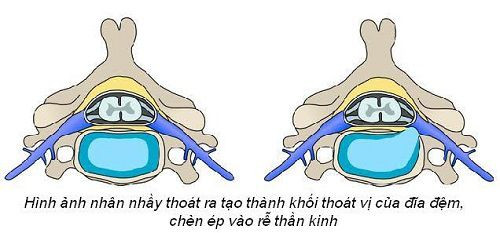 |
| The image on the right shows a patient with a herniated disc. |
When a herniated disc protrudes, it pulls the periosteum alongside it. Over time, bone grows along with it, forming bony rings. On X-rays, these appear as sharp spikes, hence the name "spinal spurs."
Typically, patients only seek medical attention when a herniated disc causes pain, numbness, weakness, or paralysis. In this case, doctors address the herniation before the "spurs" form. Herniations that don't cause symptoms (usually because they don't compress nerves) have enough time to develop "spurs." Therefore, patients shouldn't panic when they learn they have spinal spurs. In reality, very few spurs need to be removed. Also, note that "spurs" is the name given to a part of the spine and has nothing to do with spinal spurs.
Patients often ask their doctors, "Why can the nucleus pulposus protrude from the annulus fibrosus to form a herniated mass?" This is due to the degenerative process. The intervertebral disc begins to degenerate as a person learns to walk, and this process accelerates with age. Many organs in the body also undergo similar degeneration.
Degeneration is the leading cause of herniated discs. Other factors such as arthritis, heavy lifting, and injury can also weaken and rupture the fibrous capsule. Furthermore, degeneration can cause other parts of the spine to become rough, swollen, and compress nerve roots, similar to the mechanism of herniated discs. If these degenerated parts compress other parts of the spine, it can also cause back or neck pain.
In summary, spinal degeneration is the primary cause of herniated discs, leading to bone spurs and sciatica. Spinal degeneration can also cause back pain, neck pain, or sciatica without a herniated disc. Furthermore, this condition is the cause of several other diseases, all collectively known as degenerative spinal diseases.
Lumbar disc herniation is the main cause of sciatica. If the disc herniation is in the neck, you'll often be diagnosed with "cervicobrachial syndrome" or a similar term. Generally, each name has its own meaning. However, the current lack of uniformity in the use of these terms can easily confuse patients.
To prevent and reduce the recurrence of the disease, people need to exercise regularly, maintain a consistent sports training routine, especially swimming, live in a clean environment, and use food and medicine that meet hygiene and safety standards. Avoiding contact with harmful substances, avoiding prolonged sitting, and avoiding obesity will help keep your spine healthier.
According to VnExpress


