
What were President Obama's African footprints?
(Baonghean) - US President Barack Obama is on a special trip to Africa with two stops: Kenya and Ethiopia. This is Obama's fourth visit to the continent since becoming President in 2009. However, looking back at his diplomatic record, his presence in Africa seems rather faint, despite Kenya being his ancestral homeland. Therefore, it can be said that after a series of diplomatic breakthroughs such as improving relations with Cuba and reaching a historic nuclear agreement with Iran, this visit to Africa is seen as an attempt to find a distinct mark for Obama at home in the final stages of his not-so-long presidential term.
A meaningful trip back home.
Perhaps never before have the people of Kenya, and Africa in general, been as joyful as they are now, with the visit of the renowned son of the African continent, Mr. Obama, on his multi-day trip back to his homeland. The Kenyan people are particularly excited because this is Mr. Obama's first return as President. Looking back to 2006, Mr. Obama visited Kenya, but at that time he was still a US Senator. He himself expressed disappointment at not having enough time to fully explore his homeland. Therefore, the primary significance of this trip is fulfilling Mr. Obama's personal wish as his presidential term nears its end.
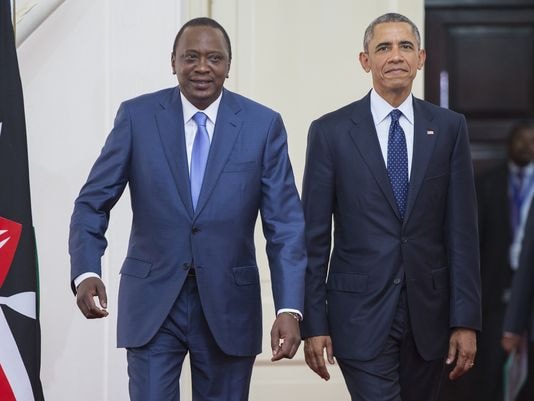 |
| US President Barack Obama (right) and Kenyan President Uhuru Kenyatta. Source: AP |
Secondly, the trip is President Obama's answer to public concerns and the expectations of African people, demonstrating that he still cares about Africa and hasn't "neglected" it as many believe. Many believe that Africans have felt a sense of resentment because President Obama, since taking office, has focused heavily on the Middle East, Latin America, then Ukraine, terrorism, and the Asia-Pacific region. Africa, on the other hand, has been largely overlooked, perhaps only in the fight against AIDS or, more recently, the Ebola epidemic. Furthermore, according to observers, Obama has largely implemented policies inherited from his predecessor, George Bush, such as maintaining around 1,500 troops in Djibouti and a limited number of drones in Somalia and Mali to combat terrorism. Therefore, this visit to Kenya and Ethiopia will, to some extent, restore the goodwill of African people towards President Obama.
Moreover, many of the key objectives set out during this trip also demonstrate President Obama's determination to adjust his foreign policy towards Africa, namely strengthening economic and security cooperation and deepening bilateral relations. With a stop in his ancestral homeland of Kenya from July 24th to 26th, most notably, President Obama announced a commitment of over $1 billion from the US government, banks, foundations, and philanthropists to help Africa. Half of this money will be used to support women and young people who want to start their own businesses. In addition to security and counter-terrorism issues, President Obama and his counterpart Uhuru Kenyatta also discussed trade, increasing transparency in government operations, and combating illegal wildlife poaching. Currently, trade between Kenya and the US reached a record $300 million in 2014, with the US being Kenya's largest supplier of goods.
Meanwhile, at the next destination, Ethiopia, anti-corruption and counter-terrorism efforts will be central topics of discussion. Ethiopia is considered a key ally in the region by the US, particularly in the fight against the al-Shabab group linked to Al-Qaeda, as well as in peacekeeping missions on the African continent. Therefore, although not two of the largest countries in Africa, the content and significance of the trip to Kenya and Ethiopia could well become one of Obama's African highlights during his presidency.
Is it possible to narrow the gap with China?
There's no denying the remarkable diplomatic shift by US President Barack Obama toward Africa. However, the question is whether this effort can help the US close the gap in the race to the African continent with other major powers, especially China. The reality is that in recent years, Beijing has been implementing a strategy of investing at an incredibly rapid pace in Africa. While in 2009 China only surpassed the US in terms of trade value with Africa, by 2013, while US-Africa trade was only $85 billion, China's figure had reached $200 billion. Another noteworthy piece of information is that the US modestly allocated less than 1% of its foreign direct investment (FDI) to Africa last year, while China allocated at least 3.4% of its FDI to the region.
The reason cited is that the Obama administration has been unable to extricate itself from the quagmire of the Middle East, while simultaneously allocating resources to a series of new hotspots such as the Ukraine crisis, the fight against terrorism in general, the fight against the Islamic State (IS) in particular, and the upcoming pivot to the Asia-Pacific region. Meanwhile, China is experiencing rapid economic growth and needs to target resource-rich regions like Latin America and Africa. Therefore, Africa will undoubtedly be a top priority in China's foreign policy. Furthermore, if there is investment, China and the US invest in somewhat different ways. According to observers, while Beijing focuses heavily on economic cooperation and resource exploitation, Washington invests more in security support, fulfilling its responsibilities as a major power.
Looking back at the two visits to Africa last May by US Secretary of State John Kerry and Chinese Premier Li Keqiang, this is immediately apparent. During his visit to Ethiopia, Angola, and Congo, Secretary Kerry focused on issues such as counter-terrorism security against Al-Qaeda, ending violence in South Sudan, Eastern Congo, and the Central African Republic. Premier Li Keqiang, on the other hand, prioritized economic benefits and new aid and investment in the continent. China committed $12 billion through 60 signed agreements to Ethiopia, Angola, Kenya, and Nigeria. This figure is nearly double the $7 billion that President Obama pledged through the "Power Africa" project announced last year during his trip to Senegal, Tanzania, and South Africa.
Therefore, some argue that Beijing's "surpassing" Washington in economic cooperation with Africa seems to be due to benefiting from the US's efforts to improve security in the region (!). However, the US cannot deny the fact that it consistently lags behind China in the race to the African continent. This trip to Kenya and Ethiopia may also mark a positive milestone for Obama during his presidency, but it will likely be more symbolic than substantive.
Khang Duy


