
First visitor of the year to a farmer's house.
(Baonghean)The reality is that currently, rural laborers view farming as a secondary occupation for food self-sufficiency, lacking focus and passion for the profession, leading to a "farming-agriculture abandonment" mentality. However, visiting some farming households in Dien Chau at the beginning of the year reveals that farmers have the opportunity to become wealthy through their primary occupation: farming.
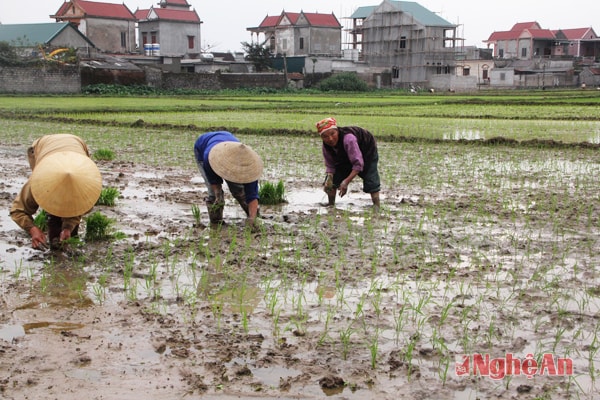 |
| Farmers in Dien Cat - Dien Chau are planting rice for the winter-spring crop. |
On the sixth day of the Lunar New Year, the festive atmosphere still lingered throughout the villages, but the fields were already bustling with activity for the new planting season. According to the general schedule, by around the 15th day of the first lunar month, over 80,000 hectares of winter-spring rice in the province will have been sown and planted. To meet the deadline, farmers began planting rice in the fields from the second day of the Lunar New Year.
Following the agricultural extension officers of Dien Chau district, we visited Dien Cat commune. Standing by a rice paddy under cultivation, Ms. Tang Thi Huong, Secretary of the Dien Lien Commune Party Committee, said: Her family cultivates 5 sao (approximately 0.5 hectares), taking advantage of the Tet holiday when many children and grandchildren came home to plant from the third day of Tet until now, and it's basically finished. The entire commune has planted over 70% of its area. In conversation, Ms. Huong stated that farmers currently cannot make a living solely from farming. In Dien Cat, the average land area per capita is only 1 sao, so agricultural production is only for self-sufficiency in food. Because of this, farmers view farming as a "secondary occupation." In each season, they work for a few days, even hiring laborers, before moving on to other jobs. A question arises: Can farmers currently live and prosper solely from farming?
In Dien Chau, we visited the farm of former Colonel Duong Ngoc Zao. After 37 years of service, Colonel Duong Ngoc Zao retired in 2008. To fulfill his dream of becoming wealthy, he leased 3 hectares of low-lying rice paddies from the commune, investing approximately 700 million VND (2009 price) to transform the poor land into a comprehensive farm. He adopted the proverb "A bumpy, uneven field is not as good as a small plot of land" as his guiding principle. He said that currently, most farmers have an inferiority complex about their work, viewing farming as a secondary occupation for self-sufficiency, thus lacking focus and passion for the profession, leading to a "leaving agriculture" mentality. For him, however, farming is a passion, a way to fulfill his dream of becoming wealthy, and he has proven that farmers can become rich right on their own land.
On the 3 hectares of land he leases from the commune, he uses 2 hectares to dig fish ponds, and builds several rows of pens for raising pigs, chickens, and pigeons on the banks. He uses the remaining 1 hectare to grow rice. His rice-growing method is also unique. During the planting season, he drains the water completely, hires machinery to prepare the land, and sows the seeds. With this direct-seeding technique, he saves about 500,000 dong on rice seeds and transplanting labor each season. When the rice grains turn red, he drains the water completely, lets the field dry, and hires a combine harvester. In just one morning, the entire hectare of rice is harvested. He brings the rice home, and the field is flooded with water again, ensuring a steady income of two rice crops and one fish crop per year. He wishes that if the commune had more land or if someone abandoned their farm, he could rent 10 hectares to make his efforts worthwhile. He dreams of becoming a "rice farmer" of Southern Vietnam. Currently, from rice, fish, pigs, chickens, and pigeons, he earns about 200 million dong in net profit each year. Combined with his and his wife's pensions, his family earns tens of millions of dong per month. Through his work, Mr. Zao realized that the land never betrays people; with love, the land will repay them.
In Hamlet 10, Dien Thanh, there is Mr. Tran Duy Hung, known as the "king of vegetables" in the lowland area. In just three days (from the 28th to the 30th of Tet), his family sold over 10 million VND worth of vegetables. With 7 sao (approximately 0.7 hectares) of land and two main laborers, from July to November (lunar calendar), his family earns over 100 million VND from supplying seedlings to other farmers. Not to mention the remaining land, which yields 3-4 harvests of vegetables and watermelons each year, bringing in tens of millions of VND. According to Mr. Hung, the secret to his success is knowing how to "avoid" crop rotations. Since 1988, thanks to this experience, he has never failed. Mr. Hung also stated that with the right methods, vegetable farming can easily yield 250-300 million VND per hectare. A farming household can become wealthy from vegetable farming with just a few sao of land.
The Nam Lien Cooperative (Dien Lien commune) was established in 1999. To this day, the cooperative remains strong and is considered one of the "bright spots" in the district. The Cooperative's Management Board is constantly striving to reduce production costs and increase farmers' income. One approach the cooperative has been implementing in recent years is acting as a bridge between farmers and businesses. Over the past two years, the cooperative has signed a contract with Vinh Hoa Company to produce AC5 rice for the company. This is a high-quality, purebred rice variety with yields comparable to hybrid rice. Thanks to the company's purchase price being 1.5 times higher than that of hybrid rice, the farmers' production efficiency has increased by 1.5 times. The current price of AC5 rice has reached 1 million VND per quintal, yet it is still insufficient to meet market demand. As a result of this success, the area planted with AC5 rice has increased from 150 hectares in the spring of 2013 to 360 hectares today, accounting for 70% of the total area in the commune. This collaboration has opened up new avenues in agricultural production, helping farmers improve their efficiency and fostering their commitment to farming.
During the spring festival, farmers and agricultural collectives shared stories that reveal the potential for wealth creation through their work, given the right conditions. Currently, the average land area per person in the province is just over 1 sao (approximately 1000 square meters), barely enough for sustenance. Surveys and polls of farmers suggest that a household of four needs an average of 2 hectares of cultivated land to become wealthy. To achieve this, it's necessary to accelerate the development of other industries and industrial zones to reduce the proportion of agricultural production to below 35% of the total workforce. Furthermore, it's crucial to apply scientific and technological advancements, create sustainable linkages between stakeholders in production, establish large-scale specialized farming areas, and improve the quality of agricultural products by developing processing industries to enhance their value. Only then can farmers truly prosper on their own land.
Mr. Tuan


