
Ancient Traces of Thanh Quả
(Baonghean) - From the center of Ro, following Highway 533 and crossing the Quan Bridge leads to Thanh Qua - Chi Ne village (Thanh Chi commune, Thanh Chuong district). It's a rural area of tranquil villages, with temples, pagodas, and shrines preserving cultural and historical heritage…
Thanh Quả and Chi Nê are two villages clustered together, surrounded by the Lam and Rộ rivers. Houses are nestled at the foot of hills and mountains. In the distant past, many temples and pagodas were built by the local people to worship those who contributed to the pioneering efforts, establishing villages and settlements... associated with numerous ancient structures such as the Cả Temple, Ba Temple, Thịnh Nội Temple, Dơi Temple, and Bụt Pagoda…
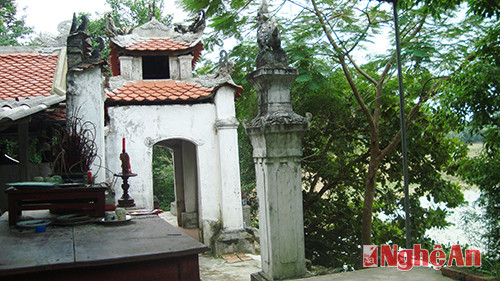 |
| A view of Lam Giang Temple. |
On Mount Quánh, jutting out into the Lam River, stand two majestic temples. Lam Giang Temple is situated on the mountainside, in the middle of the river, facing upstream. It is dedicated to the god Lam Giang, "the most sacred and revered deity of the river mouth," said to have been built nearly 200 years ago by the boat-dwelling people. In front of the main hall lies the deep Quánh gorge, where water flows year-round. Behind the main hall is a towering rock formation embracing the temple's roof. Beneath the river's surface lie two stacked rocks, the Ông and Mụ rocks, steeped in legend. On the first and fifteenth days of the lunar month, people from all over come to the temple to offer incense; the sound of the ceremonial drums echoes across the vast and mysterious landscape. Also on Mount Quánh, in the middle of the village, is Hai Temple, facing downstream, dedicated to the local deity Quánh Sơn, "the three supreme, great king, and heavenly gods." The ancient temple had three buildings, left and right, with a majestic main hall, a platform for offering sacrifices to heaven, and a stone-paved temple well. The village of Chi Nê used to perform rituals on this ancient stone foundation… After being destroyed by fire several times, the temple has been restored. Within the temple grounds, traces of the ancient altar and stone well can still be found.
Chi Nê village is the birthplace of Trần Tấn – the leader of the Trần Tấn and Đặng Như Mai uprising in 1874, raising the banner of "pacifying the West and eliminating the left," destroying both the French invaders and the Southern feudal regime. The rebel army once occupied almost all of Nghệ An and Hà Tĩnh provinces, extending its prestige to Quảng Bình and Thanh Hoá. The uprising shone brightly with the patriotic spirit and unwavering fighting will of the scholars and people of Nghệ Tĩnh against foreign invaders. On Đài Sơn mountain, on the banks of the Lam River, the moss-covered, solemn Tế Cờ altar remains – the place where he and his rebels raised the flag of rebellion. Nearby are the tombs of him and his son (Trần Tấn and Trần Hướng), resting peacefully. Next to them are Tập field and Bang cliff, landmarks associated with his uprising. At the foot of the mountain, the Trần Tấn family ancestral temple has recently been renovated and is now a magnificent structure. The complex of the Te Co altar, tombs, and ancestral temple of the Tran Tan family is a national historical relic – a significant site for local people and visitors from all over to visit, pay respects, and remember, demonstrating the tradition of "drinking water, remembering the source."
In the middle of the village stands Chi Nê Temple, commonly known as the Temple of Literature, dedicated to Confucius and other revered sages. According to Mr. Nguyen Van Tu (95 years old), the temple has two buildings, upper and lower, two pillars, a three-arched gate, and a stone stele listing the names of those who studied and passed examinations. The temple served as a meeting place and place of worship for the village, a regular gathering place for the "scholarly and intellectual society." The village held two ceremonies a year, with a procession of the royal decree at the beginning of the year. In the years 1930-1931, Chi Nê Temple witnessed the sacrifice of revolutionary fighters. The French brought several people involved in the movement here, executed, tortured, and shot dead. During the war, the temple continued to be a meeting and learning place for the villagers… Now, on its former site, the traces of the past have faded, and Chi Nê Temple remains only in the memories of those who were once connected to their homeland.
The village of Thanh Quả stretched along the Rộ River, with the Quan ferry landing connecting to the main road, leading from the district headquarters to the upstream Thanh Chương area and to the Thanh Quả fort. The French had chosen this hilly area, due to its strategic military location, to build a fort, controlling a large area on the right bank of the Lam River. According to the elders, in the center of the village at that time stood a magnificent five-bay, two-gable communal house, entirely made of ironwood; it was dedicated to the village's guardian deity and served as a meeting place for the villagers of Thanh Quả. On November 6, 1930, the people of Thanh Quả, Chi Nê, and surrounding areas gathered at the communal house to protest against the French. The enemy at the fort furiously fired at the protesters, killing and wounding more than 140 people. The bamboo grove behind the communal house and the stream flowing between the two villages became a battlements, stained with the blood of many who sacrificed themselves for their country… Years have passed, and the old communal house no longer stands on its original land. Although there is no commemorative plaque here marking this event, for the people of Thanh Quả - Chi Nê, the village communal house and the heroic struggle of that day remain etched in their memories.
In Thanh Chi, climbing Quanh Son and Dai Son mountains, visiting Lam Giang Temple, and the Te Co - Tran Tan altar, the entire region evokes nostalgic memories of ancient times. From "Truong Hill," crossing Co Ngua Bridge and following the Ro River, one sees the stream still flowing gently as it has for millennia, whispering countless ancient stories. The old inns and temples of yesteryear are gone, yet the hearts of people still echo the spirit of Thanh Qua - Chi Ne!
Text and photos:Huy Thu


