
Ancient traces of Vinh City
(Baonghean)Today, over 220 years old, Vinh City has steadfastly traversed a long journey, through many changes and ups and downs of history. Looking down from Dung Quyet, the beautiful city stretches out below, radiant and beautiful, and one can almost hear the neighing of horses and the clashing of swords from the time when the heroic Tay Son commoner built the Phoenix Central Capital...
This August, visitors to Vinh find a vibrant, youthful city bursting with industrial energy, where construction projects and urban developments are rapidly emerging. Let us pause amidst the stirring atmosphere of these historic autumn days in the heroic Red City, to reminisce about the Vinh of the past, with its endless narrow streets, its ramparts and temples, enduring through time as testaments to a Vinh that still bears the mark of its ancestors.
The title Vinh
Vinh, originally named Kẻ Ván, was later successively renamed Kẻ Vĩnh, Vĩnh Giang, Vinh Doanh, and Vinh Thi. Finally, the city's official name was shortened to a single word, Vinh, and has remained so to this day.
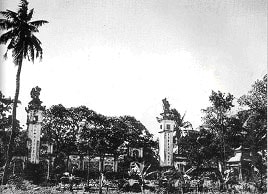 |
Hong Son Temple in the early 20th century - Archival photo |
Vinh Doanh was the name of a town during the Le Dynasty, comprising the villages of Vinh Yen and Yen Vinh, now part of Vinh City. This village later became Vinh Yen, belonging to Yen Truong commune, Yen Truong district, Chan Phuc county. During the Nguyen Dynasty, it belonged to Nghi Loc county. It was home to Vinh Market and the small Vinh Giang River. Yen Vinh village, also known as Vang village, was the location of the French Consulate, built in 1897 outside Nghe An city, west of the city walls, next to the Vinh Giang River and Vinh Market. According to Dinh Xuan Vinh in the Handbook of Vietnamese Place Names, because the French Consulate was located in Yen Vinh village, the name Vinh gradually replaced the old name Vinh (locally called Vinh).
On October 20, 1898, King Thành Thái issued a decree establishing the town of Vinh along with the towns of Thanh Hóa, Huế, Fai-Fo (present-day Hội An), Quy Nhơn, and Phan Thiết. On August 30, 1899, the Governor-General of Indochina approved this decree. The town initially surrounded the citadel of Nghệ An, and gradually expanded southward.
On December 10, 1927, the Governor-General of Indochina issued a decree merging Vinh town, Ben Thuy town (established on March 11, 1914), and Truong Thi town (established on August 27, 1917) into Vinh-Ben Thuy town, with the Commissioner of Nghe An also serving as the mayor. This was a third-class city (commune).
When Vietnam gained independence, Vinh became the provincial capital of Nghe An province. On October 10, 1963, Vinh became a city directly under the provincial administration.
During the war years, Vinh was one of the cities in North Vietnam most heavily bombed by the US Air Force. After the war, the city was rebuilt in the style of East German and Soviet urban design, featuring wide boulevards and rows of apartment buildings.
From 1975, Vinh was the provincial capital of Nghe Tinh province, and from 1991, it reverted to being the provincial capital of Nghe An province.
Ancient citadel of Nghe An
In 1803, Gia Long went north and chose Vinh Yen village, located northwest of Dung Quyet mountain (the area of the ancient citadel today), to build his administrative center. In 1884, the administrative center was officially moved from Dung Quyet to Vinh Yen, and the Nghe An citadel was built of earth. It wasn't until 1831 that Emperor Minh Mang ordered the citadel rebuilt with laterite stone in the style of Vauban (Vauban was the name of a French general who had the idea to design this type of citadel). The citadel had 6 sides, a circumference of 603 trượng (2,412 m), a height of 1 trượng, 1 tấc, 5 thước (4.42 m), and an area of 420,000 m². It was surrounded by a moat 7 trượng (28 m) wide and 8 thước (3.20 m) deep. At the start of construction, the Nguyen dynasty mobilized 1,000 soldiers from Thanh Hoa and 4,000 soldiers from Nghe An. During the reign of Emperor Tự Đức, the upgrade required 8,599 slabs of seashell stone from Diễn Châu and laterite stone from Nam Đàn, 4,848 pounds of lime, and 155 pounds of molasses, with a total cost of 3,688 quan (Vietnamese currency).
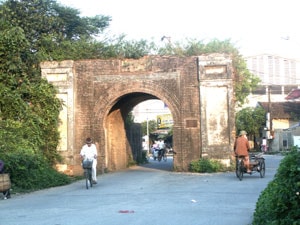 |
Right Gate - Vinh ancient citadel - Photo: Archival material |
The citadel has three gates. The front gate is the main gate facing south, used by the king, officials of the six ministries of the court, and the governor-general. The left gate faces east, and the right gate faces west. To pass through any of the gates, one must cross a bridge. Inside, the largest structure is the royal palace. To the east of the palace are the governor's residence, to the south are the residences of the chief administrator and judge, the military commander's residence, and the education director's residence. To the north are the barracks and prison. Later, to the west was the French military supervisor's residence. The entire citadel was equipped with 65 cannons, 47 of which were placed in watchtowers, and the rest were concentrated in the royal palace and the governor's residence.
Having endured numerous historical events and the ravages of war, the ancient citadel remains almost entirely, with only three city gates and the surrounding lake still standing. Nghe An Province and Vinh City have planned to restore the site and transform it into a large cultural park for the city.
Diệc Pagoda
As one of the beautiful temples in Vinh City, according to historical records, this temple dates back to the Tran Dynasty, with a thatched roof. After several renovations and upgrades, it was finally tiled in the early 19th century. Notably, the 1930 renovation involved many officials from the Hue court, several social organizations, and a large number of local people. The funds raised amounted to 2,590 Indochinese francs, 9 acres, 5 sao, and 1 thuoc of rice paddy. From then on, the ancient Diec Temple became a unique cultural and spiritual architectural landmark for the people of Vinh City. Due to historical events and the destruction of war, the ancient Diec Temple is almost completely destroyed, with only the moss-covered, crumbling triple-arched gate remaining. Recognizing the temple's value, the province and city have planned its restoration in the near future, creating a cultural and spiritual center and adding to the architectural beauty of Vinh City.
Tri Temple
The site is located in Lang Do (Loc Da - Duc Thinh, Hung Loc commune, Vinh city, Nghe An province). The temple was built in 1813 and was formerly known by the villagers as Loc Temple. It is dedicated to a general who contributed to the resistance against the Qing invaders and was bestowed the title of High-Ranking Deity. The entrance gate has a beautiful high arch, flanked by four dragons, and features three main halls. Inside, there are the magnificent Upper, Middle, and Lower Halls. On either side of the temple are two side buildings, each with two rooms for receiving guests; currently, only the Upper and Lower Halls remain.
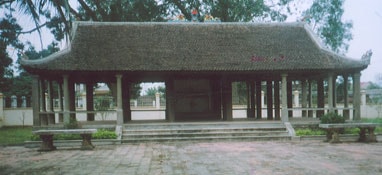 |
Dinh Trung, the place where the first Party branch was established in Lang Do village - Photo: Archival material |
In 1991, Hung Loc commune requested funding for restoration and repair to its original state. The temple was recognized as a historical relic on June 26, 1995, according to Decision 2233 of the Ministry of Culture and Information.
Hong Son Temple
The Hong Son Temple, formerly known as Vo Mieu, was dedicated to Quan Cong, also known as Quan Van Truong, a skilled martial artist during the Three Kingdoms period. Later, several temples from the city were merged into it, and since then, it has worshipped many gods and saints, including King Hung Vuong, the Holy Mother, and Tran Hung Dao.
The temple was built a long time ago and has been restored and improved many times during the Nguyen dynasty. The first restoration took place in 1838, and the second in 1898, rebuilding the Lower Hall on the large scale it stands today. The complex includes: the temple gate, the crescent-shaped pond, the front hall, the bell tower, the Lower Hall, the Middle Hall, the Upper Hall, the Left Wing, and the Right Wing.
Every year, Hong Son Temple hosts three major festivals on the following occasions: the Commemoration of the Holy Mother (2nd and 3rd of the third lunar month), the Commemoration of King Hung (9th and 10th of the third lunar month), and the Commemoration of Tran Hung Dao (19th and 20th of the eighth lunar month).
Can Linh Pagoda
The pagoda was built during the Le Dynasty on land that formerly belonged to Lang Vang village, Yen Truong commune, Hung Nguyen district (now Cua Nam ward, Vinh city). The pagoda is dedicated to Buddha Shakyamuni – the founder of Buddhism – and the monks who once resided there and in the area. The total area is 5208 m², comprising the following structures: the triple gate, the main hall, the main sanctuary, the monks' quarters, and the left and right side buildings. The pagoda hosts many annual festivals.
Tran Trung Quang Temple
The temple is located in Hung Loc commune, Vinh City, and is dedicated to King Trung Quang De Tran Quy Khoang. The temple was built during the Le Dynasty and renovated during the Nguyen Dynasty. The complex includes the temple and the mausoleum. The Tran Trung Quang Temple Festival is a festival associated with this historical site.
The festival takes place over two days, the 19th and 20th of the second lunar month every year.
Duc Hoang Muoi Temple
Located on Provincial Road 8 Vinh - Hung Nguyen, about 2 km from the center of Vinh city, is the Duc Hoang Muoi Temple, dedicated to Dai Vuong Nguyen Duy Lac, also known as Tuan Sang Sieu Loai Hien Duc. The temple was built during the Le Dynasty, but was dismantled and relocated due to war and restored in 1995. It includes the main hall and the rear sanctuary. In addition, there are supporting relics such as the tomb of Mr. Hoang Muoi, the Trung Thien platform, and the mausoleum of Co Chin clustered around it. The temple festival takes place twice a year.
Tran Hai



;)