
Combating smuggling and trade fraud.
(Baonghean)Recently, the transportation and trading of smuggled, counterfeit, prohibited, and substandard goods in our province have remained complex and are on the rise. Criminals are increasingly employing sophisticated methods and preparing countermeasures to evade the law, creating significant obstacles for law enforcement agencies in their inspection and control efforts.
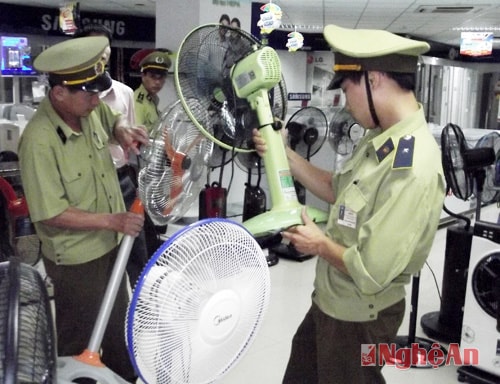 |
| Officials from the Nghe An Market Management Department inspect product labels at an electronics supermarket in Vinh City. |
| RELATED NEWS |
|---|
These goods are hidden in homes, stalls, and shops, only being brought out for sale when consumers need them, making inspection and seizure very difficult. The main smuggled items are alcohol, cigarettes, fabrics, and clothing. Tax evasion and fraud remain complex with many different methods. The production, trading, and storage of counterfeit and substandard goods, as well as those that do not meet food safety and hygiene standards, are still quite common.
These products are often manufactured abroad and in major cities and provinces within the country, then transported to rural markets for consumption. The perpetrators employ a professional team using motorcycles to infiltrate individual households under the guise of marketing and advertising, employing attractive promotions to deceive consumers. Particularly noteworthy is the recent emergence of a "localization" scheme: importing semi-finished components into Vietnam through traditional craft villages, then repackaging and labeling them as Vietnamese-branded products.
According to statistics from the Provincial Steering Committee 127, in the first six months of 2014, market management forces inspected 4,143 cases and handled 2,994 violations with a total administrative fine of nearly 3 billion VND, and the value of confiscated and destroyed goods amounted to nearly 1.9 billion VND. Of the total number of violations, 126 involved the transportation and trading of prohibited and smuggled goods, 386 involved counterfeit goods and intellectual property rights, 49 involved food safety and hygiene, 359 involved commercial fraud, and 2,096 involved business violations... A typical example is the violation in January 2014, when Market Management Team No. 3 seized a car with license plate 93N-0035 driven by Nguyen Tien Son, residing in Bich Dong Town, Bac Giang Province; A vehicle transporting 750 kg of bovine offal of unknown origin, in a state of decomposition, was found; the shipment was valued at 150 million VND. On April 14, 2014, the Economic and Functional Crime Investigation Department of the Nghe An Provincial Police caught Vu Thi Bon, residing in Ngoc Tan hamlet, Dien Ngoc commune (Dien Chau district), red-handed while producing counterfeit goods. During the on-site search, the police seized 2,000 packages of suspected counterfeit OMO brand laundry detergent, 4.5 kg of empty OMO detergent packets, a 5 kg weighing scale, 3 plastic sealing machines, 50 bags of Duc Giang brand laundry detergent produced by Duc Giang Detergent and Chemical Joint Stock Company, and 25 bags of YES brand laundry detergent. All of these goods lacked invoices and documents proving their origin.
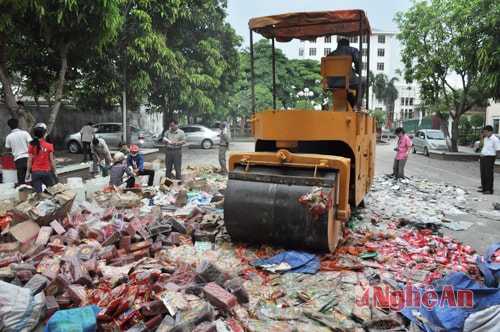 |
| Destroy smuggled goods, counterfeit goods, and substandard imitation goods. |
In reality, despite positive developments, smuggling, prohibited goods, counterfeit goods, and commercial fraud, as well as violations of industrial design rights and food safety regulations, still occur in many product categories and in some key areas. Inspection and enforcement by some sectors and localities are still lenient and lack decisiveness, resulting in low effectiveness. The work of infiltrating bases and gathering information to detect networks and groups involved in transporting, trading, and selling these goods has not yielded high results.
Through inquiries with relevant authorities, we learned that the most significant challenge in combating smuggling and trade fraud currently relates to intellectual property rights. Many businesses do not pay sufficient attention to this issue, viewing it solely as a responsibility of the authorities, and therefore have not proactively protected their products and brands in the market. While anti-smuggling efforts have uncovered and dismantled several smuggling rings, few ringleaders have been identified. Many methods and tactics of trade fraud and illegal business practices have been detected, dealt with, and warned against, yet numerous similar incidents continue to occur. The main reason is the lack of rigorous inspection, monitoring, and testing of goods entering our province from abroad.
Determined to prevent and combat this "national scourge," on March 19, 2014, the Prime Minister signed Decision 389/QD-TTg establishing the National Steering Committee for Combating Smuggling, Trade Fraud, and Counterfeit Goods. This decision was based on consolidating and upgrading the Steering Committee 127, established in 2001 (now referred to as Steering Committee 389). The permanent office is located at the Ministry of Finance, with the participation of other ministries and agencies such as the Ministry of Industry and Trade, the Ministry of National Defense, the Ministry of Public Security, etc. Its tasks, powers, and responsibilities are also more clearly defined than before. This reflects the Government's expectations for the future performance of Steering Committee 389. In our province, to achieve high effectiveness in combating smuggling and trade fraud, in addition to the efforts of the Market Management Sub-department, close and coordinated cooperation among functional agencies is needed in preventing and combating smuggling and trade fraud in key areas and routes. Furthermore, each citizen and local government needs to raise their sense of responsibility in supporting, providing information, and actively cooperating with functional agencies to promptly inspect and strictly handle violations.
Ngoc Anh


