
Promoting social participation in festival organization.
(Baonghean) - Minimizing the use of state budget funds for festival organization and promoting the socialization of resources in festival organization is a policy recently issued by the Ministry of Culture, Sports and Tourism. The main purpose is to bring festivals back to their roots, where there is active and creative participation from the majority of the people.
From the end of the twelfth lunar month, the number of visitors to Cờn Temple has been steadily increasing. In the first half of January alone, an average of thousands of visitors come daily to pray for peace and safety, and this number is expected to increase many times over during the three days (19, 20, 21) of the main temple festival. The Cờn Temple Festival is a traditional festival held annually by the people of the coastal region to pray for calm weather, peaceful seas, abundant catches, good fortune, and peace. It is a traditional folk cultural activity deeply rooted in the cultural identity of the Quỳnh Lưu coastal region.
Since 1999, after a period of interruption, the festival was revived with profound cultural and spiritual significance, becoming a major festival of the region. It is a unique festival in both its ceremonial and celebratory aspects, with the main highlights being the opening ceremony, the fishing prayer ceremony, and many other rich activities such as boat racing, stick pushing, tug-of-war, and many traditional folk games of the region. Attending the Cờn Temple Festival, one can feel that one of the reasons the festival attracts so many people is that in this festival, the people participate as true stakeholders. Therefore, it's no surprise that during these holidays, all the people in Quynh Phuong ward (Hoang Mai town) consider it a communal festival for the whole village. Hundreds of boats take a break from fishing, are decorated, welcome guests, and participate in processions and boat races… Locals and visitors from afar come here not only to participate in the festival but also to learn about the people and lives of the coastal residents.
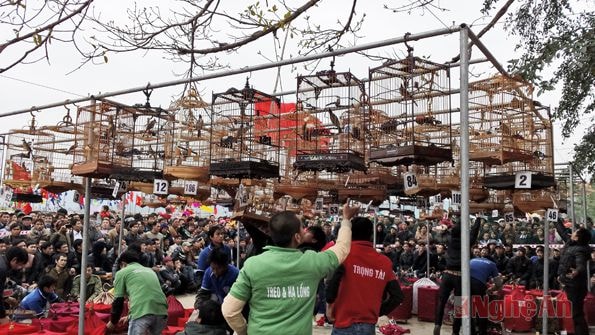 |
| The competition for the best singing of the crested myna bird at the Cờn Temple Festival (Hoàng Mai Town). |
The participation and enthusiastic response of a large number of local people and tourists from all over the country contributed to the success of the Cờn Temple Festival and created its vitality and widespread appeal. This is most clearly demonstrated in the organization and social mobilization efforts. In 2015, before the festival, the People's Committee of Hoang Mai Town spent billions of VND to repair the road leading to the temple, repave the temple courtyard, and repair many other items within the temple. Mr. Bui Thai Linh, Head of the Cờn Temple Management Board, said: "Every year, the local budget is only enough to cover the allowances for the 8 people in the temple management board. The rest, from repairs, purchasing artifacts, and organizing the festival, is mobilized from social sources or partly from donations at the temple. In 2015 alone, from social sources, the temple mobilized more than 300 million VND to purchase artifacts." Before the festival took place, the Temple Management Board mobilized over 50 million VND from villages, organizations, and individuals to prepare for the event. Several businesses sponsored fuel, uniforms, and other supplies for the boat racing teams.
In Nam Dan district, in a conversation with Mr. Nguyen Thien Dung, Head of the District Culture Department, it was learned that social mobilization is not just about donating money, but involves various other forms of support. For example, the 2015 King Mai Temple Festival would not have been successful without the support of the communes and towns. Depending on the festival's requirements, the district assigned responsibilities to each locality. For instance, the sticky rice cake wrapping competition was handled by the town, while the Van Dien commune People's Committee, in addition to supporting the temple management board, participated in the Water Procession. Other communes contributed to organizing cultural programs and sports events. Furthermore, the district also called on organizations, individuals, and hometown associations in other provinces to support the festival or to repair dilapidated structures of the King Mai Hac De temple.
Each year, Nghe An province has 25 major festivals, and the socialization of these festivals is a method many in the province implement in accordance with the State's policy, aiming to reduce budget expenditures and eventually eliminate the use of public funds in festival organization. Many festivals are entirely organized through socialization, such as the Qua Son Temple Festival, the Hoang Muoi Temple Festival, and the Corn Temple Festival. Calling for socialization and allowing people to participate in festival activities is also about restoring the festivals to their original values, because festivals originate from the people and must thrive within the community, serving the interests of the people. Besides generating funding, socialization is also a way to promote the intelligence, creativity, and voluntary participation of the people, thereby contributing to the restoration and preservation of traditional values and beautiful ancient customs. The Water Procession at the King Mai Temple Festival and the successful restoration and re-staging of the elephant and horse processions, which had faded and been forgotten for 40-50 years at the Cờn Temple Festival, are prime examples. Socialization also provides an opportunity for those living far from home to connect with their homeland, a chance for them to express gratitude to their ancestors, lineage, and hometown. The most prominent example of this is the Festival at the Temple of Tấn Quốc Công Nguyễn Cảnh Hoan in Tràng Sơn commune, Đô Lương district. To meticulously prepare for this "ten-year festival," descendants of the Nguyễn Cảnh family mobilized over one billion VND for the preparations. Regarding the procession specifically, the Nguyễn Cảnh family's organizing committee invited expert artist Trịnh Yên and a team from the Vietnam Federation of UNESCO Associations to provide consultation, design, and overall direction according to traditional rituals. All preparations began three months before the festival's opening day.
However, not all festivals can easily mobilize social resources, and currently, social mobilization has only been implemented for festivals associated with spiritual elements. Even the An Duong Vuong Temple Festival (Cuong Temple), despite receiving over 400 million VND annually through donations from Dien Chau district, only covers the repair of some temple facilities and the purchase of some ceremonial items. The remaining funds must be allocated from the district's budget each year. Other festivals in mountainous areas still depend on the district's budget. Given this reality, the question arises: how can festivals be organized to preserve traditional values while remaining economical and avoiding waste? Furthermore, relying on social mobilization cannot create an environment conducive to gambling, superstition, and other social vices. Mobilizing resources from the people must be done on a voluntary and conscientious basis, easing the burden on the people. People participate not only through financial contributions, labor, and direct performances, but also through their active participation as audience members. Festivals must create opportunities for all people from all walks of life to participate. Evaluating the organization of festivals in Nghe An province in recent times, Ms. Hoang Thi Quynh Anh, Deputy Director of the Department of Culture, Sports and Tourism, affirmed: More and more festivals are doing a good job of social mobilization, with the main resources coming from donations and contributions from philanthropists. However, in some places, due to the lack of thorough understanding by local Party committees and authorities regarding their responsibility to restore, preserve, and promote national cultural identity, including the restoration of festivals, the direction, implementation, and organization have not been sufficiently thorough and proactive. Consequently, the work of propaganda, festival planning, preservation and promotion of historical sites, and social mobilization has not been effective.
In the coming period, to ensure more effective organization of festivals, Party committees and authorities at all levels should enhance their responsibility in restoring and promoting the traditional cultural values of festivals. They should intensify the dissemination of the Party and State's policies and guidelines on festival restoration, management, and organization, strengthen festival promotion, and encourage the socialization of festivals. More than ever, festivals need to return to the people, to their original purpose, and only then will they endure, becoming meaningful and indispensable cultural and traditional activities in the community and each locality.
My Ha
| RELATED NEWS |
|---|


