
To have large-scale model fields
(Baonghean)In recent years, the development of "large-scale model fields" has become a new approach to increasing productivity and quality of agricultural products, contributing to enhancing the value of agricultural production. However, many difficulties and obstacles have been encountered during its implementation.
The large-scale model farm production in the northern provinces and cities has now entered its second year with the participation of 18 provinces and cities, including Nghe An. Through this model, the linkage between the "four stakeholders" (farmers, scientists, businesses, government, and scientists) is becoming increasingly close, with all participating parties benefiting the most, creating new developments in agricultural production, and making an important contribution to the successful implementation of the new rural development movement. In the spring of 2013, the entire province had 16 large-scale model farms with a total area of 757 hectares, including 11 rice farming models, 3 corn farming models, and 2 peanut farming models in 13 districts such as Dien Chau, Yen Thanh, Quynh Luu, Nghi Loc, Do Luong, Thanh Chuong, Anh Son, Con Cuong, etc.
To achieve the large-scale model of rice cultivation, production areas need to meet eight criteria, including: having a production area plan consistent with the overall plan; a model area of at least 50 hectares; voluntary participation of farmers in group production; participation of businesses in providing pesticides or guaranteeing product purchase; local authorities and agricultural service cooperatives providing some services; commitment to technical support and production organization; farmers voluntarily documenting production processes according to VietGAP standards; and achieving higher economic efficiency than conventional cultivation, ensuring farmers benefit at least 40% from rice cultivation.
Therefore, in practical production, meeting the above criteria is not easy, especially in a disadvantaged area like Nghe An. First, to have a large-scale model rice field, the cultivated land area needs to be at least 50 hectares for rice, 40 hectares for corn, and over 30 hectares for peanuts, all contiguous and in one plot. This is one of the criteria suitable for the terrain and farming practices of farmers in the Mekong Delta, but applying it to the northern provinces and Nghe An province becomes a difficult problem.
Although Nghe An is the largest province in the country in terms of area, two-thirds of its land is mountainous with some plains, and the slopes are gentle from Northwest to Southeast. Forming large-scale rice fields that meet the criteria for large-scale model fields is not easy. According to Mr. Nguyen Van Lap, Deputy Director of the Department of Agriculture and Rural Development: Choosing a model in a few localities is not difficult, but establishing large-scale model fields that meet the standards for mass production is challenging. Therefore, even Thai Binh province, with a field area of 35 hectares, has been recognized as a large-scale model field.
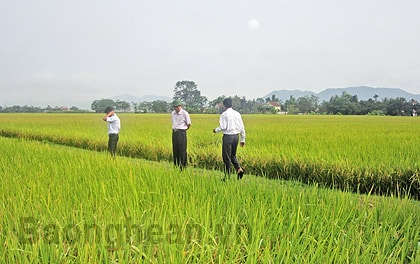
Large-scale model farm in Hung Nguyen district.
Not only is it difficult to establish large-scale production areas, but currently in Nghe An province, even with a standard area of 50 hectares for a model field, the number of households owning the land can reach hundreds. In some places, establishing a large 50-hectare model field requires the consent of more than 300-400 households. This makes it difficult for people to access scientific and technological advancements, agricultural mechanization, and policies related to model field implementation. Nghe An farmers are known for their diligence and hard work, but it cannot be denied that a significant portion of the population remains conservative, which is one of the obstacles to introducing scientific and technological advancements into production.
The relationship between the four stakeholders (the state, businesses, scientists, and farmers) plays a crucial role in the success of model fields. However, in reality, the interaction and connection between these stakeholders are still very weak and superficial. This is especially true for businesses and farmers – the two main entities that determine the success or failure of the "four stakeholders" chain. Farmers producing agricultural products are always concerned about the market for their products, while purchasing businesses are apprehensive about the farmers' commitment to the linkage.
The challenges are not only limited to agricultural land, the application of scientific and technological advancements, and the mindset of the people and businesses, but also a lack of close attention and guidance from some levels of government. The involvement of scientists is limited to businesses rather than directly engaging with farmers. Furthermore, while land consolidation has been implemented in some localities, it remains fragmented and small-scale, failing to meet the requirements for forming large-scale production areas that would allow for mechanization. Some localities are still struggling to find suitable crop varieties, and while model fields are being developed for commercial purposes, the agricultural products are not the breakthrough, high-value crops initially envisioned for large-scale model fields.
Therefore, in order for Nghe An to successfully transition from a demonstration model to mass production, it is necessary to gradually overcome the aforementioned difficulties and shortcomings.
Text and photos: Thuy Vinh (Provincial Radio Station)


