
To develop tourism in Nghe An to its full potential.
(Baonghean)Editor's Note:Following the publication of the series "Tourism in Nghe An - Advantages and Challenges," the Nghe An Newspaper editorial office received numerous opinions from experts and readers, who discussed and pondered how to develop Nghe An's tourism to its full potential. To provide further information on the awareness, perspectives, orientations, and determination of Nghe An province's leaders in the province's tourism development strategy, a reporter from Nghe An Newspaper interviewed Mr. Nguyen Xuan Duong – Deputy Secretary of the Provincial Party Committee and Chairman of the Provincial People's Committee.
>>Final article: Building tourism products by attracting investment
PV:Despite its diverse and abundant potential for developing beach tourism, forest tourism, ecotourism, etc., Nghe An's tourism sector has not yet reached its full potential. So, in your opinion, what difficulties is our province's tourism sector currently facing?
Comrade Nguyen Xuan Duong:After conducting a comprehensive assessment of the province's cultural and historical traditions, historical sites and scenic spots, and favorable natural conditions for tourism development, the province has issued numerous mechanisms, policies, action plans, and provided close guidance to exploit and promote the traditional values of the homeland into unique tourism products, especially cultural and historical tourism, festival tourism, resort tourism, and discovery tourism.
However, tourism in the province is still developing mainly in terms of breadth, with quality and efficiency still lacking; tourism products remain monotonous, and there are not many large-scale investment projects, especially foreign investment projects, to create unique and attractive tourism products, resulting in a low number of international tourists. Most tourism businesses in Nghe An are small-scale, lack linkages, and their travel business operations lack professionalism and competitiveness, especially in their ability to reach international markets. Although the accommodation business has a relatively large revenue scale, the average room occupancy rate is only approximately 50%, and the quality is inconsistent. The tourism environment in some areas, especially coastal regions, is at risk of degradation due to the lack of synchronized infrastructure. The quality of the tourism industry's staff and workers does not yet meet the increasingly high demands of tourists, lacking skilled managers, operators, tour guides, and highly skilled workers.
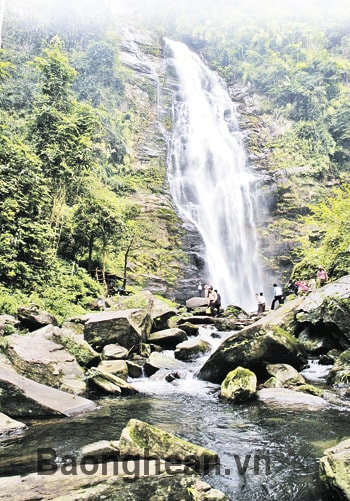
Khe Kem Waterfall (Con Cuong) Photo: Sy Minh
PV:In your opinion, what are the causes of this situation?
Comrade Nguyen Xuan Duong:Subjectively, one of the main reasons for the difficulties facing the tourism industry is the insufficient understanding among some officials and the public regarding the position and role of tourism in socio-economic development. In addition, state management of tourism still has shortcomings; the quality of planning and planning management does not meet requirements; the number of tourism management officials at all levels is still small; and the coordination between sectors and localities in tourism management is not synchronized, especially in localities with tourism development potential such as Nam Dan, Dien Chau, Quynh Luu, Con Cuong, and Quy Chau…
Objectively, investment resources for tourism are limited, and Nghe An is located far from the country's economic and tourism development centers, making it difficult to attract investment in infrastructure development and tourism projects. Furthermore, the climate and weather characteristics have resulted in the seasonal nature of tourism in Nghe An, directly impacting the quality and business efficiency of enterprises.
PV:Many investors, including those investing in tourism projects, believe that the investment attraction mechanism in our province is "open at the top but not flexible at the bottom." What are your thoughts on this assessment?
Comrade Nguyen Xuan Duong:Over the years, the province has issued many preferential mechanisms and policies to attract investment. Along with promptly supplementing and adjusting these mechanisms and policies, the province has also directed the implementation of many solutions regarding administrative reform, training and development of officials and civil servants, and strengthening promotion and marketing to create a more attractive investment environment. Thanks to these policies, investment projects in the province in general, and tourism projects in particular, have seen significant improvements. However, due to the difficulties mentioned above, investment attraction in tourism remains very modest.
However, it must be seriously acknowledged that while there has been progress in administrative reform related to attracting investment by departments and agencies, the effectiveness is still limited, with some processes remaining cumbersome and creating difficulties for investors. Some localities have tourism projects that have been planned but lack initiative and creativity in promoting and seeking investment partners; there is a lack of coordinated and synchronized efforts in land clearance and resolving difficulties and obstacles… leading to prolonged project delays or projects being registered but not implemented.
PV:What solutions do we need to develop tourism in Nghe An to its full potential, Comrade?
Comrade Nguyen Xuan Duong:Resolution No. 05-NQ/TU of the Standing Committee of the Provincial Party Committee (17th term) on the development of tourism in Nghe An province for the period 2011-2020 and the Provincial People's Committee's tourism development program for the period 2011-2015 have set the goal that by 2015, Nghe An will become one of the tourism centers in the North Central region, an attractive destination for domestic and foreign tourists, with modern infrastructure and technology, commensurate with its status as a key tourism region of the country.
To achieve the above goals, Nghe An's tourism sector first needs to shift strongly towards in-depth development, focusing investment on key areas based on exploiting outstanding resource strengths to build unique, high-quality tourism products with the motto of using cultural values to create differentiation and using the ecological environment for sustainable development. The focus should be on: effectively exploiting the Kim Lien historical site complex, linked with the system of historical sites in Nam Dan district, to become a national tourist area, a special highlight for the Nghe An tourism brand; sustainably developing beach resort tourism products by building Cua Lo town into a tourist city with a clean environment and diverse, attractive services; and developing Vinh into a center for coordinating tourists and tourism services, shopping, and entertainment in the province and the region. Gradually invest in and develop ecotourism associated with the community culture of ethnic groups in Con Cuong and Tuong Duong districts, as well as with Pu Mat National Park and the Quy Chau - Que Phong region; exploit intangible cultural values such as folk songs, traditional festivals, and traditional crafts to serve tourism development.
The plan involves connecting key areas with tourist destinations, historical sites, and scenic spots within and outside the province to form road tourism routes such as the Ho Chi Minh Highway, Route 46 to Thanh Thuy Border Gate and Pu Mat National Park, the route along National Highway 1 connecting the coastal areas of Nghi Loc, Dien Chau, and Quynh Luu, the route along National Highway 7 to Nam Can Border Gate to Laos, and the route along Route 48 to Quy Chau and Que Phong… Simultaneously, it aims to quickly open air tourism routes by expanding Vinh Airport and opening new flight routes to connect tourism with provinces and cities such as Ho Chi Minh City, Da Nang, Buon Ma Thuot, Nha Trang… as well as neighboring countries like Laos, Thailand, China, and Hong Kong…
Secondly, focus on building a safe, civilized, and friendly tourism environment by further improving security and order, protecting the ecological environment, ensuring food safety and hygiene, and carrying out rescue operations at tourist attractions and service businesses in the province.
Thirdly, improve the quality of human resources in tourism to meet immediate and long-term development requirements by diversifying training and development methods to suit the province's tourism human resource development needs; encourage linkages between training institutions and businesses with targeted, order-based training methods. This includes focusing on improving the capacity of hotel and travel management staff; and providing advanced training in professional skills, foreign languages for tour guides, interpreters, culinary techniques, housekeeping, table service, and reception.
Fourth, improve the efficiency and professionalism of tourism promotion activities, focusing on building the brand of Nghe An as a tourist destination and the brand of Nghe An tourism businesses to create a positive image for friends and tourists.
Fifth, strengthen state management of tourism, build mechanisms to mobilize resources to invest in key tourism projects that have been identified, first and foremost in tourism infrastructure for Cua Lo town to become a tourist city; policies to encourage the development of unique tourism types: community tourism, craft village tourism, etc. Improve the effectiveness of coordination among sectors through the role of the Provincial Tourism Development Steering Committee to promptly resolve difficulties and obstacles faced by businesses, while continuing to implement administrative reforms in the investment sector.
PV:Thank you very much, comrade!
Thanh Thủy (Editor)


