
To complete the winter crop production area.
(Baonghean) - The winter crop is increasingly proving its important role in the province's agricultural production. With a yield of over 100,000 tons of corn, nearly 3,000 tons of rice from the third crop, especially nearly 2,600 tons of peanuts and over 10,000 hectares of vegetables, the 2014 winter crop was bountiful, creating momentum for localities to boost economic development.
In many communes of Quynh Luu district, the winter crop is gradually becoming the main production season of the year, with two main crops: commercial vegetables, covering 1,500-2,000 hectares, accounting for about 50% of the winter crop production area, and corn, covering about 1,500 hectares, of which 600-700 hectares are corn grown on double-cropped rice land, concentrated in the communes of Quynh Dien, Quynh Yen, Quynh Van, etc. According to Mr. Nguyen Xuan Dinh, Head of the District Agriculture Department, the most difficult challenge in directing the implementation of winter crop production currently is on double-cropped rice land. Crops suitable for this land are difficult to find, mostly corn, while the beginning of the season is often flooded, the tasseling and silking stage faces drought due to the Do Luong dam system closing for repairs, and harvesting at the end of the season is difficult for drying, resulting in low yield and quality. In some areas, corn is harvested late due to replanting because of floods, forcing farmers to harvest young corn for spring production.
Furthermore, in recent years, household livestock farming has decreased, so the demand for plant stems, leaves, and seeds for animal feed is not high. Of the 7,500 hectares of rice land, only about 3,500 hectares can be used for winter crop cultivation. Adding to this are difficulties such as the winter crop production time coinciding with the Lunar New Year, and laborers often working away from home or in other supplementary occupations. Preparing the land and making ridges for winter corn and vegetables is still done manually, and many people are reluctant to do it. Given this situation, for the past 3-4 years, alongside traditional crops, Quynh Luu has focused on introducing several crops with high economic value and favorable conditions for intensive cultivation and storage, such as green squash and pumpkin. During the winter season, the entire district has nearly 300 hectares of squash, concentrated in the communes of Quynh Thang, Tan Son, Quynh Hau, and Quynh Dien… Currently, in the communes of Quynh Tho, Quynh Dien, and Quynh Xuan… after harvesting the summer-autumn rice crop, farmers are taking advantage of the time to prepare the land.
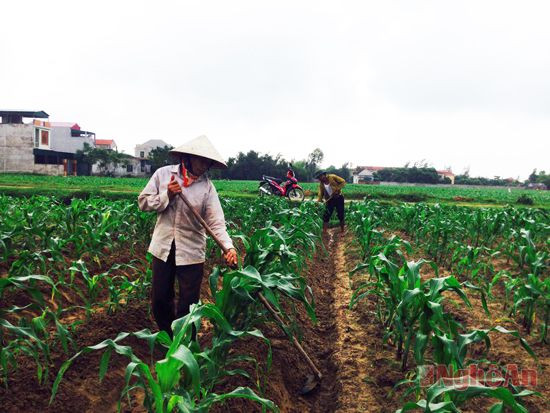 |
| Winter corn production in Nghi Hoa commune (Nghi Loc district). Photo: Chau Lan |
In Luu Son commune (Do Luong district), farmers have been "preparing" their winter crops early in recent years, ensuring competitive products for sale to traders. Waiting for the planting season, farmers in the commune actively go to the fields to plant pumpkins, corn, and green beans. After just over a month, they can harvest. A plot of land planted with winter crops, if done well, can yield an income of 4 million VND, double that of rice cultivation. The Party committee and government pay close attention to the leadership and guidance of winter crop production; farmers apply their experience effectively to achieve high production efficiency.
In Hung Loi commune (Hung Nguyen district), some hamlets are frequently flooded, making summer-autumn crops unsuitable, so the winter crop is considered the main production season. Mr. Ha Huu Khang, from hamlet 5, grows winter crops right in his garden with corn and vegetables, which is convenient for both care and flood prevention. "Although winter crop production often encounters rain and floods, when the harvest is good, the yield is high, the produce is easy to sell, and the prices are higher," Mr. Khang said. According to Mr. Phan Huu Dao, Chairman of the People's Committee of the commune, for many years, Hung Loi has hardly left any land fallow for winter crop production. From the beginning of September, winter vegetable fields begin to be sown, most commonly pumpkins for their shoots. The entire commune has 30 hectares of vegetables, concentrated in hamlets along the riverbanks, and 40 hectares of corn in the outer riverbanks in hamlets 1, 2, 3, 4, 6… grown for livestock feed, with land preparation and sowing starting at the end of September or the beginning of October.
This year's winter crop production in Hung Nguyen district has some advantages, including early implementation, as nearly 800 hectares of rice land, along with some areas of upland and riverside land, were not planted during the summer-autumn season. However, according to Mr. Hoang Duc An, Head of the District's Agriculture Department, difficulties remain due to the lack of businesses proactively investing in production and product distribution; the recent severe drought has extended the summer-autumn rice harvest period in many communes from August 15th to October 20th, delaying the winter crop production season. This year, Hung Nguyen plans to plant 600 hectares of corn, including 200 hectares on double-cropped rice land; 140 hectares of sweet potatoes and potatoes; 200 hectares of green squash; and 550 hectares of various vegetables. The district has arranged a rational crop structure, focusing on areas with high safety coefficients and guaranteed yields, and proactively implementing early planting. Currently, sufficient quantities of green and red pumpkin seeds have been supplied, and in the next few days, farmers will begin preparing the seedlings for planting.
For many years, the winter crop has become one of the three main production seasons of the year and is increasingly asserting its role in increasing farmers' income. In the 2014 winter crop season, the whole province harvested nearly 115,000 tons of corn, nearly 2,600 tons of peanuts, and more than 2,800 tons of fish and rice from the third crop. During this process, many effective models emerged: Intensive cultivation of purple glutinous corn in Phuc Thanh commune (Yen Thanh district) yielded a profit of 100 million VND/ha; tomato cultivation on double-cropped rice land in Quynh Giang commune (Quynh Luu district) yielded 32 tons/ha and a profit of 100 million VND/ha; The model of growing green squash in Luu Son (Do Luong) yields 36 tons/ha, with a profit of about 80 million VND/ha... This winter crop season, Nghe An aims to plant over 50,000 hectares of various crops, with corn being the main crop at 28,000 hectares, peanuts at 1,500 hectares, and various vegetables and legumes at 12,500 hectares. To date, the entire province has harvested about 50% of the summer-autumn rice crop, and the areas designated for the winter crop will be harvested before September 10th. Many districts such as Nghi Loc, Yen Thanh, and Dien Chau have already started producing peanuts for the winter crop.
However, the biggest challenge in completing this year's winter crop season remains the mindset of the people, especially in suburban areas and regions with secondary occupations, where income from agricultural production is not as high as other occupations. Currently, the weather remains unpredictable, making it difficult for localities to provide decisive and specific guidance early on in planning and effectively implementing propaganda and training for officials and production households, as well as guiding the appropriate crop structure for each type of land. Developing advanced processes, training, and implementing synchronized technical solutions, with a focus on new varieties such as green squash, pumpkin, chili peppers, mushrooms, soybeans, and winter peanuts, along with advancements in fertilizers, pesticides, and mechanization in production, are crucial to creating safe, sustainable products with high income potential.
Regarding product output orientation in areas where commodity production conditions are not feasible, based on consumer demand, determine the types of crops and livestock, and the scale of production to ensure safe and efficient consumption. In areas with new markets, boldly focus on concentrated production, avoiding mass production, low prices, and oversupply.
According to Mr. Nguyen Van Lap, Deputy Director of the Department of Agriculture and Rural Development: Currently, in addition to focusing on the summer-autumn harvest, localities are also directing the implementation of winter crop production. However, because this is a difficult production season, guidance and propaganda work need to be intensified. Localities must base their work on the production plan of the province and district, review the entire area for winter crop cultivation, and arrange each type of crop appropriately according to needs and land conditions. Attention must be paid to the main crops, planning for zoning, even down to individual fields, to focus on directing the achievement of the set plan. At the same time, continue to call for and create conditions for businesses to sign contracts and support farmers in production and product consumption. The agricultural sector will continue to introduce and facilitate the rapid transfer of good varieties and scientific and technological advancements to farmers, strengthen agricultural extension and plant protection activities, detect and promptly handle pests and diseases, and minimize losses to production. At the same time, measures should be taken to respond promptly when natural disasters, storms, and floods occur.
Phu Huong


