To end the suffering caused by birth defects.
According to statistics, Nghi Loc currently has approximately 1,000 children with disabilities, with congenital disabilities accounting for nearly 70%. It is estimated that each year, around 50-70 children are born with congenital defects in the district, representing 1.5-2% of the total number of births. If these cases receive early counseling, diagnosis, and treatment through prenatal screening, many birth defects can be prevented, reducing the burden on families and society.
(Baonghean)According to statistics, Nghi Loc currently has approximately 1,000 children with disabilities, with congenital disabilities accounting for nearly 70%. It is estimated that each year, around 50-70 children are born with congenital defects in the district, representing 1.5-2% of the total number of births. If these cases receive early counseling, diagnosis, and treatment through prenatal screening, many birth defects can be prevented, reducing the burden on families and society.
Overwhelmed with pain.
The family of Mr. Trinh Ngoc Hai and Ms. Nguyen Thi Phuong in Hamlet 2, Nghi Long Commune, has four children, all of whom suffer from congenital deformities. Upon birth, the children exhibited abnormalities such as clenched fists that couldn't be extended, absence of tendons in their legs, and gradual atrophy of their limbs. For many years, the couple has scrimped and saved to pay for their children's treatment. However, their hopes have dwindled with each passing year, as their children can only crawl on the ground or lie motionless in bed. With tears in her eyes, Ms. Phuong said, "When my youngest child was born (in 2005), if I had known he would also be born with deformities like his siblings, I would never have given birth to him."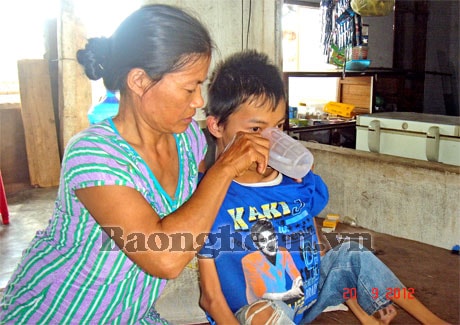
Children with birth defects are the greatest pain for mothers.
Another case is that of Ms. Nguyen Thi Ch. in Hamlet 8, Nghi Thinh Commune, who burst into tears when her second child was born with a deformed and crooked face – the son that she and her husband had been waiting for. Her son, K, suffers from Down syndrome, a condition causing intellectual disability due to the presence of an extra chromosome 21 in his cells.
Nguyen Thi A, a child from Nghi Hung commune, was born with multiple health problems: congenital heart disease, cleft palate, and intellectual disability. Her mouth and lips were severely affected by the disease, causing her immense pain; every meal was filled with tears.
These are three of nearly 700 cases of children with congenital birth defects being raised in Nghi Loc district. The pain of these mothers and the disabilities of their children are not unique to any one person; they deeply affect society. Perhaps these sufferings could be alleviated if similar cases were detected, diagnosed, and treated promptly. According to researchers, prenatal screening can reduce the incidence of birth defects by up to 95%. Prenatal screening is extremely important in improving the gene pool and enhancing the quality of the population.
Effectiveness of a project
As one of the five districts implementing the Prenatal and Newborn Screening Project, Nghi Loc district piloted the program in nine communes in 2011 and expanded it to 18 more communes in 2012. Currently, 27 out of 30 communes have implemented the project. Despite being a new initiative, the awareness of the people has shown positive changes. Through propaganda and mobilization efforts, a segment of the population has recognized the benefits of prenatal and newborn screening and has actively participated in the project's activities. After nearly two years of implementation, approximately over 3,000 pregnant women have participated in prenatal screening, and nearly 700 mothers have agreed to newborn screening for their children.
Dr. Le Ke Tu, Head of the Obstetrics Department at Nghi Loc District Hospital, said: "After the program was implemented, we collected blood samples from newborns' heels and sent them to the Central Obstetrics and Gynecology Hospital for screening. In nearly two years, we have detected 13 suspected cases of G6PD deficiency. Cases of G6PD deficiency and congenital hypothyroidism can slow brain development, cause neonatal jaundice, and chronic anemia. If these cases receive timely advice and treatment, the condition can be completely cured; otherwise, it will cause severe complications."
The implementation of the Prenatal and Newborn Screening Program is a good opportunity to contribute to reducing the disability rate in the population, thereby reducing the costs of care, treatment, and support for people with disabilities, improving the quality of the population, and ensuring a high-quality workforce for national development. Currently, the program only screens for the two most common diseases: G6PD deficiency and congenital hypothyroidism. According to Dr. Tú: "Prenatal diagnosis and newborn screening are two modern preventive measures with high scientific and technical levels, aimed at detecting abnormalities in children during the fetal stage and immediately after birth. We hope that in the future the program will expand to include rare diseases such as Down syndrome, neural tube defects, congenital adrenal hyperplasia, and other diseases to help mothers give birth to children who are healthy physically and intellectually, contributing to improving the quality of the population in the best possible way."
In my opinion, for the project to be implemented widely, it requires the active participation of various departments, organizations, and the support of the local community. Furthermore, communication efforts need to be emphasized so that people view prenatal and newborn screening as part of the national expanded immunization program. This aims to detect children at risk of disease early, provide timely treatment, and gradually reduce the suffering caused by birth defects.
T. Hien - K. Chung