
To make the festival less "heated"
Spring is the season of festivals. The Spring of the Year of the Horse (Giáp Ngọ) seems to have arrived early. From the beginning of January, visitors from all over have flocked to several famous festivals, and stories of joy and sorrow have begun to emerge surrounding these early spring celebrations. Some online news outlets reported that a young man was stabbed to death at the Hương Pagoda festival (Thiên Lộc commune, Can Lộc district, Hà Tĩnh province) on the afternoon of February 5th. The Gióng Festival and the Hương Pagoda festival (Hanoi), which opened on the 6th day of the Lunar New Year of the Horse, have seen a resurgence of exploitation of tourists and the proliferation of gambling games with prizes, causing public outrage.
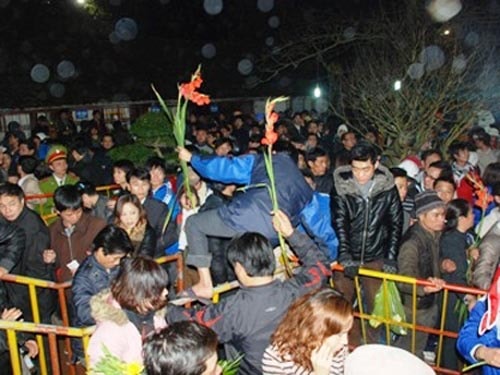 |
| Scramble for sacred offerings at the Trần Temple seal distribution ceremony. |
Festivals are forms of community cultural activities created by the people. Many festivals are rich in cultural identity, upholding national traditions, commemorating the contributions of ancestors, and fulfilling the spiritual needs of the people. For example, the rice planting festival in some northern provinces, where local leaders join the people in plowing and planting. The central coastal provinces have the fishing festival. Fishermen head out to sea with excitement, hoping for a bountiful catch.
However, many famous festivals in the northern provinces are becoming commercialized, leading to negative consequences, overcrowded festival spaces, and widespread exploitation of religious beliefs. Scenes of thousands of people scrambling for offerings at Tran Temple (Nam Dinh), exorbitant prices at Bai Dinh Pagoda, stalls displaying wild animal meat at Huong Pagoda; the burning of votive offerings and hiring people to pray for them at Ba Chua Kho Temple (Bac Ninh), Phu Giay (Nam Dinh), and Kiet Bac Temple (Hai Duong)... have become serious problems. The thoughtlessness of some people is gradually eroding the positive meaning of these festivals.
For many years, the cultural sector and local authorities in areas where festivals are held have implemented various solutions hoping to bring festival management back on track. These include adjusting the hierarchical management of festivals according to the principle of state management and supervision, with the people organizing and implementing; reducing the scale and frequency of organization; not using state budget funds to organize festivals related to specific professions or events; rationally arranging donation boxes and incense burners; limiting the burning of votive paper; and prohibiting the burning of effigies. However, the results have not been as expected. Some negative phenomena, eroding the positive values of festivals, such as gambling and the abuse of religious beliefs for superstitious practices, persist. Despite the cultural sector's increased vigilance in inspection and supervision, negative manifestations in festival activities have yet to be prevented.
Faced with the reality of festivals becoming secularized, many opinions suggest the need for an inventory and classification, determining which festivals are at the national level, which are at the provincial level, and which are at the village level. According to an expert in the field of cultural heritage, the weakness in current festival management is the lack of a scientific database and a proper approach. We only know that there are a certain number of festivals, but we don't fully understand the value of those festivals. If festivals have faded away, lost their essence, and their festive spaces, is it necessary to revive them? And does the revival truly stem from the will of the people?
To ensure that festivals become well-organized and truly serve as places for preserving and promoting cultural values, it is time to clarify the distinction between traditional and modern festivals. Without clearly identifying and categorizing the festivals we have, management will remain ineffective. While rigid administrative measures are unacceptable for dealing with culture, including festivals, the future of festivals is unlikely to improve without a suitable festival management model.
According to News


