
To make Vietnamese festivals even more beautiful in the hearts of tourists.
In Vietnam, there are nearly 8,000 festivals each year; of which folk festivals account for up to 90%, while the rest are religious festivals, historical and revolutionary festivals, and some other types of festivals imported from abroad.
Festival activities take place throughout the year, but are concentrated in the spring and mainly consist of folk festivals.
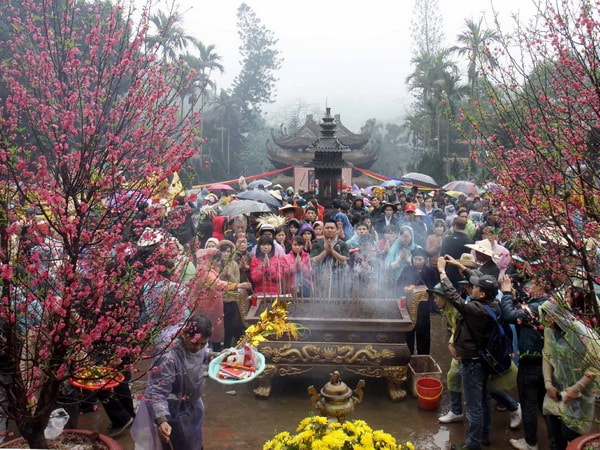 |
| Visitors offer incense at Thien Tru Pagoda during the Huong Pagoda Festival. Photo: VNA |
Safe, healthy, and effective
Safe, wholesome, and effective – that's the assessment of festival activities in 2013 by Pham Van Thuy, Director of the Department of Grassroots Culture under the Ministry of Culture, Sports and Tourism.
Taking place primarily in the spring, folk festivals attract tens of thousands, even hundreds of thousands, of participants, creating a lively and exciting atmosphere in the people's working and productive lives. Organized with diverse content and forms, the ceremonial part ensures traditional values, while the festive part features many attractive cultural activities, combining traditional and modern elements. Through these festivals, people's cultural and spiritual needs are enhanced, contributing to strengthening social relationships.
Director Pham Van Thuy stated that the successful organization of folk festivals has contributed to educating about the nation's fine cultural traditions, enriching and strengthening the spiritual life of society, and contributing to building an advanced Vietnamese culture imbued with national identity. Folk festivals are organized and funded by the people themselves, mobilizing social resources, with the state playing a managerial and guiding role.
The historical and revolutionary festivals were also organized solemnly and healthily with a spirit of frugality, contributing to arousing national pride and self-respect, commemorating the contributions of our ancestors, and educating the younger generation about the principle of "drinking water and remembering the source" passed down from our forefathers.
Industry festivals have become well-established, showcasing industries, products, and cultural highlights of each region across the country to international friends, contributing to economic development, tourism, and cultural promotion worldwide.
In particular, religious festivals and festivals imported from abroad all take place in a joyful and wholesome atmosphere, showcasing cultural diversity and attracting large numbers of people to participate.
There are still some flaws.
To ensure that festivals are held safely, healthily, and effectively, festival management boards and provincial heritage site management boards closely coordinate with relevant agencies to develop plans to ensure security and order, food safety and hygiene, fire prevention, traffic congestion resolution, and provide telephone numbers and hotlines to promptly handle any issues that may arise during the festivals…
However, according to Director Pham Van Thuy, although localities have detailed plans for each festival, due to improper implementation, lack of coordination, and insufficient sense of responsibility from individuals, congestion and pushing still occur, such as at the opening ceremony at Tran Temple in Nam Dinh, Hung Temple in Phu Tho, and the Huong Pagoda Festival in Hanoi on the main day of the festival.
Security and order at some festivals have not been well-maintained, with incidents of theft, pickpocketing, and disguised gambling activities still occurring, such as at the Lim Festival and the Ba Chua Kho Temple in Bac Ninh. Begging, fortune-telling, spirit medium rituals, and hired prayer services still take place at some festivals, such as the Tay Ho Temple and Duc Thanh Ca Temple in Hanoi, and the Mau Temple in Lang Son…
The acceptance of donations in kind, the addition of artifacts, the decoration of religious objects in a manner inconsistent with tradition, the installation of commemorative plaques, the construction of iron frames, corrugated iron roofs, and awnings, and the exploitation of services have distorted the historical site.
"In particular, the placement of numerous donation boxes and oil lamp money trays at places of worship; the collection and use of donation funds at religious and worship establishments in some places are inconsistent, with some being managed by local authorities, and others by temple keepers, incense keepers, or abbots, resulting in ineffective reinvestment in the restoration of historical sites," Director Pham Van Thuy stated.
Furthermore, the appearance of fake donation boxes at the Ba Den Mountain Spring Festival in Tay Ninh and the Ba Chua Kho Temple in Bac Ninh, as well as the high-priced money exchange services at most major historical sites and festivals, have caused public outrage.
Strengthen inspection and supervision.
Strengthening inspection, examination, and supervision of festival management and organization activities; resolutely and promptly handling violations in festival organization and damage to historical relics are among the measures that the cultural sector will vigorously implement in the coming time to thoroughly address weaknesses and negative aspects in festival activities.
Minister of Culture, Sports and Tourism Hoang Tuan Anh requested festival organizers and monument management boards to rationally arrange stalls, services, and parking areas; and to minimize the number of stalls selling votive paper, exchanging small denominations of money, and operating games that could easily be used for gambling during festivals.
Festival organizers and monument management boards need to strengthen their promotional efforts through various means, focusing on promoting the historical and cultural value of the monuments and the significance of the festivals; adding signs and boards to guide visitors in complying with regulations on civilized behavior; and reviewing the fire prevention and control equipment and organization at the monuments.
The organizing committees and management board advise visitors not to burn votive paper or incense inside the buildings of the historical site to ensure the absolute safety of the site…
The cultural sector continues to make positive changes in the management of donations and offerings, limiting the improper distribution of cash and considering this a breakthrough for the sector. At the same time, it is determined to prevent the recurrence of practices such as placing or scattering money on statues, throwing money into wells, ponds, and lakes, as well as the operation of money exchange services at historical sites and festivals that cause offense.
In addition, local authorities need to provide unified guidance to management boards, organizing committees, and abbots of historical sites to ensure that donations are used transparently, for the right purpose, and in the most effective way.
According to Vietnam+


