
We propose that China negotiate to maintain friendly relations between the two countries.
On the morning of May 31st – the second working day of the 13th Asian Security Summit (Shangri-La Dialogue) – General Phung Quang Thanh, Member of the Political Bureau and Minister of National Defense of Vietnam, delivered a speech at the plenary session on the topic of “Managing Strategic Tensions”.
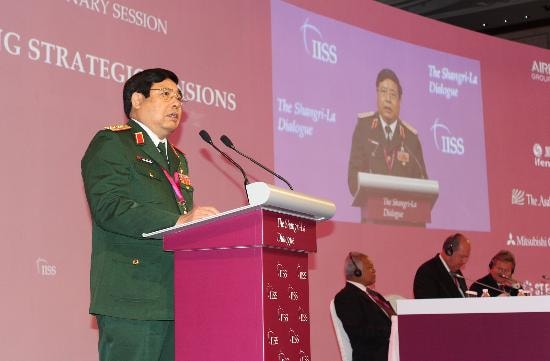 |
| Minister of Defence Phung Quang Thanh speaks at the Shangri-La Dialogue 2014. Photo: VNA |
Minister Phung Quang Thanh stated: “The common aspiration of countries around the world, including Vietnam, is to always desire for the region to maintain a peaceful and stable environment, to cooperate in development, and to prevent conflicts and wars from occurring.” According to the Minister, to manage the risks that could lead to conflict, countries “need to have a common understanding in upholding international responsibility, especially the role and responsibility of major powers. Countries must all be responsible for maintaining a peaceful and stable environment for cooperation and development, must respect international law, the United Nations Charter, respect independence, sovereignty and territorial integrity, and must not use force or threaten to use force to resolve disputes. They must strengthen cooperation on the basis of equality, mutual respect, and mutual benefit, without distinction between large and small countries.”
Also in his speech, Minister Phung Quang Thanh mentioned China's unilateral placement of the Haiyang Shiyou-981 deep-sea drilling rig in Vietnam's exclusive economic zone and continental shelf, which has caused outrage among the Vietnamese people and concern among countries in the region and the international community. After reaffirming Vietnam's commitment to resolving the issue peacefully on the basis of international law, particularly the 1982 United Nations Convention on the Law of the Sea and the Declaration on the Conduct of Parties in the South China Sea (DOC);
Regarding ASEAN's six-point statement on the South China Sea and the progress towards building a Code of Conduct in the South China Sea (COC) between ASEAN and China, Minister Phung Quang Thanh urged China to immediately withdraw the Haiyang-981 oil rig from Vietnam's exclusive economic zone and continental shelf, and to negotiate with Vietnam to maintain peace, stability, and friendly relations between the two countries.
Also on the morning of May 31st, Minister Phung Quang Thanh and members of the high-level Vietnamese military delegation attending the 13th Shangri-La Dialogue held a bilateral meeting with US Secretary of Defense Chuck Hagel.
The content of Minister Phung Quang Thanh's speech:
First, we express our appreciation for the message on Japan's "active peace policy" presented by Prime Minister Shinzo Abe last night.
Also at this Forum in 2013, Vietnamese Prime Minister Nguyen Tan Dung conveyed a message to the international community about "strategic trust," emphasizing that "trust is the source of all friendly relations and cooperation; it is an effective remedy to prevent calculations that could lead to conflict. Trust needs to be nurtured and cultivated continuously through concrete, consistent actions, in accordance with common standards and with sincerity."
Looking back after a year, we see that the world and the region still face many tensions and potential risks of conflict or war, as we witness daily and hourly through the mass media. Therefore, building trust remains more urgent than ever in the current global and regional situation.
Strategic tension management is a critical issue, related to the peace, stability, and development of countries, regions, and the world, in line with the common aspirations of the international community and the interests of nations, and is the topic I want to share with you.
Ladies and gentlemen!
Overall, the current global and regional situation shows that peace, cooperation, and development are the dominant trends, but the situation remains complex and fraught with unpredictable uncertainties. Tensions and conflicts related to religion, ethnicity, separatism, local wars, territorial disputes, political unrest, intervention, subversion, and terrorism are intense; threats to non-traditional security, high-tech crimes in the fields of finance and currency, electronics and telecommunications, biotechnology, and the environment continue to increase.
The Asia-Pacific region is dynamic, experiencing high growth and attracting global investors; however, tensions persist on the Korean Peninsula, and sovereignty disputes exist in the East China Sea and the South China Sea... These factors affect regional peace and stability.
The root causes of these problems stem from conflicts of interest, leading to skepticism about goodwill and trust in relationships and cooperation, friction of interests in strategic competition, and acts of mutual restraint. Furthermore, conflicts and differences in culture, religion, ethnicity, ideology, etc., persist, while the parties involved have yet to find effective solutions.
The common aspiration of countries around the world, including Vietnam, is to maintain a peaceful and stable environment in the region, to cooperate in development, and to prevent conflicts and wars from occurring.
I believe that, in order to manage the risks that could lead to conflict, we first need a shared understanding of upholding international responsibility, especially the role and responsibility of major powers. All countries must share the responsibility to maintain a peaceful, stable environment for cooperation and development, respect international law, the UN Charter, and respect independence, sovereignty, and territorial integrity. We must refrain from using force or threatening to use force to resolve disputes, and strengthen cooperation on the basis of equality, mutual respect, and mutual benefit, without distinction between large and small nations.
When we have a shared understanding, we will have a solid foundation for building trust. Trust is not only expressed through words, but also through concrete actions, through practical deeds to promote transparency, equal and open dialogue, building friendly relations and cooperation between nations, respecting the law and norms in international relations. Major powers have a responsible role and make important contributions in building and strengthening this strategic trust.
In reality, even within a nation or a family, conflicts and disagreements exist, let alone between neighboring countries where border and territorial disputes or clashes are inevitable. The key is for high-ranking leaders of these countries to remain calm and restrained, placing national interests within the context of regional and international interests; choosing peaceful solutions through diplomatic negotiations to maintain friendly relations between nations.
In resolving any conflict or dispute, the parties involved need to exercise restraint, remain calm, objectively understand the nature of the problem, and make decisions very cautiously. Even a small mistake can escalate tension into conflict. In managing tensions between countries, the role of the military is crucial; the military must restrain, control, and strictly manage all activities of each commander and soldier in commanding and operating weapons, equipment, and combat vehicles such as warships and aircraft.
In strategic tension management, the role and responsibility of the media are crucial. This includes providing truthful, objective, and timely information in a constructive spirit that benefits the nation and its people. The media should create a favorable environment to contribute to the peaceful resolution of conflicts and disputes, avoiding inflammatory language, especially those that incite ethnic hatred, and refraining from escalating tensions or putting pressure on leaders during the decision-making process regarding dispute resolution.
To control and minimize the risks of conflict, we should effectively utilize both bilateral and multilateral cooperation mechanisms. Issues involving only two countries should be resolved bilaterally, while issues involving multiple countries and parties should be resolved through multilateral mechanisms. The process of resolving conflicts and disagreements must be open and transparent to the international community, avoiding misunderstandings or creating public suspicion.
Currently, we have regional cooperation mechanisms such as the ASEAN Regional Security Forum (ARF), the Council for Asia-Pacific Security Cooperation (CSCAP), the East Asia Summit (EAS), the ASEAN Defence Ministers' Meeting (ADMM) and the ASEAN Defence Ministers' Meeting Plus (ADMM+), the ASEAN Maritime Forum (AMF), as well as today's Shangri-La Dialogue, which are important frameworks for building trust, promoting preventive diplomacy, and seeking effective conflict management measures.
Ladies and gentlemen!
Overall, relations between Vietnam and its neighbor China are developing well in many aspects, with only the issue of sovereignty disputes in the South China Sea remaining. This sometimes leads to clashes and tensions, such as the incident on May 1, 2014, when China unilaterally deployed the Haiyang-981 deep-sea drilling rig in Vietnam's exclusive economic zone and continental shelf, causing outrage among the Vietnamese people and concern among countries in the region and the international community.
We are well aware that the struggle to protect territorial sovereignty is sacred. Vietnam consistently advocates for resolving issues peacefully on the basis of international law, especially the 1982 United Nations Convention on the Law of the Sea; the Declaration on the Conduct of Parties in the South China Sea (DOC); the ASEAN Six-Point Declaration on the South China Sea; moving towards the development of a Code of Conduct in the South China Sea (COC) between ASEAN and China; and the Agreement between the high-level leaders of Vietnam and China, maintaining peace, stability, security, and safety of maritime and air navigation in the South China Sea, maintaining political stability to focus on socio-economic development, improving the lives of the people, and preserving the traditional friendship between the people of Vietnam and China, through dialogue at many levels and in many sectors with China to reduce current tensions.
With this policy in mind, Vietnam has exercised great restraint, not using aircraft, missile boats, gunboats, etc., but only employing fisheries patrol vessels, coast guard vessels, and fishing boats of fishermen, in coordination with law enforcement forces to protect its sovereignty. We have not proactively rammed or used water cannons against Chinese vessels. We urge China to withdraw its oil rig from Vietnam's exclusive economic zone and continental shelf and to negotiate with Vietnam to maintain peace, stability, and friendly relations between the two countries. This would benefit both countries, the region, and the world.
I believe that the militaries of both countries must exercise utmost restraint, strengthen cooperation, and closely monitor all activities to prevent any actions from getting out of control. The militaries of both countries must play an advisory role to the Party and State leaders in handling issues appropriately, calmly, and persistently, to avoid conflict, and certainly not war.
Vietnam is very proactive and positive in defense cooperation with ASEAN countries, such as participating in search and rescue exercises, providing humanitarian assistance and disaster relief, and establishing a hotline for information sharing among ASEAN countries. On June 8, 2014, Vietnam and the Philippines will hold an exchange between forces stationed on Song Tu Dong and Song Tu Tay islands, part of the Spratly Islands, to strengthen friendship, build trust, and reduce tensions in the region.
We hope that through the joint efforts of the international community, conflicts and disagreements will be gradually resolved, maintaining stability and development in the region, and contributing to a peaceful global environment.
Finally, to conclude my presentation, I would like to once again convey a message from the Government and people of Vietnam: with its tradition of harmony and love for peace, Vietnam is always ready to be a friend and a reliable partner with all countries in the international community on the basis of respect for independence, sovereignty, equality, and mutual benefit, working together to build a peaceful, prosperous, cooperative, and developing environment in the Asia-Pacific region and the world.
According to News


