
Easy to remember a street name
(Baonghean)How many people remember a street name unless they live there or work or study there every day? But there are people who, even if they rarely return, still know the name of a street by heart simply because they once loved and were attached to a particular house, a tree, or a small, undeveloped path from a time when the street wasn't yet... a street! Le Duẩn Street (Vinh City) now often evokes such nostalgic memories...
To give an example, back when it was Vinh City in the early 1960s, what is now Le Duan Street was just a section of National Highway 1A running through it. There were no sidewalks or curbs; the bumpy asphalt road ran through uneven sandy plains overgrown with weeds, scattered rice paddies, and a few thatched houses. During those years of relentless bombing, soldiers on march waiting to cross the Ben Thuy ferry would yearn for, but could hardly hope for, even a single green tree to provide shade during their rest stop...
Miraculously, amidst that desolate landscape stood the Vinh People's Theater. There, the sounds of singing drowned out the noise of bombs during performances by cultural troupes and art groups; it also served as a mobile cinema for the public on Saturday evenings. The theater, resembling the Vinh football stadium today, was built in the late 1950s and later demolished to make way for new construction projects. It is now the site of the Intimex supermarket, numbered 343, located on the south side of Le Duan Street...
The elderly woman selling tea, her hair streaked with gray, sat alone on the north side of the street, right where the Phuong Dong Hotel's fence met the Trường Thi street frontage. A resident of Vinh Street for decades, she suddenly seemed young again as she recalled the 70s and 80s, when she would go to the theater night after night to watch performances by the Central Cai Luong Troupe, the Chuong Vang Troupe, and the Kim Phung Troupe. During the day, the streets from Ben Thuy to Cau Ram were clear and bright, but at night, they were packed with young men and women, old and young, from all directions, flocking to the People's Theater to listen intently to artists like Ai Lien, Le Tho, Tieu Lang... singing the traditional folk songs in famous plays such as "Two Streams of Mother's Milk," "The Time of Girlhood is Gone"...
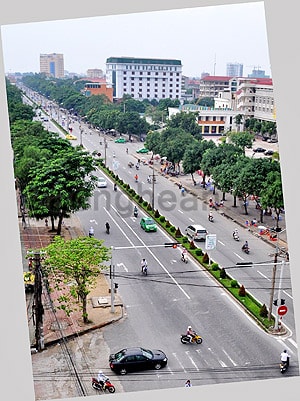
A panoramic view of Le Duan Street.
According to author Duong Van Ky in "Vinh - The City of My Childhood" (VHNA - 2012), in the 1960s, "almost directly opposite the People's Theater was a vast, desolate area overgrown with weeds and bushes. It is said that this area was once the examination center for Nghe An and neighboring provinces such as Thanh Hoa and Quang Binh, dating back to the Tran Dynasty. During the Nguyen Dynasty, this examination center produced outstanding graduates such as Nguyen Cong Tru and Phan Boi Chau, famous figures known throughout the country. After the end of the examination system, the French built one of the largest railway factories in Indochina on this land, employing thousands of workers. Along with it were a timber factory, a match factory… all of which laid the foundation for Vinh's first industrial development. Now, if you go deeper inside, you only see here and there heavy railway wheels, and even a few rusty steam boilers lying scattered in the weeds…".
The city, its hometown, had just fallen silent after the 1973 Paris Agreement when the bombing ceased, and life immediately began to stir with people returning to revive it. The area of the former Truong Thi campus began to sprout the single-story buildings of Vinh University of Education, the first university in Nghe An province, established in 1959. It was a frontline university of the socialist North and the second largest university in the country (after the National University system). Former students of Vinh University, proud of their school and its current location, draw their memories from their studies and training amidst hardship but also filled with dreams and aspirations. Those were the nights of power outages, spent diligently studying until the oil lamp ran out; the afternoons strolling with friends along the street where new constructions of the 4th Military Region Command, the Military Region Museum, and the residential areas began to appear, gradually obscuring and disappearing the traditional lime kilns, the trading stalls, the horse-drawn cart and tricycle transport cooperatives... The scattered thatched-roof stalls selling sticky rice cakes, green tea, and peanut candy back then are now the places where numerous "street food stalls" are concentrated on the sidewalks serving students at the far north end of Le Duan Street, at the Vinh University intersection.

A corner of the Vinh University intersection on Le Duan Street.
Le Duan Street in Vinh City is perhaps a unique street, as neither side of the street is numbered starting from 1; nor does it follow the usual numbering system starting from the city center (usually marked by the number 0 at Vinh Market), but rather from the Ben Thuy area inwards. This is because Le Duan Street was separated from Nguyen Du Street in 1997, and although the street name was changed, the house numbering system remained the same. Starting from the odd-numbered side (187) and the even-numbered side (182) at the Vinh University intersection, it continues up to the roundabout in front of Phuong Dong Hotel (connecting to Tran Phu Street and intersecting Truong Thi Street), with the last number 343 belonging to Trung Do Ward and the number 187 on the north side belonging to Truong Thi Ward.
This street is a bustling, two-way thoroughfare, full of shops and businesses. Stretching almost the entire north side is the fence surrounding the buildings of Vinh University, always lively, in contrast to the other side where the 4th Military Region Command Headquarters maintains a quiet atmosphere. The south side of the street houses many offices and training facilities, including schools of all levels in Trung Do ward and vocational schools. While the 4th Military Region Museum and the Military Region Cultural Center are historical and cultural landmarks on the south side of the street, the Vinh University Information Center and Library, named after Professor Nguyen Thuc Hao, a descendant of the famous Nguyen Thuc scholar family in Nam Dan and the first rector of Vinh University (from 1959-1973), is a noteworthy cultural highlight on the north side. Whether by coincidence or feng shui, the Vinh University Information Center and Library is believed to have been built right on the site of the former examination hall.
Le Duan Street now, alongside the modern, well-maintained buildings, still retains glimpses of moss-covered, red-brick walls of old apartment complexes built during the subsidy era in the small alleys on the south side; or Bach Lieu Street branching off to the north evokes a sense of melancholy. Le Duan Street today is bustling and vibrant year-round, so if you want to truly feel the street's soul, come here late at night. You'll find only a couple of small shops with red lights, seemingly just adding a touch of nostalgia for those who left before the street became a city, and now have the chance to revisit.
Comrade Le Duan was born on April 7, 1907, in Bich La Dong village, Bich Ha commune, Trieu Phong district, Quang Tri province (now Bich La Dong village, Trieu Dong commune, Trieu Phong district, Quang Tri province). He was one of the first revolutionary fighters and an outstanding disciple of President Ho Chi Minh. At 79 years old, with 56 years of Party membership and nearly 60 years of continuous revolutionary activity, Comrade Le Duan was entrusted with many important responsibilities: Secretary of the Central Committee of the Party (1937); Standing Committee Member of the Central Committee of the Party (1939); Secretary of the Southern Committee of the Party; Secretary of the Central Bureau of the Southern Region (1946-1954); Member of the Politburo (1951); First Secretary and General Secretary of the Central Executive Committee of the Party (1960-1986). Comrade Le Duan passed away on July 10, 1986. His name has been given to many avenues and streets in major cities across the country.
Text and photos: Dinh Sam


