
To manage and utilize state assets effectively.
(Baonghean) - On July 28th, in Hanoi, the Ministry of Finance held a specialized press conference on the orientation for reforming the mechanism for managing and using state assets at public service units. According to the report, as of December 31st, 2014, the total original value of state assets nationwide was nearly 1 trillion VND, not including assets at units of the People's Armed Forces and state-owned enterprises. Nearly 60,000 public service units alone currently manage over 300,000 assets (accounting for 63.82% of the total state assets), with a total original value of nearly 700 trillion VND. How to use these resources effectively is a matter that the Ministry of Finance needs the enthusiastic support of the press in the coming period.
70% of the total value of state assets has not been utilized effectively.
According to statistics from the national database on state-owned assets, the structure of state-owned assets in public service units includes: 75,000 plots of land (accounting for 70%), nearly 200,000 buildings with a total original value of 165 trillion VND (accounting for 24%), nearly 16,000 automobiles with a total original value of nearly 7.8 trillion VND (accounting for 1.12%), and nearly 18,000 other assets with a total original value of 35 trillion VND (accounting for over 5%). The current mechanism for managing and using state-owned assets in public service units shows that there are many legal documents on the mechanism of allocating capital to financially autonomous public service units, allowing these units to use state-owned assets for business purposes; ensuring transparency in the management and use of state-owned assets, and effectively exploiting available resources from state-owned assets in conjunction with mobilizing social resources to develop public service activities. The implementation process has achieved certain results; many units, upon being allocated capital, have effectively utilized their potential and strengths to both fulfill their assigned political tasks and improve service quality, increase employee income, and contribute to the state budget.
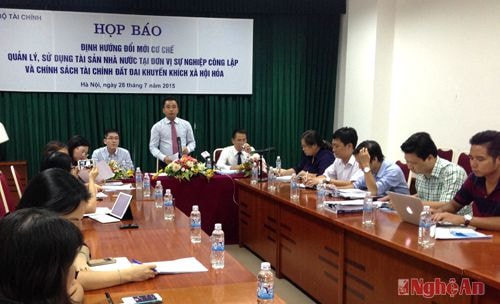 |
| A view of the press conference on the direction of reforming the mechanism for managing and using state assets. |
However, despite the initial results mentioned above, the current mechanism and implementation still reveal limitations and shortcomings that need to be addressed. Firstly, some current regulations need to be changed to suit the new situation and accelerate the implementation process. Accordingly, some criteria for determining eligibility for the State to determine the value of assets assigned to units for management under the mechanism of capital allocation to enterprises are still unreasonable and easily create apprehension among units, such as: requiring a plan for asset utilization, requiring a commitment from the State not to supplement funding from the state budget (except in cases of increased tasks or increased staffing)... Determining the value of assets for capital allocation, especially the value of land use rights, is still complicated because it requires determining specific land prices according to market prices using comparative, deduction, income, and surplus methods, which are no longer necessary, costly, and time-consuming. The timeframes for completing the steps in the asset valuation and transfer process need to be revised to shorten the procedure; at the same time, responsibilities should be more clearly defined.
Secondly, the recent issuance of several relevant policies requires adjustments to the management and utilization mechanisms of state-owned assets to ensure synchronization, develop public service activities, and enhance the autonomy of public service units. This reality necessitates the creation of mechanisms to encourage units to strengthen the exploitation of their potential and strengths (including state-owned assets under their management and use) to increase revenue from public services, thereby increasing their financial autonomy.
Thirdly, determining the value of assets to be transferred to public service units for management under the mechanism of capital allocation to enterprises is a new policy; some public service units are still hesitant to change and rely on state subsidies; some units have not yet recognized the important benefits of efficient use of state-owned assets. Meanwhile, the guidance and direction from some ministries, central agencies, and localities have not been decisive or coordinated.
The aforementioned shortcomings and limitations have resulted in low efficiency in determining the value of assets to be allocated to financially autonomous public service units. According to incomplete reports from ministries, sectors, and localities, only 579 financially autonomous public service units have been allocated capital under the enterprise capital allocation mechanism so far, with a total asset value of approximately over 19 trillion VND.
Remove some conditions to speed up the process.
According to the Ministry of Finance, the direction for amending and supplementing the current mechanism and its implementation should focus on revising and supplementing the conditions for units to be granted state-owned asset valuation for management; the procedures for determining asset value and assigning management; and strengthening the dissemination of regulations on the management and use of state-owned assets to help agencies and units fully understand the benefits of determining the value of state-owned assets for management, as well as the responsibilities of agencies, units, and their leaders in directing and organizing implementation. Accordingly, ministries, central agencies, and provincial People's Committees must review all units under their management to identify units that meet the conditions for state-owned asset valuation for management, as a legal basis for implementing subsequent tasks.
In these guidelines, the Ministry of Finance proposes expanding the scope and removing some conditions to facilitate the process of determining the value of state-owned assets (such as removing the condition that the unit must have a plan for using state-owned assets approved by the competent authority, removing the condition that the state will not increase funding, to eliminate the reluctance of units when implementing capital allocation). In addition, the Ministry of Finance requires a comprehensive review of the procedures for determining the value of assets and assigning management to eliminate unnecessary content, specify the content, methods of implementation, and deadlines for each stage of the work to speed up the process of transferring assets to units.
Specifically, this includes: eliminating the need to determine the asset value for the land area leased from the State to units that pay annual land rent, thereby reducing procedures and costs for determining the value of land use rights for nearly 1,000 units subject to the transition to land lease. Using the local land price table and land price adjustment coefficient to determine the value of land use rights allocated to units; specifying deadlines for asset valuation, reporting to competent authorities, and asset allocation decisions to clearly define the responsibilities of relevant agencies and expedite asset allocation; and shortening the asset handover period from 60 days to 15 days to speed up the process. With these regulations, the time from start to finish of asset allocation to public service units can be shortened by at least half.
The Ministry of Finance will also review the system of sanctions for violations in the management and use of state-owned assets, especially cases where the value of assets is not determined before being assigned to the managing unit, but the state-owned assets are still used for business purposes, or where revenue from state-owned assets is used improperly. Information related to the determination of asset values for assignment to the managing unit, as well as the use of state-owned assets for business purposes, will also be updated in the national database on state-owned assets for monitoring, management, and public disclosure as prescribed.
Red River


