
Exam questions and suggested answers for Geography (Block C)
This morning, July 9th, tFor candidates in Group C, the first subject is Geography. Below are the exam questions and suggested answers.Performed by the top graduates of GSTT Group:
Topic:
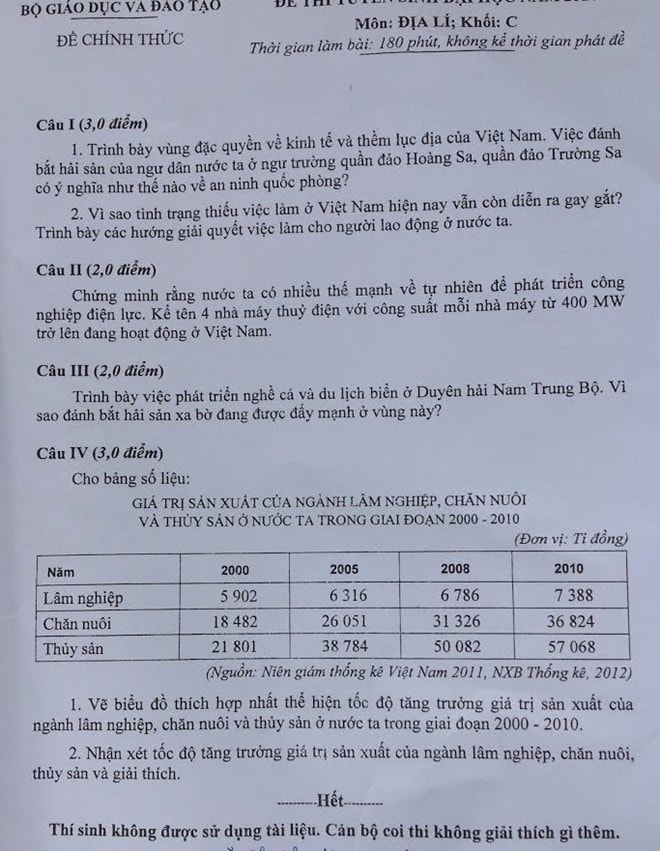 |
Suggested answer:
Question I:
1. - Exclusive Economic Zone: This is the area adjacent to the territorial sea and, together with the territorial sea, forms a zone extending 200 nautical miles from the baseline. Vietnam freely exploits its resources economically, but still allows other countries to lay oil pipelines, submarine cables, and operate aircraft and ships in accordance with international conventions.
- Continental shelf: This is the underwater and subsoil portion of the continent that extends beyond the territorial waters to the outer edge of the continental margin, to a depth of approximately 200 meters. Vietnam has full sovereignty over this area.
- The significance of fishing in the Hoang Sa and Truong Sa fishing grounds for national security and defense:
The development of offshore fishing not only helps to better exploit marine resources.
+ Develop the fishing and aquaculture industry; the seafood processing industry, maritime transport, tourism, etc.
+ Solving employment problems and improving the living standards of the people in the island districts.
+ Affirm which island district of our country has sovereignty over those islands.
2. - The unemployment situation remains severe:
+ Although Vietnam creates approximately 1 million new jobs each year, the employment situation remains critical. In 2005, the national unemployment rate was 2.1%, while underemployment was 8.1%. Unemployment was high in urban areas at 5.3%, and underemployment was 4.5%. In rural areas, unemployment was 1.1%, and underemployment was 9.3%.
+ Due to the slow economic development, the ability to create jobs is limited.
+ The seasonal nature of agriculture and the limited development of rural occupations.
+ Young population structure.
+ The source of funding for job creation from the state budget is limited.
+ Unreasonable labor training structure: a surplus of academics and a shortage of skilled workers.
- Proposed solution:
+ Redistributing the population and labor force.
+ Implement population and reproductive health policies effectively.
Diversify production activities.
+ Strengthen cooperation to attract foreign investment and expand the production of export goods.
+ Diversify training programs to improve the quality of the workforce.
+ Promote labor export.
Question II:
- Natural advantages for developing the power industry:
Vietnam has great potential for developing its power industry. Electricity production has increased very rapidly, from 5.2 billion kWh in 1985 to nearly 52.1 billion kWh in 2005. Regarding the structure of electricity production by source, hydropower consistently accounted for over 70% during the period 1991-1996. By 2005, the advantage shifted towards electricity production from coal and gas, accounting for approximately 70% of output, with the highest proportion belonging to diesel-gas turbines (45.6%). In terms of the power transmission network, the most notable is the 500 kV ultra-high voltage line from Hoa Binh to Phu Lam (Ho Chi Minh City), spanning 1488 km.
+ Vietnam has enormous hydropower potential. Theoretically, the capacity could reach approximately 30 million kW with an output of 260-270 billion kWh. This potential is mainly concentrated in the Red River system (37%) and the Dong Nai River system (19%).
A number of large-capacity hydropower plants are in operation, such as Hoa Binh (on the Da River, 1920 MW), Yaly (on the Xe Xan River system, 720 MW), Son La (on the Da River, 2400 MW), Tri An (on the Dong Nai River, 400 MW), Ham Thuan - Da Mi (on the La Nga River; Ham Thuan 300 MW, Da Mi 175 MW), Da Nhim (on the Da Nhim River, 160 MW), and Thac Ba (on the Chay River, 110 MW).
Tuyen Quang (on the Gam River, 342 MW)...
+ The fuel source for thermal power plants in the North is coal, mainly from mines in Quang Ninh. In the Central and Southern regions, they rely on imported oil. Since 1995, natural gas has also been used to power gas turbine power plants in Ba Ria, Phu My, and Ca Mau.
Our country's major thermal power plants in the North include Pha Lai 1 and 2 (coal-fired, with capacities of 440 MW and 600 MW respectively), Uong Bi and Uong Bi Expansion (coal, 150 MW and 300 MW), Na Duong (coal, 110 MW), and Ninh Binh (coal, 100 MW). In the South, there are Phu My 1, 2, 3, and 4 (gas, 4164 MW), Ba Ria (gas, 411 MW) in Ba Ria - Vung Tau, Hiep Phuoc (oil, 375 MW), Thu Duc (oil, 165 MW) in Ho Chi Minh City, and Ca Mau 1 and 2 (gas, 1500 MW)...
- 4 hydroelectric power plants:
+ Son La hydropower plant on the Da River, with a capacity of 2400MW
+ Hoa Binh hydroelectric power plant on the Da River, with a capacity of 1920MW
+ Yaly on the Xe Xan River, with a capacity of 720MW
+ Tri An hydroelectric power plant on the Dong Nai River, with a capacity of 400MW.
Question III:
1. The development of fisheries and marine tourism in the South Central Coast region.
a. Briefly describe some basic features of the South Central Coastal region (this point is encouraged for some high-achieving students)
b. Fisheries
- The sea area is rich in seafood, with many large shrimp and fish grounds concentrated in the southernmost part of Central Vietnam, the Hoang Sa (Paracel) Islands, and the Truong Sa (Spratly) Islands.
- The region has many bays and lagoons, which are favorable for aquaculture.
- The catch volume is quite large. Lobster farming is developing strongly in Phu Yen and Khanh Hoa. Seafood processing activities are becoming increasingly diverse, with fish sauce being a well-known product (Nha Trang, Phan Thiet).
- The rational exploitation and protection of the marine environment is a matter of urgent importance.
c. Beach tourism
- Coastal areas with famous beautiful beaches in Da Nang, Nha Trang, Ninh Thuan, Binh Thuan... are among the top potential destinations for beach tourism in our country.
- Many major tourist centers have been established and developed, such as Da Nang and Nha Trang. Many types of combined tourism can be developed: beach and island tourism, wellness tourism, sports tourism, etc.
2. The reason offshore fishing is being promoted in this region is because it brings the following benefits:
- Regarding the economy:
+ Avoid overexploiting coastal resources to better protect our country's marine resources, as coastal fishing with rudimentary tools can quickly deplete marine resources.
Offshore fishing helps to better exploit marine resources.
- Regarding national security and defense: Our sea area has many islands and archipelagos that form a forward defense system for the country, a system of bases for our country to expand into the sea and ocean in the new era. Therefore, offshore fishing not only better exploits marine resources but also helps protect our airspace and territorial waters.
Question IV:
1. Draw a graph.
a. Data processing
Assuming the growth rate in 2000 is 100%, the growth rates for the remaining years are summarized in the following table:
Year2000200520082010
Forestry100107.0114.6125.2
Livestock farming100140.9169.5199.2
Seafood100177.9229.7261.8
Table showing the growth rate of production value in the forestry, livestock, and fisheries sectors in Vietnam during the period 2000-2010 (unit: %).
b. Draw a graph:
The most appropriate graph to represent the growth rate of production value in the forestry, livestock, and fisheries sectors in our country during the period 2000-2010 is a line graph (students should draw it themselves).
Request:
- Draw the chart in the correct format (using the year 2000 as the reference point, representing 100%).
- Draw the years with correct spacing and numerical values, and include specific data annotations.
- Clear annotations
- Well-proportioned, clean, and free from erasures.
2. Comments and explanations
- Comments on the growth rate of production value in various sectors:
The strongest growth rate was in the fisheries sector, and the slowest in the forestry sector. The livestock sector experienced average growth (students should compare and contrast the growth rates of the different sectors).
- Explain:
The fisheries sector has experienced the strongest growth due to the government's policies promoting development with a series of strategies, including boosting offshore fishing, etc.
+ The slower growth rate in forestry and livestock farming is due to unresolved difficulties such as investment capital constraints and government policies…
According to Liel


