
To prevent money in your savings account from "disappearing"
(Baonghean.vn) - Recently, there have been many cases of customers' savings passbooks being forged or emptied, resulting in the loss of hundreds of billions of dong. The perpetrators are often bank officials and employees who take advantage of customers' gullibility and carelessness. So what should customers do to avoid these risks?
Choosing the right bank is crucial – it's about choosing where to entrust your money.
To deposit savings, you should first choose a reputable bank with a long history and high security. Banks typically publish quarterly and annual financial reports on their websites and through various media channels.
Note the bank's branch and transaction office network, as well as their operating hours (during and outside of business hours), to easily conduct transactions when needed.
The quality of service at each bank is also reflected in its friendly and dedicated staff, comfortable and convenient transaction environment, and simple and fast transaction procedures.
Transactions should be conducted at the counter.
 |
The common thread among customers who lost money when depositing savings is that they asked someone else to deposit the money on their behalf with the promise of "higher interest rates," but without authorization from the account holder.
Furthermore, for some VIP and loyal customers, bank staff often give preferential treatment by going to their homes or workplaces to deliver money and open savings accounts, instead of requiring them to come to the counter as per regulations. Therefore, risks may arise if staff deliver counterfeit savings passbooks, or fail to deposit the money into the vault or enter it into the system.
Therefore, whether you are an individual or a business customer with bank deposits, you should conduct transactions directly at the counter. Because when transacting at the counter, customers will receive...The camera records the incident, and this will be very good evidence if an incident occurs later.
You should check your deposit account balance regularly.
Currently, customers can easily check their deposit account balances on a weekly or monthly basis via Internet Banking or Mobile Banking, or by visiting a bank branch in person.
This measure aims to help customers quickly detect unusual balance fluctuations. If money is lost, customers can immediately report it to the bank and relevant authorities for appropriate action.
The longer it takes, the more difficult it will be for customers to recover their money, as authorities and banks need more time for investigation and review, especially if the thief no longer has the money to return to the customer.
Internet Banking/Mobile Banking should be used.
 |
You should use Internet Banking or Mobile Banking services to check and monitor the increase and decrease of your savings deposits.
In principle, when you receive notification of the deposit amount through either of the above services, it means the money has entered the bank's system, and the bank is responsible for reimbursing the money in case a bank employee misappropriates your funds.
Do not sign blank documents.
 |
Many customers agree to sign a blank set of transaction documents (without content) out of trust and for convenience, to save time on cash deposit and withdrawal transactions, or because they are away on business on the maturity date of their savings account.
However, there have been many unfortunate cases involving such blank transaction forms. Taking advantage of customers' trust, bank employees can fill in the information on these forms to embezzle or siphon off customers' deposits in various ways.
Do not transfer money anddeposit savings onlinelarge amount of money
 |
Currently, there are no reported issues of losing money when depositing savings online, because in principle, money deposited online is automatically transferred to the bank's system, and the bank is responsible for these deposits.
However, if you are depositing a large sum of money, to avoid risk it is best to conduct the transaction in person at the bank, holding your savings passbook as proof.
You shouldn't change your signature frequently.
You've probably experienced the frustration of being asked to sign documents multiple times by bank staff because your signature was incorrect. However, this is perfectly legitimate to ensure the safety and interests of customers.
Maintaining a consistent signature throughout the transaction process is crucial, as it serves as a security code verifying customer deposits and withdrawals. If a customer signs one way when opening a savings account but signs something else when closing it, it will be very difficult and time-consuming to verify the signature.
Therefore, maintaining a signature is essential to facilitate and expedite your transactions with the bank.
It shouldn't be done.Skip the step of checking the account after sending money.
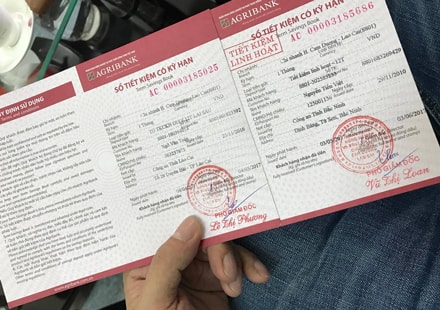 |
Customers may face risks if bank employees accidentally enter the wrong deposit amount, or intentionally misappropriate funds if the customer fails to detect the error due to not checking the savings passbook, or if the passbook or deposit contract does not contain complete information.
When receiving your savings passbook, you need to check the following information: bank name, currency type, amount; deposit term; deposit date; maturity date; interest rate; interest payment method; full name and address of the savings account holder and co-holders; ID card or passport number; card number, seal, and signature of the head of the unit (or authorized person)...
You should not lend your savings passbook to anyone or ask them to hold it for you.
 |
Because you've had a long-standing relationship with the bank employee, you might feel comfortable and complacent, allowing them to "pay off your debt" or asking them to hold your passbook for you. Please note that you shouldn't do this, as everyone is a person who keeps their word before breaking a promise.
In fact, there have been many cases where bank employees have been fired or absconded, embezzling all the savings of their regular customers.


