
To bring Truong Sa closer...
(Baonghean) - Forty years have passed, and Truong Sa district is changing day by day, catching up with life on the mainland. Following in the footsteps of the soldiers, the sea ducks from the Dai Xuyen Duck Research Center have boarded ships to the island. The journey of bringing sea ducks to the island is a touching and arduous story about the people who create the vitality and greenery of Truong Sa...
In early March, I went to Cam Ranh with Ms. Hoang Le Ha (from the Department of Science and Technology of Khanh Hoa province) to check on the ducks one last time before they were loaded onto the ship and taken to the island. I was happy, perhaps partly because the peninsula's atmosphere always fills me with excitement whenever I set off, and partly because I enjoyed seeing how big the ducks had grown. Reading my thoughts, she gently said, "We can only be temporarily at ease when the ducks are safely transported and have adapted well to the environment there." I understood that for almost two months she had been constantly worrying, mobilizing support from various sources for feed, disease prevention, and breeding techniques, and making time to visit the team to check on the flock.
The car sped through the endless sand dunes, accompanied by incessant conversations about the soldiers on the islands. I often wondered why this woman cherished the soldiers and had such a special affection for Truong Sa. The story of bringing sea ducks to Truong Sa was not as simple as I thought. For over a year, the work of bringing sea ducks to the islands received responsible support from various agencies, units, and those with unspoken hearts dedicated to the homeland's islands. Ms. Nguyen Thi Thuy Nghia, then Deputy Director of the Dai Xuyen Duck Research Center - Institute of Animal Husbandry, Ministry of Agriculture and Rural Development, said: “It was quite by chance that Ms. Ha learned about the sea duck breed being experimentally raised by the Dai Xuyen Duck Research Center and contacted me by phone about her desire to bring the sea duck breed to Truong Sa to help the soldiers there improve their lives. The two of us were determined to get the ducks there.”
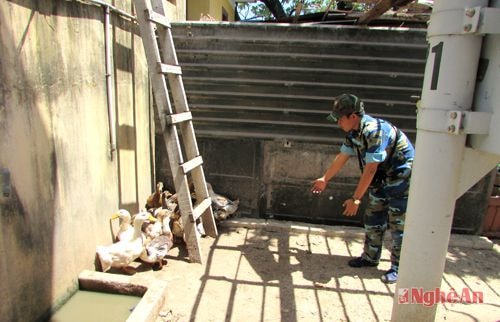 |
| Raising ducks on Sinh Ton Island. |
The Sea Duck (HY) breed from Dai Xuyen Center has good adaptability to freshwater, saltwater, and brackish water environments; it is a breed that can grow and develop well in saltwater environments. Sea ducks are suitable for free-range farming in coastal and island areas, and are adaptable to climate change.
In Vietnam, the common duck breed cannot tolerate seawater. However, the Dai Xuyen Duck Research Center has discovered a new breed that can survive in saltwater. Sea ducks are fast-growing and can be raised on islands… They only need to be raised for 8 weeks to reach a weight of 2 kg and begin laying eggs after 21 weeks. The shallow areas on the islands provide an excellent habitat and foraging environment for sea ducks.
The first time, the Dai Xuyen Duck Research Center sent 100 sea duck eggs to Truong Sa Dong Island, but only a few hatched. The second time, they sent them to Truong Sa Lon Island for incubation, but the results were no better. Undeterred, everyone sought out successful breeding experiences in Quang Ninh and Phu Quoc.
On December 19, 2014, 600 one-day-old sea ducklings were transported by air to Cam Ranh. The ducklings were taken to the centralized processing and breeding station. There, they will be raised for a short period to acclimatize to the climate conditions before being transported by ship to the islands.
Mr. Ngo Duy Do, Vice Chairman of the Truong Sa District Front, told us about the importance of agricultural production on the islands, which is of great significance to ensuring on-site logistical support. The successful breeding and raising of this flock of sea ducks contributes to improving the meals of the soldiers and civilians on the islands, especially on submerged islands where it is very difficult to do so due to the lack of land.
He added that the unit is currently facing some difficulties due to a shortage of commercial feed for ducks and urgently needs regular support in terms of breeding stock, farming techniques, and disease prevention. In the first few days after the ducks were brought in, the Central Veterinary Institute sent people to vaccinate them and provide guidance on how to care for them. After a few weeks, the flock of ducks had adapted to the peninsula's environment.
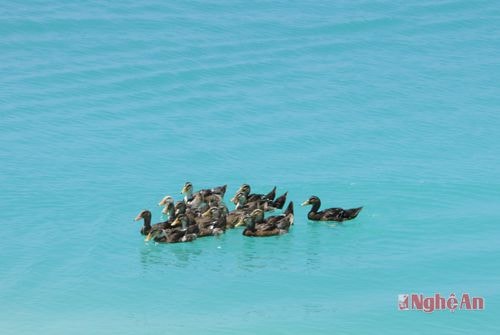 |
The Chairman of the People's Committee of Truong Sa Island District, Nguyen Viet Thuan, welcomed us at the centralized livestock breeding station. His resolute face, weathered by sun and wind, smiled broadly: "You've come to see the sea ducks? We'll have them transferred to the ship the day after tomorrow!" Three "musketeers" from the livestock processing station were already waiting.
The flock of sea ducks, each with sparrow-colored feathers, a white collar, and dark blue-black wing feathers. The male ducks have darker feathers than the females. Looking at the ducks bewildered by the strangers in the stuffy, cramped space, everyone was amazed at how quickly they grew, weighing over 1kg and beginning their molting period. The station only has three people. Besides caring for the ducks, they also have to look after over forty hybrid wild pigs, make fish sauce, and raise fish. Private Nguyen Viet Dung, in charge of the three-person team, said: "During the day, we take turns getting food, picking vegetables, chopping bananas, cleaning the pens… and at night we take turns checking the pens…"
April days. Truong Sa in the calm sea season… Gentle waves caress the sandy shore, mingled with the rustling wind and the chirping of ducks playing in the vast expanse of water. A peaceful scene of a fishing village at the edge of the homeland. A rooster crows at midday, then a few more, filling a corner of the island with their lively sounds, pulling me out of my reverie. The ducks begin to come ashore, their footsteps on the coral sand a familiar sight. Good news comes to me: Sea ducks have arrived on ships at almost all the submerged and above-water islands of Truong Sa.
Standing beside the sovereignty marker on Sinh Ton Island, the heroic image of 40 years ago, when the first soldiers set foot on the archipelago to liberate it, unfolds like a slow-motion film, interwoven with the vibrant Trường Sa of today. A poignant longing wells up in my heart: “Oh Trường Sa! Tomorrow the ship leaves the harbor / We return to our beloved city / Warm embraces, stories of joy and sorrow / The sea remains calm, but my heart is stirred.” And, just like the people here… Trường Sa desperately needs compassionate hearts.
Truong Sa, Sinh Ton Island, April 2015
Nguyen Xuan Tinh
(Military Science Department - Naval Academy)


