
Cong Temple
(Baonghean)The Cong Temple was built in 1471 in the former Tien Yen village (now Quynh Hung and Quynh Ba communes, Quynh Luu district). It is a cultural monument, a testament to the people's efforts to honor and commemorate those who contributed to the nation and its people. The deities worshipped at the temple include General Dinh Le, Dinh Liet, and 53 other revered ancestors.
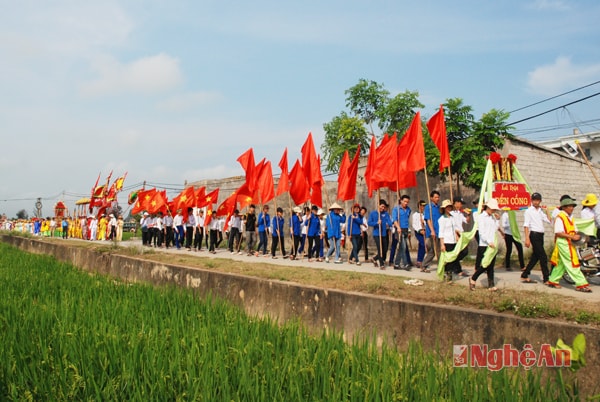 |
| Cong Temple Festival. Photo: TT |
General Dinh Le was from Lam Son, Tho Xuan, Thanh Hoa. He was the nephew of King Le Loi, a brave and resourceful man with exceptional martial skills. As a young man, he served as Le Loi's bodyguard and fought alongside the king against invaders from the early, arduous days in the Chi Linh mountain region. After many years of facing life and death situations, he was gradually promoted to the rank of Minister of War and granted the royal surname. Dinh Le was one of the most experienced generals on the battlefield, achieving numerous victories.
In the year of Ất Tỵ (1425), Lê Lợi ordered his troops to besiege Lý An and Phương Chính in Nghệ An citadel. In May 1425, Đinh Lễ and his younger brother Đinh Liệt were tasked by the king with besieging Diễn Châu citadel (Thành Trài). Relying on the rugged terrain of Cồng forest, they successfully completed their mission, driving the enemy all the way to Tây Đô (Thanh Hóa). After each battle, the corpses of the enemy lay scattered in Cồng forest, and the people buried them in mounds known as Cồn Giặc (Enemy Mound). Not only did the enemy suffer losses, but many members of the Lam Sơn army also fell, and the people buried the bodies of the soldiers at Đồng Phúc and Đồng Quách. This same land was once the site where the Lam Sơn army organized a weapons forging workshop, a relic that remains to this day under the name Cồn Rèn (Forging Mound).
In November 1426, the Lam Son rebels fought a decisive battle against the Ming army at Tot Dong - Chuc Dong. General Dinh Le had the honor of participating and making a significant contribution to this victory. In 1427, he died while pursuing the enemy. Upon hearing of Dinh Le's death, Le Loi was deeply saddened; in 1428, when Le Loi ascended the throne, he rewarded Dinh Le, ranking him second among the 136 founding national heroes. In 1471, to commemorate his great contributions, King Le ordered the villagers of Tien Yen to build a temple on the land that had once been associated with his glorious struggle. The temple's name is taken from the village's place name, but also from the name of a tree that once shielded him and the Lam Son rebels from the enemy's arrows and spears, as a token of gratitude from the people to the hero of the Lam Son rebels.
In the 15th year of Hong Duc (1484), King Le Thanh Tong posthumously bestowed upon him the title of Grand Tutor and the rank of Bin Quoc Cong. Later, he was posthumously granted the title of Hien Thanh Vuong. Currently, a street in Hanoi is named after him, and in Vinh City, Nghe An province, there is also a street proudly bearing his name.
Every three years, on the 15th day of the third lunar month, the people solemnly hold a memorial ceremony for the two brothers Dinh Le and Dinh Liet at the temple. This is an occasion for people from near and far, and tourists from all over, to gather here to light incense and pay tribute to the ancestors who contributed to protecting the nation and its people; to express the principle of "drinking water, remembering the source" of our nation; and at the same time, to pray for the gods to protect and bless the people with a prosperous and happy life.
Thanh Hien(st and gt)


