First Temple
The First Temple was built by the people of First Village in Tan Phong hamlet, Dien Nguyen commune, Dien Chau district, Nghe An province. Throughout history, the place name has changed, but the monument has retained its original location.
From the center of Vinh city, follow National Highway 1A for about 40m to the Dien Chau intersection, turn left onto National Highway 7A for about 7 km, then turn right onto the inter-communal road for about 3 km to the beginning of Tan Phong village, turn right onto the inter-village road for 200m to reach the historical site.
The First Temple was built during the Le Dynasty to worship Sat Hai Dai Vuong Hoang Ta Thon. According to the Hoang family genealogy in Van Phan (now Dien Van commune, Dien Chau district, Nghe An province) and the stele "Nam Mieu Ton Than Su Tich" compiled by the Director of the National History Institute, Cao Xuan Duc, and some other local documents, Sat Hai Dai Vuong's real name was Hoang Ta Thon, his alias was To Dai Lieu, born on April 15, 1254 (Year of the Tiger) in Van Phan village, Dien Chau district. His mother was from the Truong family in Ly Trai village.
Legend has it that one early morning, Mrs. Truong went to the river to fetch water when she suddenly saw two buffaloes leap from the water and butt heads. They charged towards her, but she chased them away with her carrying pole, and the two buffaloes mysteriously disappeared.
But a buffalo hair got caught on the end of the carrying pole and fell into the water bucket. She drank it and felt something unusual in her body. From then on, she became pregnant and soon after gave birth to a handsome baby boy, whom she named Hoang Ta Thon. Growing up, Hoang Ta Thon was exceptionally strong, skilled in wrestling, and unmatched by any young man in the region, especially in swimming.
Hoang Ta Thon grew up during a time when the country was invaded by the Mongol invaders. Because of his swimming skills, martial arts prowess, intelligence, and strategic brilliance, he was recruited by Hung Dao King Tran Quoc Tuan into the royal navy and appointed as "Internal scribe" (assisting in military affairs).
In the autumn of August 1284, Hung Dao King reviewed his troops at Dong Bo Dau wharf.Hoang Ta ThonHe was assigned the task of "managing the fierce wolf army" in naval battles, stationed at strategic locations. During battles with the enemy, he and his comrades dived into the river to sink hundreds of enemy ships.
The Mongol army panicked and fled in disarray. Toa Do was beheaded, Thoat Hoan had to hide in a copper pipe to escape, and O Ma Nhi used a small boat to flee across the sea. From then on, he became a close assistant to Hung Dao Vuong.
After two failed invasions of Dai Viet, in March of the year Binh Tuat (1286), the Yuan army decided to conquer our country again. This time, Hoang Ta Thon was again entrusted by the court with the task of commanding the "fierce wolf" naval force. The war lasted for two years (1286-1288), resulting in the glorious victory of the Battle of Bach Dang in the year Mau Ty, which was likened to the Battle of Chibi, striking fear into the hearts of the Yuan army and causing them to completely abandon their intention to invade Dai Viet.
After the country was liberated from enemy forces, the court rewarded those who had rendered meritorious service. King Tran Nhan Tong bestowed upon Hoang Ta Thon the title of Sat Hai Chang Lai Dai Tuong Quan (Great General of the Sea Guard), granting him the title "Minh Tu" (Minh Tu), making him the commander of the naval forces guarding 12 seaports and protecting the coastal region. From then on, he trained and instructed the soldiers day and night, turning them into the most skilled naval warriors. On March 15, 1339, while on a sea patrol from Thanh Hoa to Cua Trao, Hoang Hoa district, he passed away.
The imperial court, upon hearing the news, posthumously bestowed upon him the title of Tô Đại Liên Thiên Bồng Nguyên Soái Đại Tướng Quân (Great General of the Heavenly Marshal of the Heavenly Army), and sent a dragon boat to carry his coffin back to his hometown of Vạn Phần for burial in Mả Cháy, where a temple was erected. Later dynasties bestowed upon him the titles of “Sát Hải Đại Vương Quản quân Mãnh Lang Thiên Bồng Nguyên Soái Đại Tướng Quân, thượng thượng đẳng tôn thần” (Great King of the Sea, Guardian of the Sea, Protector of the Manor, Mighty General, Great and Virtuous, Assisting the Nation and Accumulating the People, Great King of the Great Strategy and Profound Compassion); ...
In remembrance of his great contributions, people throughout the coastal regions erected...templeHis hometowns include: Nghi Loc, Quynh Luu, Thanh Hoa, Ha Tinh, Ninh Binh, Thai Binh, Hai Phong, Khanh Hoa, Ninh Thuan...
During times of natural disasters, droughts, and epidemics, the imperial court would order the people of the surrounding areas to bring the deities to the First Temple to set up altars and pray for their salvation. Currently, in addition to the main deity Sat Hai Dai Vuong Hoang Ta Thon, the First Temple also houses the worship of other Buddhas such as:
The statue of the Goddess of Mercy (Quan Am) was brought from the temple of De Nhat village to the communal temple. Originally, De Nhat village had very few male descendants, so the villagers built a temple to pray for offspring. Notably, this temple only worshipped the Goddess of Mercy. In 1976, when the cooperative built a new road to the temple grounds, the temple was dismantled to make way for a granary, and the villagers moved the statue of the Goddess of Mercy to the De Nhat communal temple.
Ksitigarbha Bodhisattva is a fully enlightened being who has attained enlightenment over countless eons. He made a great vow: He would not attain Bodhi until he had saved all sentient beings. Because of this vow, he manifested himself many times to rescue sentient beings from the ocean of suffering. Every year, the Buddhist community celebrates the anniversary of Ksitigarbha Bodhisattva on the 30th day of the 7th lunar month.
Since 1949, due to wartime conditions and natural disasters, many Buddhas, saints, and deities from temples and pagodas in neighboring communes such as Dien Nguyen, Dien Dong, Dien Lien, Dien Thai, etc., were collectively worshipped at the First Temple. Therefore, many other deities and Buddhas are worshipped here, including: Dong Phuong Thai Giam, Bac Phuong Thai Giam, Confucius, Hung Dao Dai Vuong, Tam Toa Thanh Mau, Mau De Nhat Thuong Thien, Mau De Nhi Thuong Ngan, Mau De Tam Thoai Phu, Song Dong Ngoc Nu, Ban Tho Thanh Hoang of Dong Phu village, Ban Xu Anh Linh of Dong Phu village, Ngo Vuong Thuong Dang Chinh Than of Thu Phu village, Ban Canh Thong Due Ton Than of Thu Phu village, Ban Canh Thanh Hoang Linh Huu of Thu Phu village, Ta Thanh Tra, Huu Giam Sat, ...
The First Temple is not only a religious and spiritual architectural structure but also a place that commemorates many important historical events of the locality in particular and of the nation in general.
During the Can Vuong movement, De Nhat village was the encampment of the resistance fighters led by scholar Nguyen Xuan On. It was here that the scholar organized fundraising, and the people of De Nhat village contributed significantly. The total amount of support from De Nhat village was the largest in the region. Later, on several occasions when the scholar visited his soldiers, they would stop here to rest and light incense, praying for divine protection.
In 1928, Comrade Vo Nguyen Hien was assigned by the Vietnam Revolutionary Youth League to establish a base in Dien Chau. From the base in Hau Luat (Dien Binh), he expanded to De Nhat village (Dien Nguyen).
After the Dien Chau District Party Committee was established, the De Nhat Village Party Branch - one of the first two Communist Party branches in Dien Chau - was also founded at the De Nhat Temple.
During the Nghe Tinh Soviet movement of 1930-1931, recognizing that the First Temple was a secluded place, surrounded by dense trees, far from residential areas, and a sacred site rarely desecrated, the Party cell of the First village chose it as a meeting place to discuss operational plans. The First Temple also served as a printing location for Party documents and was where the Party flag was hoisted in front of the temple gate on May 1, 1930.
On August 20, 1945, the people of Dien Nguyen, under the leadership of the Party, rose up to seize power. At the First Temple, the village headman handed over the seal, books, and documents to the revolutionary government.
On August 21, 1945, the people of De Nhat village gathered at the temple courtyard, then joined the people of Thai Xa village to arrest the village chief Huu Tran. The demonstration group then moved down to coordinate with the people of the entire district to protest and fight to seize power and establish the Viet Minh government.
On September 4, 1945, President Ho Chi Minh, on behalf of the Government of the Democratic Republic of Vietnam, launched the "Gold Week" campaign. Responding to his call, a large number of people from De Nhat village gathered at the De Nhat temple courtyard to donate money, gold, and silver.
During the two sacred wars of resistance against the French and the Americans to save the country, the First Temple became a place to store weapons and ammunition, a gathering place for militia and self-defense forces, a place to welcome soldiers returning to the village, a place to recruit new party members, and a gathering place for people to spread revolutionary propaganda.
The First Temple is a center of cultural and spiritual activity for the people of the First village in particular, and Dien Nguyen commune and surrounding areas in general.
Every year at the First Temple, there are major festivals such as: the Opening Ceremony, held on the 7th day of the first lunar month; the Lantern Festival, also known as the Upper Nguyên Festival, a ceremony to pray for peace and ward off misfortune at the beginning of the year, held on the 14th and 15th days of the first lunar month; the Offering Ceremony; the Qingming Festival, held during the Qingming Festival; the Buddha's Birthday; the Auspicious Blessing Ceremony; the Mid-Autumn Festival; the Dinh Sacrifice Ceremony; the Upper Nguyên Festival, etc.
The most significant event is the commemoration ceremony for King Hoang Ta Thon, held on the 15th day of the third lunar month (March 14-15). The main ceremony takes place from 9:00 AM to 11:00 AM on March 15. Currently, the ceremony is organized very solemnly by the people of De Nhat village, attracting not only local people but also a large number of visitors from all over. This is considered one of the most important festivals in De Nhat village.
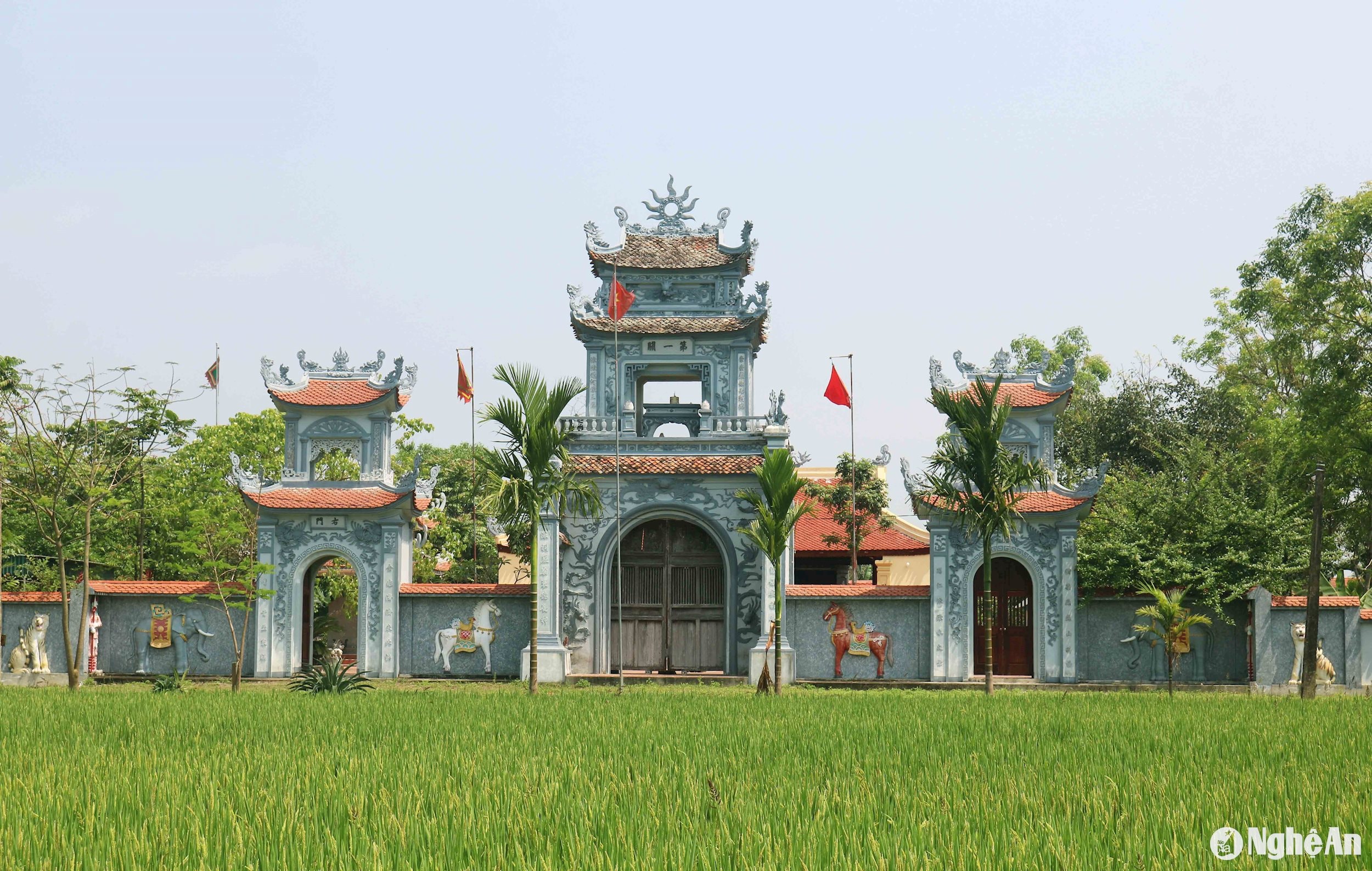
The First Temple is a spiritual architectural structure built during the Le Dynasty, located at the beginning of the First Village, comprising the following structures: the triple gate, the main hall, a well, and the Van Hoi stele.
The triple-arched gate is built in a tiered, three-story, eight-roofed style, gradually sloping upwards. The first level is constructed in the style of a city gate, with a rounded archway. Above the lintel is a fierce tiger figure. On either side are bas-reliefs of two phoenixes with their wings spread, facing towards the center.
Adjacent to the front of the first floor are two side wings adorned with bas-reliefs of two gatekeeper generals, one representing civil affairs and the other military affairs. Immediately in front of the wings is a pillar, constructed in the style of a square pillar tapering at the base, topped with a four-sided, star-shaped ornament, with couplets inscribed on all three sides of the pillar.
The second floor is smaller than the first, with a structure similar to the first, but the windows are no longer arched; instead, they are square windows with geometric patterns forming a decorative screen. Above the second floor is a roof covered with scale tiles, with four curved eaves adorned with four dragons facing in four directions.
The third level is the top level, with a structure similar to the first and second levels. In the center of the roof of the triple-arched gate is a sun-shaped sculpted figure, while the two ends are adorned with swirling cloud patterns.
Upon entering, you'll find the temple well, located to the east of the temple, within the grounds of the sanctuary.
The Văn Hội stele is located to the west of the temple. It is rectangular in shape, with stylized floral patterns along its border, and the text of the inscription is carved in the center.
The temple courtyard is paved with cement, forming an open-air space between the central and lower halls. Next to it is a garden planted with shade trees such as Bodhi trees, Ficus microcarpa, Ficus benghalensis, and eucalyptus.
The main hall, located at the back, is a two-bay, three-truss structure arranged into three worship areas. The central area consists of two bays. The outer bay is furnished with three layers of incense burners and altars, followed by two ancient altars made of jackfruit wood, painted red. On the altars rests an ancient lotus throne, flanked by two candlesticks, with a statue of Ksitigarbha Bodhisattva in the center. The inner bay contains a worship platform supported by a main pillar, arranged in two layers of worship. The outer layer houses statues of the Inspector and Supervisor. The inner layer is a shrine, which holds the ancestral tablet of Sat Hai Dai Vuong Hoang Ta Thon. The left-hand shrine is furnished with two altars of equal height. The first altar holds an incense burner, and the second holds the ancestral tablets of the deities.
In the center is the ancestral tablet of the Eastern Eunuch, flanked by the ancestral tablets of the Local Guardian Spirits of Trung Phong But Giang, the Local Guardian Spirits of Hien Quang Linh Ung, the Local Guardian Deity of Ho Quoc Cong, the Local City God, and the Local Guardian Spirit of Linh Huu. The right side of the altar is dedicated to the Northern Eunuch, the Supreme God of Ngo Vuong, the Local City God, the Western Eunuch, and the Local Dragon Lord.
Having existed for hundreds of years, the First Temple is a typical and long-standing cultural and spiritual landmark of the people of Dien Nguyen commune in particular and the entire region in general. It is a place that marks and witnesses many historical events as well as cultural and religious activities of the local people over many centuries. Therefore, every year, on important holidays, a large number of people from the surrounding area come to attend. This also demonstrates the gratitude and the tradition of "drinking water, remembering the source" of the nation, contributing to the moral education of present and future generations.