
Duc Khanh Temple
(Baonghean) - Along Route 7b, passing through Canh village (Ta Ca commune - Ky Son district), there is a recently restored temple nestled under the canopy of a cluster of ancient banyan trees providing abundant shade. Locals commonly call it the Banyan Tree Temple, or Duc Khanh Temple.
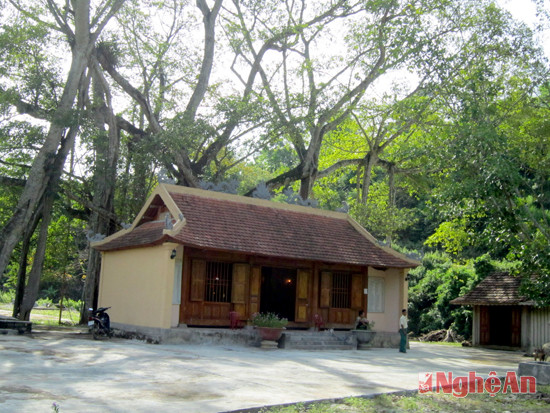 |
| Duc Khanh Temple is located in Ta Ca commune, Ky Son district. |
The temple is roofed with tiles, and most of its structural components are made of ironwood. According to Mr. Vi Van Van (82 years old), the temple was restored just over a year ago, mainly thanks to funding and efforts mobilized from agencies, businesses, and local people. The cluster of ancient banyan trees behind the temple, with their foliage forming a canopy and roots intertwined around the trunks, evokes a sense of enduring vitality and strong bonds.
Under the banyan tree, village elder Vi Van Van pondered, seemingly piecing together facts from his memory. Then his eyes lit up, and he recounted: “These banyan trees and this temple date back about four centuries, witnesses to a glorious and heroic period in the history of this borderland. All of this is connected to the merits of Duc Khanh, whom the people hailed as the King of the village…”
According to the village elder of Cánh village, around the mid-17th century, this place was still wild and overgrown, teeming with birds and wild animals, and inhabited by tribes. One afternoon, an elderly couple and their child stopped under a banyan tree by the roadside. The man cut wood to build a house, while the woman cleared land and sowed seeds. With his exceptional archery skills, the man helped the villagers hunt wild animals and organized hunting expeditions to domesticate them. He also guided the villagers in leveling hills and damming streams to create rice paddies. The name Tà Cạ (meaning "rice paddy" in Thai) likely originated from this. Life gradually became stable, prosperous, and peaceful. This man, named Đức Khánh, was revered by the local people as "King of the Village." Duc Khanh was originally a general of Kham Ong and Kham Ec (borderland chieftains), skilled in horsemanship and archery, and deeply devoted to his people and soldiers. When the northern invaders invaded the border region and established their rule, Duc Khanh and his wife fled with Kham Ong's son to escape the enemy's pursuit. Reaching the village of Canh, they realized it was a place where they could settle permanently, so they decided to establish a village and build a new life. To foster a spirit of building and protecting the village, and to prepare for foreign invasion, Duc Khanh regularly organized training sessions and held martial arts competitions and hunting contests. His reputation for skill and virtue spread far and wide, and people from that area immediately sought him out to live and work. From then on, the village of Canh became increasingly prosperous and bustling. Located beside the Nam Mo River, Duc Khanh advocated for helping the villagers build boats and open a market to develop trade. Before long, the place became a bustling scene of boats and people on the docks.
Duc Khanh passed away near the age of 100, leaving behind immense sorrow and the profound respect of the people of Ta Ca. To commemorate his merits and pass them on to future generations, the villagers contributed money and labor to build a temple. The temple was erected under the banyan trees where he once rested, with the Nam Mo stream flowing in front. The villagers called this temple the Duc Khanh Temple, or the Banyan Tree Temple. From then on, the Duc Khanh Temple became a center of spiritual and cultural activity for people throughout the region, a place to pray for peace, prosperity, blessings, and a good harvest. Around the beginning of the 19th century, a massive flash flood devastated the Ta Ca area, transforming what was once a flat plain into steep cliffs, swamps, and rocky areas. Ta Ca could no longer be a trading center, so the river port and market were moved to Phay village (present-day Muong Xen town). Some time later, the people returned to reclaim Ta Ca, rebuild the village, and did not forget to restore the Duc Khanh temple... Every year, in April, when the rainy season begins, the people of Ta Ca organize the Duc Khanh temple festival to pray for a peaceful and prosperous life!
Tuong Anh


