Quả Sơn Temple and its priceless artifacts
(Baonghean)Quả Sơn Temple is located on the banks of the Lam River in Bồi Sơn commune (Đô Lương district, Nghệ An province). This is a sacred temple dedicated to Uy Minh Vương - Lý Nhật Quang, the eighth son of Lý Thái Tổ Công Uẩn, the founder of the Lý dynasty.
|
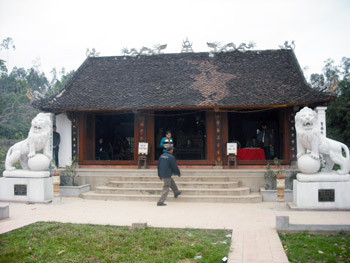
Legend has it that in his youth, he was mentored by the King and Queen to become a pillar of the nation. From 1039, he was sent by the court to Nghe An to oversee tax collection and was later officially appointed as the district chief. During the 16 years from 1039 to 1055, under the reigns of Emperors Thai Tong and Thanh Tong, Uy Minh Vuong - Ly Nhat Quang dedicated his entire life to the cause of national restoration.
He rendered great services to the imperial court and the people of Nghe An. Despite his challenging role as the southernmost frontier of Dai Viet, Ly Nhat Quang successfully defended the borders, issued decrees, and won the hearts of the people. He vigorously developed production, transforming the border region into a prosperous and secure base, providing reliable support for many subsequent dynasties.
|
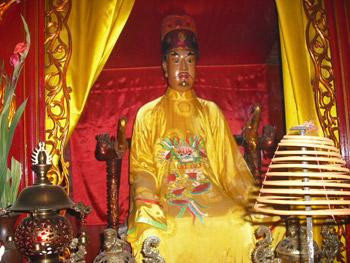
Ly Nhat Quang passed away in 1058. After his death, the people of Nghe An province built dozens of temples to offer incense. The Qua Son Temple in Boi Son commune is the main one. In remembrance of his contributions, people from all over the country come to light incense at the Qua Son Temple throughout the year, especially at the beginning of spring, when locals and tourists come to offer incense to commemorate his virtues and pray for a prosperous new year.
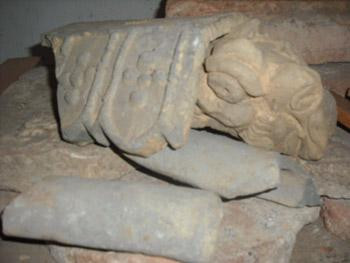
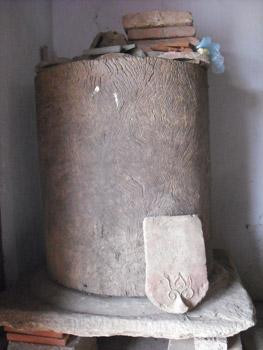
Currently, the architecture of Quả Sơn Temple is quite modest compared to its original form. According to historical records, the temple had a massive structure with 7 buildings, 40 rooms, and a palace. To prove this, the temple still preserves a stone base for a column and a section of a wooden column that was once hollowed out by locals to use as a rice storage bin. In addition, there are Lý Dynasty-era roof tiles measuring 20 x 30 cm, very thick fired clay bricks, and decorative motifs made of very light yet durable materials.
|
|
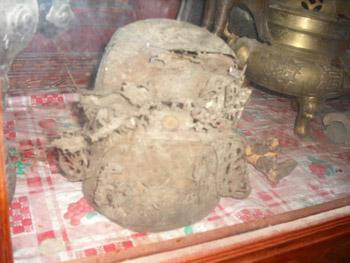
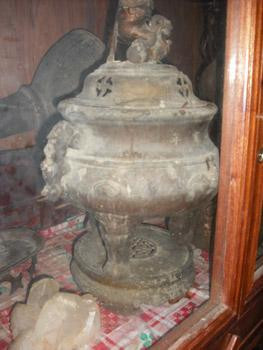
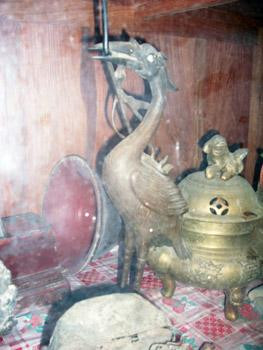
Furthermore, the Quả Sơn Temple currently preserves many ancient artifacts, notably an incense burner, a bronze hat, two ancient wooden and bronze loudspeakers used to command soldiers, a very ancient Champa bronze statue, and a betel tray. Recently, in the Bạch Ngọc area of Bồi Sơn commune, the people unearthed a bronze coin jar named "Cổ càn Phù Nguyên Bảo," minted in 1042, and "Minh đạo Không Bảo," minted in 1043. This shows that even at that time, Lý Nhật Quang was very interested in commerce and used currency for trade.
The ancient artifacts at Quả Sơn Temple are numerous and have been entrusted to trusted individuals for safekeeping. In addition to the artifacts at the temple, there are many other valuable items such as: three ancient silver swords, a tea set made of ivory, etc.
Besides the artifacts, the most important aspect of Quả Sơn Temple is that it is dedicated to Uy Minh Vương - Lý Nhật Quang, who had a special relationship with the Lý dynasty – a crucial figure in Đại Việt. According to the temple's historical records: After the victory over Champa in 1044, on his way back to Nghệ An, King Lý Thái Tổ left Đông Chinh Vương Lý Lực and Dực Thánh Vương (whose given name is unknown) to assist Lý Nhật Quang. These were half-brothers... Thus, the Lý dynasty at that time left three princes with the people of Nghệ An.
|
|
|
Nearly 1,000 years have passed, and dynasty after dynasty, generation after generation, have always revered the merits of Ly Nhat Quang.
Visiting Quả Sơn Temple amidst the fragrant spring of the Year of the Ox, the people of Nghe An province offer gifts and incense to express their gratitude to the hero of the nation-building era, the patron saint of the entire region, and also the person who helped the people of Nghe An develop strongly in terms of socio-economic aspects.
The Quả Sơn Temple Festival will take place from January 20th to 21st. This festival will commemorate the 1,000th anniversary of Thăng Long - Hanoi.
Text and photos: Le Ngoc Phuong