
Is it time for Vietnamese people to use 100% imported, cheap cars?
By relying solely on importing components for assembly, Vietnam's automotive industry has essentially failed. Car manufacturers prioritize importing vehicles for quick profits. The development strategy and plan recently approved by the Prime Minister are facing numerous challenges.
Should we shut down domestic production and switch to importing?
The Ministry of Finance has just submitted to the Government a long-term policy for the development of the automotive industry, which includes a roadmap for reducing preferential import taxes on passenger cars under the ASEAN Trade in Goods Agreement for the period 2015-2018. Specifically, import taxes on passenger cars will gradually decrease from the current 50% to 40% in 2016, 30% in 2017, and 0% in 2018.
In addition, this Ministry also provided feedback to the Ministry of Industry and Trade on tax policies and the implementation of the Strategy and Planning for the development of Vietnam's automotive industry.
In the near future, Vietnam will have to implement a series of tax reductions on imported automobiles. According to WTO commitments, import taxes on all types of automobiles will be reduced from 100% to 70% seven years after joining. Under the Trans-Pacific Economic Partnership Agreement (TPP), once negotiations are complete and Vietnam joins, import taxes on passenger cars within the bloc are expected to be reduced to 0% by 2026.
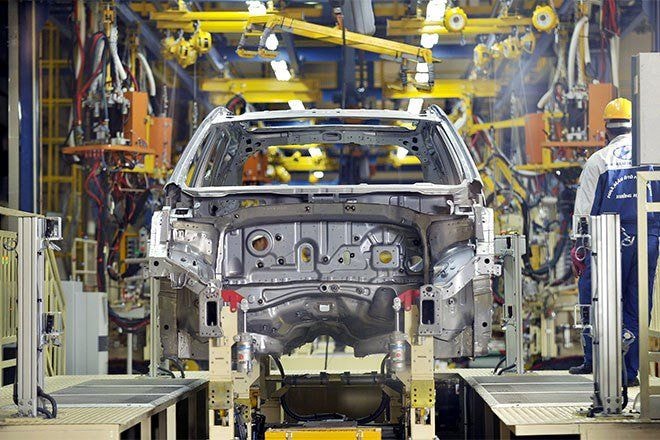 |
| The main reasons why Vietnam's automotive industry is not progressing well are primarily due to tax policies and capital constraints. |
Furthermore, according to the WTO accession commitments, there should be no discrimination between domestically produced goods and imported goods. Therefore, the Ministry of Finance believes that protectionism for domestic businesses is unsustainable. Domestic businesses need appropriate strategies and steps.
Upon receiving this information, some automotive businesses commented that perhaps the best adaptation would be to cease all production and switch to importing and distributing, even if import tax rates on automotive components are reduced to 0% in the near future.
Currently, importing a complete car from Thailand to Vietnam, including insurance, costs only about $400, and from Japan about $500. Meanwhile, importing components doesn't cost much less, and requires disassembly and reassembly, incurring significantly higher costs for labor, land, factory space, utilities, and equipment depreciation. Therefore, importing is actually more profitable than investing in domestic production.
The Vietnamese automotive industry can be considered a failure. The development strategy and plan, approved by the Prime Minister in late July/early August 2014 with many ambitious goals, probably only exist on paper.
Mr. Bui Ngoc Huyen, Director of Xuan Kien Automobile Joint Stock Company (Vinaxuki), believes that the main reasons why Vietnam's automobile industry is lagging behind are primarily due to tax policies and capital constraints.
I only like assembling things.
According to Mr. Huyen, Vietnam's current policy for the automotive industry only prioritizes assembly and does not encourage production or increase localization. Businesses only need to import component kits to assemble cars and receive preferential import tax rates that are 1/2 to 1/3 lower than importing complete vehicles.
Under this policy, businesses only need to invest in a simple, low-cost production line, perform the final four stages—welding, painting, assembly, and inspection—and then import all the components to assemble cars in order to receive tax incentives.
"This will not encourage businesses to promote localization. If incentives are only given for assembly, it will be difficult to develop an automotive industry, because assembly only accounts for 6% of the value of a car," Mr. Huyen said.
Similarly, excise tax is calculated based on the selling price of the vehicle. With this method of calculation, automotive businesses don't need to push for localization. Countries in the region levy excise tax based on the import invoice of component sets. For example, if a business imports 100% of the car components for assembly at a price of $10,000 per set, the cost will be high when subject to a 45% excise tax. However, if a business localizes 50% of the components and only imports 50%, the cost will be less than half.
In other words, the more domestic production and the less imports, the less excise tax is levied. This approach will help businesses achieve a high localization rate, reduce costs, and increase competitiveness without violating the regulations of signed trade agreements.
“Previously, I have repeatedly suggested that if any automobile company achieves a 40% localization rate, the special consumption tax should be immediately reduced by 50% to encourage it. The Ministry of Industry and Trade strongly agreed, but the Ministry of Finance shook its head. In other countries, when the localization rate increases, the tax is definitely reduced,” Mr. Huyen said.
The production of core components such as car bodies, shells, and engine gearboxes has not received much attention. Even if businesses invest in production, they do not receive incentives. For example, Vinaxuki invested in and domestically produced the entire chassis of 5-8 seater vehicles, achieving a localization rate of 39%. The company also manufactures some components and purchases them from suppliers in Vietnam, achieving an overall localization rate of 53%, but received no incentives. Businesses still have to borrow commercially, at times with interest rates as high as 20% per year, to import equipment and machinery, while the profit margin in this industry is less than 10%.
Meanwhile, to encourage the production of car bodies and increase the localization rate, businesses in many countries are offered preferential loans of $100 million over 20 years, and if they manufacture engines, they can borrow another $100 million, also for 20 years. This policy, however, is not yet in place in Vietnam.
Moreover, Vinaxuki had sufficient assets to mortgage for bank loans, but the banks refused to lend because, according to them, localization was not feasible, risky, and unstable. Conversely, there are automotive companies that lack technology, have nothing at all, and barely meet the standards for manufacturing cars, yet they can borrow 500-700 billion VND to import parts to Vietnam for assembly, or import complete vehicles for sale.
Because of the mindset that "Vietnam can't make cars, this industry is only for foreign countries," we will never have a real automotive industry, Mr. Huyen said.
According to VietNamnet


