
Weaving together "Threads of remembrance, threads of affection"
(Baonghean) - In 2013, a prominent achievement in foreign affairs was the completion of the reinforcement and renovation of the border marker system along the entire Vietnam-Laos border after six years of arduous construction. The completion of the border marker system, thanks to the efforts of the Party, State, and people of both countries, further enhances the special and unwavering friendship and solidarity between the two nations. Immediately following the solemn inauguration ceremony of the border markers, twinning activities continued. The border markers have, are, and will continue to elevate the cooperative relationship to new heights.
(Baonghean) - In 2013, a prominent achievement in foreign affairs was the completion of the reinforcement and renovation of the border marker system along the entire Vietnam-Laos border after six years of arduous construction. The completion of the border marker system, thanks to the efforts of the Party, State, and people of both countries, further enhances the special and unwavering friendship and solidarity between the two nations. Immediately following the solemn inauguration ceremony of the border markers, twinning activities continued. The border markers have, are, and will continue to elevate the cooperative relationship to new heights.
 |
| Leaders of the Ministry of Foreign Affairs and provincial leaders welcomed the Lao Prime Minister at Vinh Airport. Photo: Sy Minh |
The arduous journey of marking the boundaries.
To complete the reinforcement and restoration of 116 border markers along the 419.5 km border between Nghe An province and the three provinces of Hua Phan, Xieng Khouang, and Bolikhamsai in Laos, according to the plan and schedule of the Joint Border Demarcation Committee of the two countries, Nghe An province established Border Marker Team No. 1 in December 2008, and Border Marker Team No. 2 was established in October 2010. Fulfilling the sacred task entrusted by the two parties and two states, the two border marker teams from Nghe An and the two border marker teams from Laos have coordinated closely and harmoniously to overcome countless hardships, challenges, and dangers in building the border marker system.
The border between Nghe An province and the three aforementioned provinces of Laos is very long and has complex, rugged terrain, far from the indigenous communities, with many places virtually untouched by human footprints. Those responsible for marking the border had to rely on sheer willpower, a strong sense of responsibility, patriotism, and international friendship to complete their assigned task. During the construction of the 116 border markers, we accompanied the two teams many times. The lowest point was at least 700-800 meters, while the highest reached 1,800 meters, notably Phuxailaileng peak at 2,711 meters, known as the "roof of Indochina." Some markers took five consecutive days to reach, requiring sleep in the forest. Mosquitoes, flies, leeches, and snakes became their companions, leaving their mark as mottled marks on the bodies of the border markers. During the dry season, water was extremely scarce, only enough for cooking; brushing teeth and washing face was impossible.
The thick fog was so dense it felt like it was being cut into pieces, making it impossible to get separated. During the rainy season, streams and floods submerged everything, pushing everything back. In winter, the high mountain passes were windy and freezing cold, the biting chill making one's skin turn purple. It was common to be stranded for two or three days in the forest because floods cut off the streams. In many sections, the mud was dozens of centimeters deep, but one had to wade through it barefoot, because wearing shoes would make it impossible to lift one's feet. Climbing mountains and crossing waterfalls, the person in front could smell the heels of the person behind; carelessness could lead to slipping and trampling the person behind, extremely dangerous. Because of the relentless marching and continuous surveying of landmark positions in the field, many people collapsed from exhaustion, too tired to even eat.
Just the luggage alone—food, equipment, hammocks—each person had to carry 30kg. That's not including the loads of iron, stone, and cement needed to build the markers. It's estimated that constructing one marker requires transporting about 12 tons of various materials. Transporting just one medium-sized marker to its intended location requires 40-50 people. Of those, about 20 people carry the large granite blocks on their shoulders, and about 10 use ropes to hold the marker in place to prevent it from sliding down the slope. Coordinating so many people smoothly in the hilly terrain is no easy feat. Furthermore, there's a strict requirement that during the movement and securing of the marker, no damage, scratches, or chipping should occur.
Lieutenant Colonel Phan Thanh Hong, Team Leader of Border Marker Demarcation Team No. 2, was all too familiar with hardship and danger, but he couldn't help but shudder at the experience of his mission in early January 2012. It was close to the Lunar New Year, but due to the mission, the Inter-agency Bilateral Survey Team still marched to survey and monitor border markers in Mon Son commune (Con Cuong district). This was an extremely difficult and arduous area; the markers were very far from populated areas and located in strategically important positions. The team had to travel by both river by boat and by land, covering a distance of about 60 km. During periods of severe cold, they had to march along streams with waist-deep water for more than half a day. At an altitude of 1,525m, nighttime temperatures sometimes dropped to 4-5 degrees Celsius, making sleep impossible; the team could only rely on fires for warmth. The survey of these two markers took more than 10 days. During those days, the entire group never saw the sun, only thick fog that made it impossible to see each other's faces even at a distance of 2-3 meters, and our clothes were always soaking wet. In some sections, due to the extreme fog and dense forest, the satellite navigation system lost signal and couldn't observe the terrain, causing the entire group to get lost and descend the mountainside. It took us two hours to climb back up. Tripping, falling, and getting injured due to slippery, muddy paths were commonplace. By the time we completed our mission and returned to Post 555, it was already the 25th day of the Lunar New Year.
Despite the hardships and difficulties, not a single member of the border demarcation teams has abandoned their mission. Lieutenant Colonel Phan Van Hong, Team Leader of Border Demarcation Team No. 1, confided to the reporter, as if speaking to himself: "Every time we touch a newly erected border marker, the team members feel an overwhelming sense of pride – the Fatherland today is built by our hands; we feel even stronger to continue traversing endless ancient forests untouched by human footsteps, climbing towering mountain peaks to define new border markers"...
During the days we spent accompanying the two teams marking the border and beautifying the country's landscape, we felt and understood more deeply the hardships and dangers that those marking the border had endured. They considered the border their home, their homeland, always proud that every inch of their country's land was protected sustainably by their own sweat and effort. The joint efforts of our Lao friends on the border marking journey showed us more clearly the noble friendship between the two nations. It was moments when Lao brothers and Vietnamese brothers shared a cigarette by the stream; huddled together over a map and beamed with smiles when the border marker was identified and surveyed; it was moments of eating, living, and working together, with our Lao doctors bandaging our wounded officers, Vietnamese officers carrying Lao officers with swollen joints, and both sides sharing a pot of undercooked rice.
Deep brotherly love
By July 2013, the border section between Nghe An province and three provinces of Laos had been completed. This also marked the completion of the work to reinforce and renovate border markers along the entire Vietnam-Laos border on the ground. The governments of the two countries decided to jointly organize a solemn ceremony to commemorate this significant political event, demonstrating the special solidarity and traditional friendship, cooperation between the two parties, two states, and peoples of Vietnam and Laos in general, as well as the good cooperation in resolving territorial and border issues between the two countries in particular, at border marker 460 in Thanh Thuy (Nghe An) - Nam On (Bolikhamsai) on July 9, 2013.
 |
| The cultural program celebrated the friendship between Vietnam and Laos. |
On the inauguration day, the weather was perfect – a slight fog in the early morning, but the sky gradually cleared and the sun shone brightly. A magnificent platform and stage were erected at border marker 460, marking the boundary between the two countries. A large crowd of people from both sides of the border gathered. Everyone, without exception, tried to gaze upon and touch this historic marker with boundless pride. In every glance and smile, a truth shone through: the marker was not erected to create separation, but to further emphasize the long-standing friendship between the two nations, "mountains connected, rivers shared"...
Mr. Koong Kham Duong Keo, Head of the News Department of Lao National Television, said: “The completion of the Vietnam-Laos border demarcation is an extremely important event, contributing to building a peaceful, friendly, stable, cooperative, and mutually developing border, creating favorable conditions for promoting socio-economic development in the border area in particular and the economic development of both countries in general.” Mr. Bun Vong Chon, Head of Chup Tong village, Xay Cham Phon district (about 20 km from border marker 460), shared: “Now that the border marker is completed so beautifully, I and the villagers will go back and spread awareness about preserving and protecting the shared border marker.”
People of both nations rejoiced to see the two states working together, overcoming numerous difficulties to build the border marker system between the two countries. The border is where bonds of remembrance and affection are formed, where all divisions, suspicions, and disputes may be eliminated. The completed border marker system affirms the determination for lasting unity and friendship, a precious fraternal bond. At the momentous ceremony, Prime Minister Nguyen Tan Dung and Prime Minister Thongsing Thammavong of the Lao People's Democratic Republic emphasized: The inauguration of border marker 460 at Thanh Thuy - Nam On border gate marks the completion of the work to reinforce and beautify the Vietnam-Laos national border marker system on the ground.
This is a significant event, contributing to ensuring border security and demonstrating the high level of trust, understanding, and consensus between the two parties, two states, and the people of the two countries. It is also one of the vivid proofs of the traditional friendship, special solidarity, and comprehensive cooperation between Vietnam and Laos, based on the principles of respect for each other's independence, sovereignty, territorial integrity, and legitimate interests, equality, and mutual benefit, for the benefit of the people of both countries. The parties, governments, and people of both countries are determined to build a friendly, peaceful, stable, cooperative, and mutually developing border.
With the new, modern, and enduring border marker system, the Vietnam-Laos border will forever remain a meeting place of friendship and close cooperation for the prosperity of both countries, worthy of the expectations of the people and fulfilling the determination of the leaders of both nations… Si Von, from Nong Het, Xieng Khouang province, currently a postgraduate student in the Faculty of Educational Management, class of 20, representing over 300 Lao students studying at Vinh University, shared: This event demonstrates that cooperation between Laos and Vietnam is increasingly elevating in all areas of defense, security, foreign affairs; trade, education cooperation, and human resource training. Coordination and cooperation in all fields between the two countries have been continuously strengthened and achieved high effectiveness.
Looking back at the development of the Vietnam-Laos relationship, we can see even more clearly that every step forward, every victory of the revolution in each country, is closely linked to the flourishing development of the traditional friendship, special solidarity, and comprehensive cooperation between Vietnam and Laos. I firmly believe that the traditional friendship, special solidarity, and comprehensive cooperation between Vietnam and Laos will forever be preserved and nurtured as President Kaysone Phomvihane wished: "Mountains may wear away, rivers may dry up, but the friendship between Laos and Vietnam will forever be stronger than mountains and rivers"; and that relationship will continue to bear fruit for the benefit of the people of both countries, and for peace, stability, cooperation, and development in the region and the world.
Joining hands in a big circle
The celebratory event held in Nghe An was considered a significant highlight, not only because the province has the longest border in kilometers along the Vietnam-Laos border, but also because it represents the trust placed in it by the governments of both countries. Following this event, the People's Committee of Nghe An province proposed organizing a twinning program between border communities in Nghe An. The provinces sharing the border – Hua Phan, Xieng Khouang, and Bolikhamsai – of the Lao People's Democratic Republic unanimously agreed and jointly signed a memorandum of understanding in Vinh City in August 2013. Six pairs of neighboring villages were selected as pilot projects before expanding the program. The twinning program focused on specific issues: coordinating efforts to raise awareness among the people on both sides of the border about the policies and laws of each country, especially regarding territorial sovereignty and national borders according to the agreements and border regulations signed by the two countries; Mutual assistance in exchanging learning experiences on leadership, management, and operation of grassroots political systems and tasks related to managing and protecting territorial sovereignty and maintaining security and order in villages and hamlets; Cadres and people on both sides of the border cooperate in protecting the integrity of the border line and preserving the national border marker system; Regularly monitor the situation related to security and order and proactively and promptly exchange information, while coordinating efforts to prevent illegal border crossings, infringements of territorial sovereignty, resource exploitation, and environmental damage on both sides of the border; Strengthen coordination in preventing illegal migration, illegal religious activities, drug trafficking and use, human trafficking across the border, and other violations of the law…
Implementing the policy of establishing sister-village relationships between border villages of the two countries, the Party Committees and authorities of border districts, along with the Border Guard forces along the 419.5 km border in the province, have closely coordinated with functional forces, authorities, and people of Lao ethnic groups to carry out bilateral activities. In the final days of the year, working teams from the Thanh Thuy Border Gate Border Guard Station have closely coordinated with the Nam On Police Station, Xay Cham Phon district, Bolikhamsai province (Laos) to strengthen efforts to mobilize the people of Xop Tang village (Nam On cluster) and the people of Hamlet 3, Thanh Thuy commune, to prepare for the establishment of sister-village relationships. Accordingly, the people on both sides of the Thanh Thuy-Nam On border gate will enhance exchanges, trade, and share experiences in socio-economic development, and together protect and build a peaceful and friendly border. Mr. Xay Kham Di, Head of the Nam On Police Station (Bolikhamsai - Laos), said: “Xop Tang village is over 25 km from the border gate, so if people want to cross over to interact with Hamlet 3 - Thanh Thuy, they have to travel dozens of kilometers. The current difficulty is that the road on the Nam On side is not yet paved and is still muddy, but the people are still enthusiastically preparing for the fraternal relationship between the Vietnamese and Lao people on both sides of the border. In the future, when the road is built, all trade activities will be more convenient and there will be more exchange activities between the people of the two sides.”
 |
| Signing ceremony for the two copies (Vietnam - Laos) |
On the morning of November 30th, a ceremony to establish a fraternal relationship between villages took place in Muong Phu hamlet, Thong Thu commune, Que Phong district, Nghe An province, between Muong Phu hamlet, Thong Thu commune, Que Phong district, and Nam Tay hamlet, Vieng Phan cluster, Sam To district, Laos. During the ceremony, the two village chiefs signed a commitment to jointly mobilize the local people to actively participate in protecting the integrity of the border line, border markers, and border boundary signs; protecting territorial sovereignty; maintaining political security and social order in the border area; countering subversive activities by hostile forces; and promptly detecting and preventing all types of crime.
Also at the ceremony, the two villages unanimously committed to not constructing any projects that would alter the flow of rivers and streams on both sides of the border. They pledged to cooperate in implementing the border agreements and regulations signed by the two countries in the area. In addition, the people of the two villages will help and support each other in economic development, poverty alleviation, disaster relief, healthcare, preserving ethnic cultural identity, and learning from each other in leadership of local governments and organizations to gradually improve the material and spiritual lives of the people, building a stable, peaceful, friendly, cooperative, and developing border region... On December 10th, in Muong Tip commune, Ky Son district, the ceremony of establishing a fraternal relationship between Ta Do village, Muong Tip commune, and Na Muong village, Pha Ven cluster, Noong Het district, Xieng Khouang province, took place in a warm atmosphere of solidarity and friendship. Following Muong Tip commune, the remaining 10 border communes of Ky Son district will organize the signing of agreements with the neighboring districts.
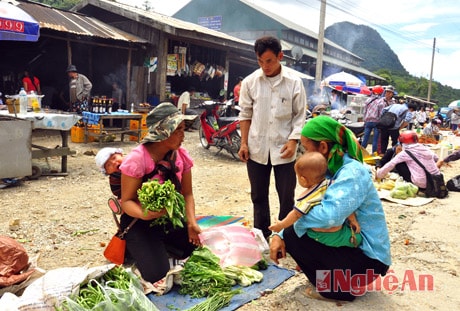 |
| Vietnamese and Lao people shopping at the Nam Can - Noong Het border market. Photo: Tran Hai |
Based on mutual trust and understanding, the sister villages are achieving many positive results in various fields. This is one of the people-to-people diplomatic activities aimed at further strengthening the friendship between the two brotherly countries, Vietnam and Laos. The sister village relationship between the people on both sides of the border further strengthens the close ties of kinship and ethnicity, with similar cultures, and deepens the Vietnam-Laos relationship that was founded by President Ho Chi Minh and President Kaysone Phomvihane. Both sides also cooperate closely in training and developing cadres, wholeheartedly helping each other develop socio-economic aspects...
In a continuous and seamless process, the Party Committee and people of Nghe An province have closely coordinated with the provinces of Bolikhamsai, Xieng Khouang, and Hua Phan (Laos) to strengthen fraternal ties, jointly develop the economy and society, and protect and build a border line steeped in friendship. This strong bond opens up many avenues for development in the border region – where the people of the two countries have long had close ethnic and kinship ties, supporting each other through thick and thin. Soon, in addition to the Nam Can International Border Gate, the Thanh Thuy-Nam On International Border Gate will open, and trade with neighboring Lao provinces at the Tam Hop (Tuong Duong), Cao Veu (Anh Son), and Thong Thu (Que Phong) border gates will be strengthened, thus elevating cooperation and fraternal ties between the two sides to a new level.
Thanh Chung - Nguyen Son


