
Walking along the spring road…
Only a few days remain until the Lunar New Year of the Rat. We traveled along the western branch of the Ho Chi Minh Trail, from Khe Sanh, Lao Bao - Huong Hoa (Quang Tri) to Minh Hoa, Tuyen Hoa (Quang Binh), through Huong Khe, Huong Son (Ha Tinh)... to Nghia Dan (Nghe An) and then back up to Que Phong, into Nam Giai - where the devastating flash flood of early October 2007 still leaves its mark...
NAO -Only a few days remain until the Lunar New Year of the Rat. We traveled along the western branch of the Ho Chi Minh Trail, from Khe Sanh, Lao Bao - Huong Hoa (Quang Tri) to Minh Hoa, Tuyen Hoa (Quang Binh), through Huong Khe, Huong Son (Ha Tinh)... to Nghia Dan (Nghe An) and then back up to Que Phong, into Nam Giai - where the devastating flash flood of early October 2007 still leaves its mark...
Ho Tan Nhac, Secretary of the Huong Hoa District Party Committee, recently attended a New Year's meeting with central and local journalists organized by the district. He enthusiastically stated: “Currently, the dossier for the district's nomination for the title of Heroic Unit in the Renovation Period has been completed. The Khe Sanh Economic-Defense Zone project and the Lao Bao Special Economic Zone project have proven effective, making positive contributions to socio-economic development and strengthening local defense and security… Recently, in coordination with the border guards, we have reinforced the communes with border guard officers serving as permanent deputy secretaries to further enhance the fighting capacity and leadership of the Party committees and grassroots Party organizations.”
Forty years ago, on this very land, the Route 9 – Khe Sanh campaign was launched, with the strategic objective of drawing the main US-puppet forces westward through Quang Tri, creating favorable conditions for the countryside, plains, and cities to launch the general offensive and general uprising of the Spring Offensive of 1968… The victory at Lang Vay has been recorded in history – according to Major General Tran Van An, former Deputy Political Commissar of the 325C Division – as having strategic, operational, and tactical value. In particular, the gunfire at Lang Vay contributed to creating the momentum and strength for the troops and people of the plains and cities of the Tri Thien – Hue battlefield to bravely attack and rise up in victory.
|
We stopped by the victory monument on the hilltop of Vay village. A warm, vibrant red earth stretched across the landscape. A tank silhouetted against the sky. In the distance, lush green forests, verdant coffee and rubber plantations stretched as far as the eye could see… On either side of the road, vast fields of white reeds swayed in the cold late-winter wind, heralding the arrival of spring in the Trường Sơn mountains. The Vân Kiều and Pa Cô people diligently carried heavy baskets of firewood and cassava up the steep slopes leading to their remote villages… After crossing the Sa Mù pass, we were surprised by the midday crowing of wild roosters on the Trường Sơn mountain peaks, amidst the thick fog and rustling mountain winds. The road was damp, covered in green moss, and slippery. Huân, a former artillery driver in the army, gripped the steering wheel firmly, guiding the cart inch by inch… At the foot of Sa Mù, the barracks of Production Team 8 of the B37 Economic-Defense Group (Military Region 4) was hidden in the fog. The elders recounted: Once upon a time, this was a bustling village of the Van Kieu people, the only remaining traces being the large jackfruit trees and the fields on the mountain. But then a terrible malaria epidemic wiped out two-thirds of the villagers. The people believed it was a place of "poisonous water," forbidden by the spirits, and they all left… Only the B37 soldiers marched in to build a camp, holding their ground in the Truong Son Mountains to carry out their duties… The production team had five people, all five were struck down by malaria, yet no one left their post…
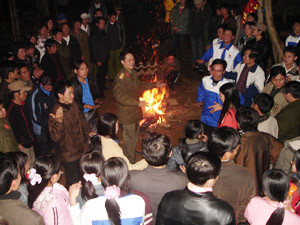
Spring is just around the corner, that's what we felt when we met the officers and soldiers of the Cu Bai border guard post, right on the Ho Chi Minh Highway, bringing branches of wild peach blossoms to the village for the villagers to celebrate Tet. The officers and soldiers of the Cu Bai border guard post remain steadfast here, eating, living, and working alongside the villagers; building and maintaining a peaceful and friendly border with our Lao friends… The Se Bang Hieng river meanders through the mountains and forests, life has revived on this land that was once a key target of American air attacks. Although there are still many difficulties and hardships, the people still wholeheartedly believe in the Party and the revolution.
|
We continued our ascent deeper into the Truong Son mountain range. Last month's floods caused landslides at dozens of points along the route, but most have been repaired. Only one point, 165 km south of Khe Gat (Quang Binh), remains in disarray: tens of thousands of cubic meters of earth and rocks have collapsed, cutting off the only access road. Two excavators, three bulldozers, and dozens of road management workers, seemingly oblivious to the approaching Tet holiday, tirelessly leveled the embankment and repaired the road. Our all-terrain vehicle, even with its 4x4 engaged, couldn't climb the hill on its own and needed the help of a 175-horsepower bulldozer...
Arriving in Tuyen Hoa (Quang Binh province), the area most severely affected by the recent storms and floods, we witnessed the extraordinary efforts of the local Party committee, government, people, and armed forces in overcoming the consequences of the natural disaster. Chau Hoa commune, located across the Nguon Tro River, is isolated like a deserted island. The Chairman of the Chau Hoa Commune People's Committee informed us that, as of January 2008, the total amount of relief rice provided to the commune was 188 tons, along with 117 million dong in cash and many other essential goods. The commune has a plan to assist 150 poor households at risk of food shortages from now until after the Lunar New Year. The commune Party committee has issued a resolution on planting winter corn and vegetables to combat hunger on an area of over 40 hectares. On the fields of Chau Hoa commune, we saw the green color of rice seedlings and young rice plants spread everywhere. The people believe that the new harvest will be bountiful!
The Ho Chi Minh Trail led us through Huong Khe and Huong Son (Ha Tinh province), where the only remaining traces of the severe flooding in early August 2007 were faint streaks of water across house walls and large tree stumps uprooted and eroded by the flood along the roadside. Along the banks of the Ngan Sau and Ngan Pho rivers, lush green cornfields and smooth rice paddies stretched out. The villages were peaceful… We then followed the Ho Chi Minh Trail to Nghia Dan (Nghe An province), then up to Que Phong, and into Nam Giai…
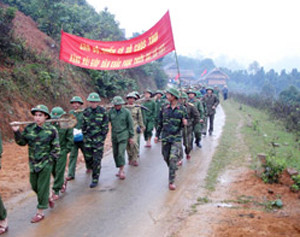
The devastating flash flood in early October 2007 plunged Nam Giai into grief, sorrow, and destruction. One hundred days have passed, and although many difficulties remain, the lives of the people are gradually stabilizing. On January 25th, Tet (Lunar New Year) gifts from the government and the Red Cross, along with hundreds of tons of relief rice, continued to be delivered to Nam Giai. On January 26th, 500 young volunteers began their journey to Meo and Puc villages to help the people overcome this hardship. We witnessed the emotional tears of the villagers during the Tet gift-giving ceremony for families who lost loved ones in the flash flood. Each gift package included 30kg of rice, cakes, and candies worth 100,000 VND, plus 1,000,000 VND from the Red Cross. The roads to Puc and Meo villages are being leveled to allow vehicles to reach even the most remote areas. On the newly opened road, innocent children play. Where the flood passed, the streambed has been leveled, and a thick layer of sand, 2-5 meters deep, has covered the fields. After the departure ceremony, the youth shock troops of the Nghe An Provincial Military Command, the main units of Military Region 4 stationed in the area, and local forces quickly fanned out to the most remote villages of Nam Giai. They shoveled sand and cleared fallen trees to restore the land for cultivation. They rebuilt the thatched roofs for mothers, constructed small bridges across the streams, and repaired village roads for children to get to school… The green of military uniforms and the green of volunteers blend with the spring colors of the mountains and forests, nurturing a new spring…
Traveling along the Ho Chi Minh Trail, the road through the majestic Truong Son mountain range, a road of miracles and legends. A new spring is coming!
Text: Tran Hoai; Photos: Hoang Hao



