
Millions evacuated due to storm.
Strong winds reaching up to 109 km/h from Super Typhoon Chan-hom began affecting the coastal areas of Zhejiang province, China, around noon on July 11th.
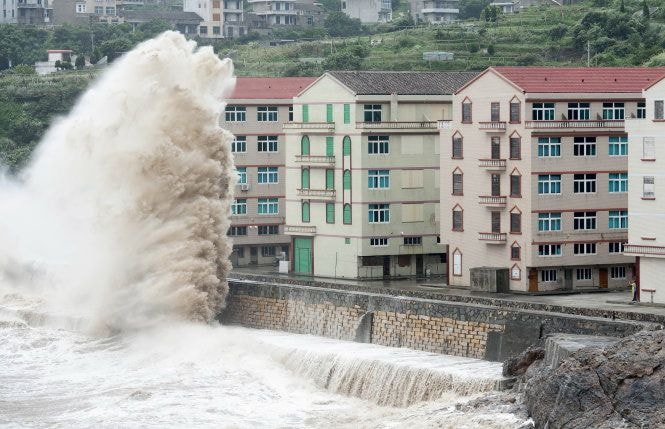 |
| High waves caused by Typhoon Chan-hom threaten residential areas in Wenling, Zhejiang province on July 10 - Photo: Reuters |
Yesterday morning, the Chinese government evacuated more than 865,000 people in eastern China as Super Typhoon Chan-hom headed towards Shanghai after sweeping through Japan's Okinawa island chain and Taiwan.
Xinhua News Agency reported that a total of 28,764 fishing boats docked in ports in Zhejiang province from 10 pm on July 10 to avoid the storm, while many cities in the province experienced heavy rain and strong winds. Taiwan was also affected by Typhoon Chan-hom, with heavy rain and strong winds.
AFP, citing information from the China National Meteorological Center (NMC), reported that Super Typhoon Chan-hom could be the strongest typhoon to hit Zhejiang province south of Shanghai since 1949.
The storm also killed five people in the Philippines earlier this week and injured more than 20 in Japan on July 10th when strong winds uprooted trees and damaged buildings. Four people were also injured when the storm swept through Taiwan.
The storm disrupted traffic and shipping routes between Taiwan and Zhejiang province, China. Approximately 100 flights and several bus and ferry services were delayed or canceled on July 10th.
The National Meteorological Center (NMC) predicts the super typhoon's path will sweep across Zhejiang, east of the financial capital Shanghai, and Jiangsu by noon today (July 12) with wind speeds reaching 210 km/h. Heavy rain and strong winds will affect neighboring Anhui and Fujian provinces.
Residents at coastal fish farms in Fujian province south of Zhenjiang also evacuated on the morning of July 10th when the NMC issued a red alert – the highest level for super typhoons.
Super Typhoon Chan-hom is the second tropical storm to hit China in two days, following Tropical Storm Linfa's devastation in southern Guangdong province.
Meanwhile, Typhoon Nangka began strengthening over the Pacific Ocean on July 11th and is expected to move northwest toward Japan's Ryukyu Islands in the coming days. The Japan Meteorological Agency predicts this typhoon will be very strong.
(According to Reuters/TTO)
| RELATED NEWS |
|---|


