
Historical sites and landmarks...
(Baonghean) - Returning to Nghe An, a land of outstanding people and rich cultural traditions and revolutionary struggles, friends from near and far often take the time to visit the hometowns of famous figures and revolutionary patriots to express their gratitude and learn more about the family backgrounds and childhoods in the place that "nurtured" the spirit of these predecessors...
The wooden bed and the first steps of President Ho Chi Minh.
In 2012, the Ho Chi Minh Memorial Area in Kim Lien commune was recognized as a Special National Historical Monument. Contributing to this special value are the documents, artifacts, and cultural and historical spaces related to President Ho Chi Minh's childhood and that of his family members (his father Nguyen Sinh Sac, his mother Hoang Thi Loan, his sister Nguyen Thi Thanh, and his brother Nguyen Sinh Khiem). Visiting this place is like entering a "sacred realm," filled with deep affection for the place where President Ho Chi Minh was born and spent his childhood. Each artifact here seems to evoke cherished memories of him, and viewing them inevitably brings tears to the eyes of those who see them.
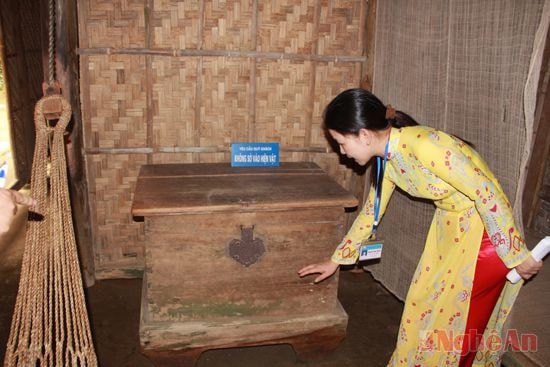 |
| The wooden bed frame is on display at the Kim Lien historical site. Photo: HP |
Visiting Hoang Tru, the ancestral home of President Ho Chi Minh's mother, tourists often stand thoughtfully before the time-worn wooden chest (or storage box) nestled in the corner of the small thatched house. This was the item that Mrs. Hoang Thi Loan used to store rice and other valuables of the family. In the old days, rice was scarce, so the chest was made very small, but it was a significant asset. It was part of the dowry her parents gave Hoang Thi Loan when she married, as a reminder to their daughter to be thrifty and save so that her family would not fall into poverty.
The wooden platform, placed next to the bed where President Ho Chi Minh was born and spent his childhood, is where he first learned to walk. As a toddler, Nguyen Sinh Cung would often lean on the platform to keep from falling; his steps gradually became steady... Thus, this small platform, used to store rice, witnessed the first tentative steps of President Ho Chi Minh. From those first steps beside that wooden platform, he ventured across the globe to find a path to national liberation. For this reason, the platform has become a precious artifact, both intimately familiar and deeply meaningful, possessing immense value.
During a visit to his hometown in 1961, to his mother's village of Hoang Tru, when he was 71 years old, Uncle Ho stood silently looking at the wooden bed, his eyes welling up with tears. He said to the officials and staff of the Management Board: "This is my mother's wooden bed! In the old days, my mother used to store rice and grain. You all have been so careful in preserving it..."
Visiting Kim Lien, President Ho Chi Minh's birthplace, tourists can also admire many other valuable artifacts and witness the simple life of his family and relatives in the past. These include thatched houses, old beds, bamboo benches, dish racks, looms, lush green gardens, and blooming lotus ponds... Along with "Hoang Tru, his mother's hometown, and Lang Sen, his father's hometown," visitors can also visit Dong Tranh Mountain in the Dai Hue mountain range, where Mrs. Hoang Thi Loan rests. Then, they can visit Chung Mountain, where President Ho Chi Minh often went as a child to herd buffalo, fly kites, and play mock battles.
The verdict of the top scholar...
Visiting the Phan Boi Chau Memorial House in Nam Dan Town (Nam Dan District), tourists will inevitably feel moved and touched by the quiet, peaceful atmosphere, evoking a sense of the simple life of a famous revolutionary patriot.
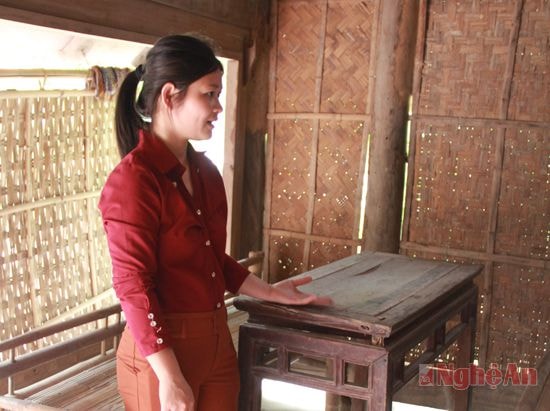 |
| The writing desk of Phan Bội Châu is on display at the Memorial Area. |
The thatched-roof house is where Phan Bo Chau was born and spent his childhood, where he taught his students, and where he reunited with his wife and children after more than 20 years of wandering in search of a way to save the country. The house currently preserves several valuable artifacts such as a writing desk, bookshelves, an ancestral altar, a wooden bed, a wooden platform, a long bench, a serving tray, a chest of household items, a rice storage bin, a rice mill, a sickle, a loom, and a silk spinning wheel...
Among the aforementioned artifacts, the writing desk stands out, a piece closely associated with the scholarly life of the patriot Phan Bội Châu. Legend has it that at this desk, at the age of six, Phan Bội Châu memorized the "Three-Character Classic" in three days; at seven, he wrote "Phan Tiên Sinh's Analects"; and at seventeen, he wrote "Bình Tây Thu Bắc"... These works vividly reflect the thoughts of a man deeply concerned about his time and the world, possessing the value of awakening people's hearts, inspiring patriotism, and guiding them towards a path of struggle to break free from the shackles of slavery.
Beside this very desk, Phan Boi Chau once lectured and graded papers for generations of students, and it was also the meeting place for him to discuss literature, current affairs, and the fate of the nation with like-minded individuals, including the "Four Tigers of Nam Dan" (comprising Phan Boi Chau, Nguyen Sinh Sac, Vuong Thuc Quy, and Tran Van Luong). This desk also witnessed the arduous study that led to his success, the determination to diligently pursue his studies to achieve academic excellence and find a way to save the country and its people, which helped Phan Boi Chau pass the Nghệ An examination (in 1900). From here, Phan Boi Chau gained further fame and status to awaken and unite the people, pursuing a great cause.
The Phan Boi Chau Memorial House currently covers an area of over 5,000 square meters, including two thatched houses, a statue of Phan Boi Chau, an exhibition hall, and a green garden. Besides the artifacts in Phan Boi Chau's thatched house, the exhibition hall also houses many valuable photographs, documents, original artifacts, and scientific materials that help us understand the basic aspects of the life and career of the patriotic scholar Phan Boi Chau. The lush, year-round green fruit garden provides a relaxing, rustic, and endearing atmosphere, deeply rooted in the culture of Nghe An province.
The small wooden plank and Le Hong Phong's final journey.
Hung Thong commune (Hung Nguyen district), not far from Vinh City, is the birthplace of General Secretary Le Hong Phong (1902 - 1942). The revolutionary leader has passed away, but his hometown still holds countless memories of his childhood and family. The memorial area is surrounded by green bamboo groves and vast fields. Here, a thatched house preserves artifacts that were once closely associated with the General Secretary's family. These include everyday items such as wooden platforms, wooden beds, benches, cribs, wooden chests, meal trays, and dish racks. Le Hong Phong was born and grew up in this house. This was also once a meeting place for revolutionary organizations in Vinh and Central Vietnam; where Party leaders met to discuss strategies during the revolutionary period of 1936-1939.
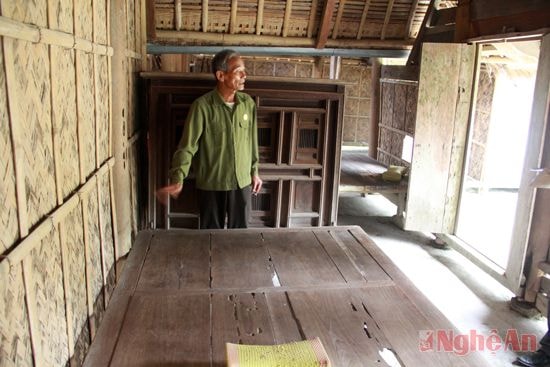 |
| The wooden platform where Comrade Le Hong Phong sat reading before his arrest. |
All the artifacts displayed in the thatched house evoke the simple yet orderly life of Confucian families of the past. Particularly noteworthy is the wooden bed frame, riddled with holes from termites and the ravages of time. On September 29, 1939, after being released from an imperial prison and under house arrest in his hometown, Comrade Le Hong Phong was arrested for the second time while sitting and reading on this bed frame. When the secret police burst in, Le Hong Phong only had time to ask to go into the inner room to get his hat before leaving. That was also his last departure, because nearly three years later (September 6, 1942), he died in Con Dao prison...
The wooden platform where Le Hong Phong sat before his capture was assembled from small pieces of wood, measuring 1.6 meters in length and 1.4 meters in width. His family, relatives, and friends preserved the platform in its original form, determined not to lose it, even through two fierce wars, so that today we have the opportunity to see it firsthand. Through this, we gain a deeper understanding of the courage and will of a leading figure in the Vietnamese revolution.
Next to the thatched house relic is a memorial area and a spacious, airy grounds with native trees such as pomelo, guava, and mango... The memorial area has recently been invested in and built in a grand and impressive manner, preserving valuable documents and photographs. Visitors will have the opportunity to admire photographs recreating the life and career of General Secretary Le Hong Phong, starting from his childhood to his departure to Thailand and China for revolutionary activities, then his time as a student at the Whampoa Military Academy (China), the Soviet Air Force School, the University of the East, attending the 7th Congress of the Communist International (1935) in the Soviet Union, and ending with his time in the Tiger Cage solitary confinement cell at Con Dao prison.
Phan Đăng Lưu's book chest
The Phan Dang Luu Memorial House Historical and Cultural Relic Site was formerly located in Dong Hamlet, Trang Thanh Village, and is now in Phan Dang Luu Hamlet, Hoa Thanh Commune (Nam Thanh District). The entire site is a beautiful space encompassing an old house nestled in a garden filled with flowers and fruit trees, a spacious and cool fish pond. This is the land where Comrade Phan Dang Luu was born and spent his childhood.
Phan Đăng Lưu's parents were patriotic and hardworking people. His adolescence was a beautiful time. After leaving his village and district schools, Phan Đăng Lưu studied in Vinh and then Hue. With a deep connection to the land and people of his homeland, Phan Đăng Lưu enrolled in the Tuyên Quang Agricultural School, hoping to acquire agricultural knowledge to help the people expand their agricultural practices. After graduating, Phan Đăng Lưu worked at the Nghệ An Department of Agriculture, then returned to the Đông Câu silkworm farm (Diễn Kim), the Linh Cảm silkworm farm (Hà Tĩnh), and the Lâm Đồng silkworm farm. Therefore, the house and garden, which serve as a memorial, are often referred to as the house of Mr. Phan Tằm (his son works as a civil servant at the large silkworm farms). Mr. Phan Tằm's house was built in 1929, with a yin-yang tiled roof, and has three main rooms and two upper floors; the upper floor is used for ancestral worship.
Upon entering the house, you immediately encounter a book chest – a relic preserving traces of Phan Đăng Lưu's childhood. This was where valuable professional documents and materials, books, and newspapers propagating revolutionary ideology were stored. The wooden chest at the memorial house can be seen as a memento, a repository of the dreams, aspirations, and ambitions of a steadfast and indomitable revolutionary fighter.
During his time working in Nghe An, Phan Dang Luu joined the Tan Viet Party and he himself returned to Yen Thanh to establish the Trang Thanh Tan Viet cell, kindling the first seeds of revolution there. During the years he spent away from home participating in revolutionary activities and until the day he died (August 26, 1941), Phan Dang Luu visited his hometown and his parents twice. Each time he visited home, he would open the chest of books as if searching for childhood memories, for peaceful days, to further sharpen the spirit and will of a revolutionary soldier.
Visiting the place where revolutionary Phan Đăng Lưu was born and lived the most beautiful days of his revolutionary life, you will preserve beautiful memories of a man, an intellect, a character who contributed to the glory of his homeland, Nghe An.
Temple of Literature by the Lam River
From Ro Bridge (Vo Liet commune - Thanh Chuong district), looking down the right bank of the Lam River, visitors will see an ancient and imposing communal house nestled amidst lush green rice fields. This communal house, named after the entire region - Vo Liet, is the place of worship for the tutelary deity Phan Da, a general of Le Loi, and also the meeting place of the Vo Liet Literary Society of the past. The communal house is also considered the Confucian temple of Thanh Chuong, bringing pride to generations born and raised in this land.
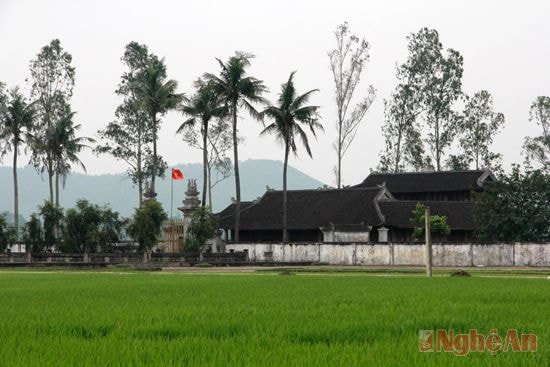 |
| Vo Liet Temple (Vo Liet commune - Thanh Chuong district). |
The Vo Liet communal house is considered the Confucian temple of Thanh Chuong, not only because it served as a gathering place for literary figures and scholars, but also because it houses two rows of stone steles with six stone tablets recording the names and hometowns of 455 scholars who passed the examinations from the Bachelor's to the Doctorate level in Vo Liet commune from the Later Le dynasty to the Nguyen dynasty. Perhaps this is why General Vo Nguyen Giap once wrote in a letter to the Party Committee and people of Vo Liet commune: "In a commune, in a district, few places have historical relics like this. I said: This is a very proud 'district Confucian temple' in our homeland; future generations must continue to uphold the tradition of studiousness of our ancestors."
According to historical records, the Võ Liệt Pavilion was designed and built by Hoàng Chính Trực. His father was an official in Hậu Lộc district, Thanh Hóa province, and often took his son to admire the scenery of Thăng Long, including the Temple of Literature. At the age of 28, Hoàng Chính Trực passed the Cử Nhân examination and built a structure similar to the Temple of Literature in his hometown with the aim of promoting learning. The Thanh Chương District Literary Association accepted this idea and entrusted him with the main task of implementing it in 1859. Legend has it that patriotic scholars in the region such as Phan Bội Châu, Nguyễn Sinh Sắc, Đặng Nguyên Cẩn... often came here to discuss literature and current affairs.
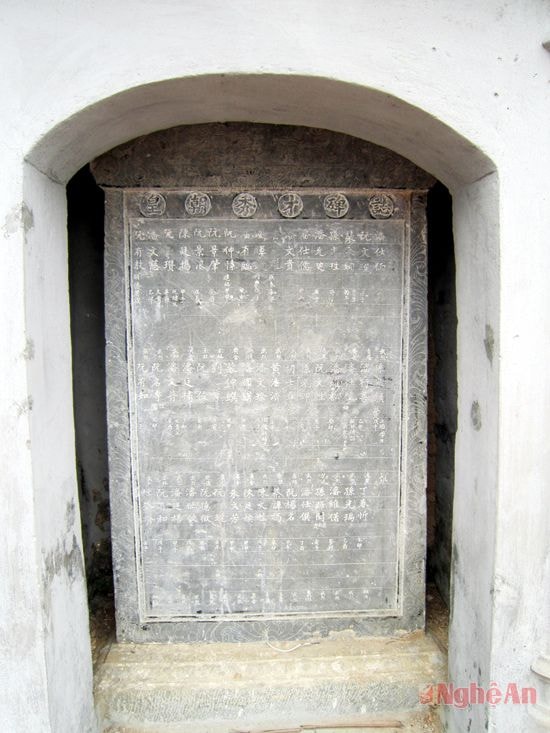 |
| The stone stele in front of Vo Liet communal house lists the names of those who passed the examinations. |
During the Soviet-Nghe Tinh Uprising (1930-1931), Vo Liet communal house was the gathering place for tens of thousands of people from Vo Liet commune and the communes of Bich Hao, Xuan Lam, and Dai Dong to march to the district headquarters to fight against the colonial and feudal regimes. The struggle was victorious, establishing a Soviet government and bringing faith and hope to all strata of the people. In the years that followed, Vo Liet communal house witnessed the restoration of the Vo Liet Party Branch (1940) and the Congress of Delegates of Zone 4, chaired by comrades Nguyen Chi Thanh, Ho Tung Mau, and Major General Nguyen Son.
Visiting Vo Liet Temple, tourists will admire the beauty and sophistication of its ancient architecture, creating a unique charm rarely found elsewhere. The surrounding scenery is harmonious and picturesque, with rivers, mountains, and vast fields further enhancing its ancient, sacred, and expansive atmosphere. At the same time, visitors can get a sense of the early revolutionary struggle under the leadership of the Party.
Cong Kien - Duc Tien


