
Nam Can is a bright spot.
Nam Can commune comprises 6 villages in the mountainous Ky Son district, with 343 households and 2,100 inhabitants, all of whom are Mong people. Due to the remoteness of the villages and difficult transportation, most school-aged children were previously unable to attend school because of safety concerns, especially crossing mountain passes and streams during floods. The number of students was small, with some classes having only 2-3 children. Therefore, Nam Can Primary School had to operate as a combined class system. Teaching and learning became even more challenging, and the quality of education remained stagnant.
(Baonghean)Nam Can commune comprises 6 villages in the mountainous Ky Son district, with 343 households and 2,100 inhabitants, all of whom are Mong people. Due to the remoteness of the villages and difficult transportation, most school-aged children were previously unable to attend school because of safety concerns, especially crossing mountain passes and streams during floods. The number of students was small, with some classes having only 2-3 children. Therefore, Nam Can Primary School had to operate as a combined class system. Teaching and learning became even more challenging, and the quality of education remained stagnant.
In recent years, thanks to the multifaceted attention of the Party Committee, the local government, and the border guards, the school has been divided into 6 school locations associated with 6 villages, creating favorable conditions for students to attend school. Currently, the school has 366 students in 24 classes. It is gratifying that most children of school age attend school; they are well-behaved and many are excellent students. In the 2011-2012 school year, 48 students achieved the title of Excellent Student at the school level; 6 students achieved the title of Excellent Student at the district level. The school has 14 teachers recognized as excellent teachers at the school level; 7 teachers recognized as excellent teachers at the district level. For many years, the school has been recognized as an Advanced Labor Collective; in the 2011-2012 school year, it was recognized as an Outstanding Labor Collective.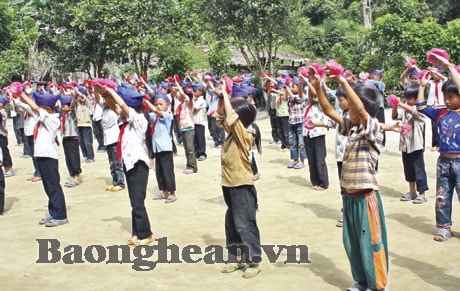
Physical education class for students at Nam Can Primary School.
The school in Nam Khien village is a prime example. It has 10 classes and 140 students. For many years, the village has ensured over 97% of children of school age attend school, with a high percentage of students achieving good or excellent grades, and nearly 100% of students achieving average or above-average grades annually. Thanks to well-organized primary education, the number of students in Nam Khien village continuing their education is steadily increasing. In the 2011-2012 school year, Nam Khien had 92 students attending junior high school, 78 students attending senior high school, and 8 students who are currently studying at colleges and universities in the province and at the central level.
Of the 40 teachers at Nam Can Primary School, 8 are Hmong, 3 are Thai, and the rest are Kinh. The biggest challenge is that the Kinh teachers do not know the Hmong language, while most of the first and second graders do not yet know the common Vietnamese language. The school has combined teaching the Hmong language to students to help preserve ethnic identity with teaching the Hmong language to Kinh teachers. As a result, most teachers in the school can now connect with the students, helping to improve the quality of teaching and learning.
Despite the complex terrain and difficult travel between campuses, the school leadership organized regular classroom visits and observation sessions, providing timely support and encouragement to teachers and students. The school focused on establishing good practices in all activities. As a result, students not only excelled academically but also received physical training and participated effectively in cultural activities. The school also made positive contributions to building cultural life in the villages.
Hong Quang Mausoleum


