
A pillar of support on the border
(Baonghean)Tri Le is a mountainous commune in Que Phong district, with a 17.5 km long border, adjacent to Phan Thoong and Pha Danh communes (Muong Quan district, Hua Phan province, Laos).
Four ethnic groups live together in the commune: H'Mong, Thai, Khmu, and Kinh; of which the H'Mong people account for more than 35% of the total population, mainly residing in villages along the border, in rugged terrain with difficult transportation.
Due to the nomadic farming practices of the Hmong people, their limited understanding of borders and national boundaries, and their close kinship with the Hmong people in Laos, the illegal migration of Hmong people from Tri Le to Laos is quite complex. Some individuals have exploited this free migration to cultivate opium poppies and traffic drugs.
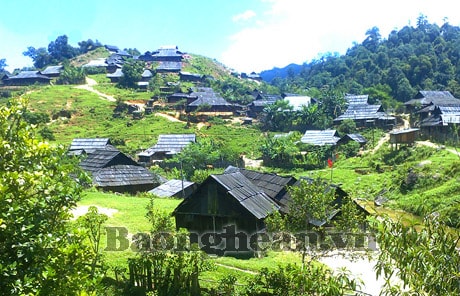
Huoi Moi village, Tri Le commune.
Faced with this situation, the Military Command of Que Phong district advised the District Party Committee and the District People's Committee to develop a plan, proactively coordinating with the 4th Economic-Defense Brigade, Tri Le Border Guard Station, and local departments to persistently stay close to the people and the area, implementing the "four together" principle with the people (eating together, living together, working together, and speaking the ethnic language together) to propagate and mobilize the people to not migrate freely, not replant opium poppies, and not engage in drug trafficking...
At the same time, the role of local forces, especially village elders, village chiefs, and militia and police officers in the villages, was promoted to promptly identify signs of spontaneous migration among the people and take preventive measures. In addition, the District Military Command, together with the Party Committee, government, and local organizations, effectively implemented policies to help people alleviate poverty, such as: mobilizing forces to help people reclaim barren land; going to each village and household to encourage people to develop rice cultivation from one crop to two crops; guiding people on techniques for growing rice, sugarcane, passion fruit, and raising buffalo, cattle, pigs, and chickens…
In particular, in June 2009, 118 households/875 people of the Hmong ethnic group who had illegally migrated to Laos returned en masse to their hometowns. After months of arduous struggle for survival in the remote, dangerous forests of a foreign land, they returned to their homeland facing countless difficulties: no housing, no fields to cultivate, etc. Officers and soldiers of the District Military Command, along with the commune militia, crossed mountains and forests to help the people build temporary houses, reclaim barren land, and persuade local residents to cede land for the newly returned families to cultivate. The district developed a plan and mobilized 120 Hmong households in the villages of Huoi Moi 1, Huoi Moi 2, Huoi Xai, Nam Tot, etc., to move to the Minh Chau New Economic Zone and coordinated with the 4th Economic-Defense Group to develop livestock and production models for the people to learn from.
After a period of persistent propaganda, mobilization, and implementing the "four together" approach with the people, the Mong ethnic group, who previously only knew how to cultivate crops by clearing forests for slash-and-burn farming, and constantly moving to other locations after a few seasons when the land became barren, have now reclaimed 135.8 hectares of land in 10 Mong villages to grow wet rice twice a year, and planted dozens of hectares of sugarcane and passion fruit. Livestock farming models such as buffalo, cattle, pigs, and chickens have also developed well. 100% of households now have houses and land for production. The people have learned to prosper on their own homeland.
Mr. Ly Chong Ho, from Huoi Xai 1 village, shared in broken Vietnamese: “Before, I didn't know any better and migrated freely, living a nomadic life, constantly moving from place to place, which was very hard. Now, thanks to the ‘Uncle Ho’s Soldiers’ guidance, I have been able to grow rice, passion fruit, and raise over 70 cows, earning nearly 100 million dong per year. My children are also learning to read and write. Thank you so much to the soldiers. From now on, I will tell the villagers not to migrate illegally anymore.”
Not only Mr. Ly Chong Ho, but now most of the people have learned to do business and develop the economy... life is gradually improving, changing the mindset and way of doing things for the people. Illegal migration of the Mong people in Tri Le to Laos has decreased significantly. In 2012 alone, only 2 households/6 people migrated to Laos, a 90% decrease compared to 2004.
Huy Cuong


