
Dien Chau: Bringing the Law of the Sea into practice
(Baonghean) - Right from the time the Vietnamese Law on the Sea came into effect (January 1, 2013), the People's Committee of Nghean district directed the Department of Justice, the Military Command, the Dien Thanh Border Guard Station, and the leaders of 9 coastal communes to organize thorough dissemination and study among the people.
CAlong with the Vietnamese Law of the Sea, the communes also focused on disseminating information about the Law on National Borders, Government Decree 161/CP on the regulations for border areas, and other documents related to maritime border areas, helping people raise awareness, understand the law, and feel secure in fishing and enriching their homeland. The Dien Thanh Border Guard Command also dedicated time to conducting campaigns to disseminate the basic contents of the 1982 United Nations Convention on the Law of the Sea, the 4th Resolution of the Central Committee of the Communist Party of Vietnam (10th term) on the strategy for Vietnam's seas and islands until 2020, and other decrees and regulations related to the seas and islands. These campaigns attracted thousands of officials and fishermen.
Through studying Vietnam's Law of the Sea, and being introduced to images of the sea, islands, and the Navy, Coast Guard, and Border Guard forces who, undeterred by storms, high waves, and strong winds, stand firm day and night to protect the sea and islands of the Fatherland, the people of the 9 coastal communes of Dien Chau have become even more confident in their love for the sea, their commitment to fishing, and their pursuit of wealth from the sea. Mr. Ngo Tri Dong, Chairman of the Dien Ngoc Commune Fisheries Association, said: "I myself own 3 offshore fishing vessels, and the entire commune has 400 boats, including 80 offshore fishing vessels. Through this study, I know that our sea is vast, has abundant resources, and holds an important position in the region and internationally. The more I love the sea, the more I stick to fishing. In 2012, my establishment caught 650 tons, in 2013 it increased to 700 tons, and in the first four months of 2014, we caught and sold 250 tons." If we include the entire commune, the catch in 2012 was 11,000 tons, and in 2013 it increased to over 13,000 tons, the highest in the district.
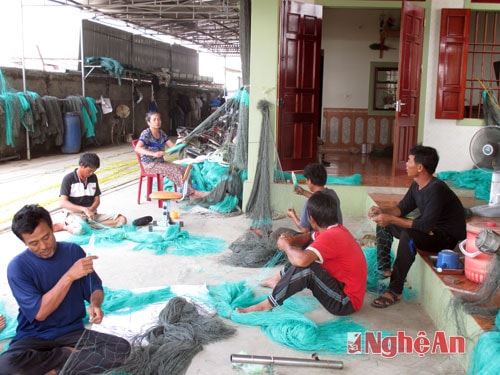 |
| Mr. Le Sy Vinh's net weaving and embroidery workshop in Dien Ngoc commune, Dien Chau district. |
Thanks to studying and thoroughly understanding Vietnam's Law of the Sea, fishermen in the Dien Chau coastal area enthusiastically invested capital to upgrade and build new boats, purchase fishing gear, and venture further offshore to catch seafood, contributing alongside the Navy, Coast Guard, Fisheries Surveillance, and Border Guard forces to firmly protect the country's seas and islands. Meanwhile, onshore workers actively expanded aquaculture, processing, and seafood consumption. Every commune has established aquaculture zones, opening 6 to 8 additional facilities for producing ice, weaving nets, processing seafood, supplying fuel and ice, and building and repairing boats and fishing gear, generating incomes of 100 to 350 million VND per household per year. A prime example of high-income shrimp farming is Mr. Ngo Xuan Dai in Dien Trung commune, who cultivates 4 hectares of shrimp and, after deducting expenses and labor costs, earns a profit of 1 billion VND per year. Former soldier Ngo Xuan Hanh from Dien Kim commune has built a frozen jellyfish processing plant for export, creating jobs for 60 workers and achieving an annual revenue of 10 billion VND.
In just the past two years, the Dien Chau coastal militia has not only harvested tens of thousands of tons of delicious fish from depths of 30 meters and beyond, but has also provided the Dien Thanh Border Guard Station and the District Military Command with dozens of valuable pieces of information, including six cases of illegal fishing and smuggling using explosives at sea.
To date, all nine coastal communes have established nine mobile militia platoons and dozens of marine militia squads, ensuring that each offshore fishing vessel has a militia squad consisting of 6 to 7 soldiers. The marine militia forces receive annual military training and political education to thoroughly understand the Party and State's guidelines on people's war, serving as the core force in offshore fishing and protecting the homeland's seas and islands. When the sea is calm, they fish; when incidents occur, they carry out rescue and relief missions to protect the lives and property of the people.
Le Hoai Thung


