
Dien Nam raises cattle for commercial purposes.
Dien Nam hamlet (Ky Tan commune, Tan Ky district), located west of Roi bridge, connects the two banks of the Con River, about 4 km from the Ho Chi Minh Highway. For decades, in addition to agricultural production, the people here have also engaged in commercial buffalo and cattle farming. Although a secondary occupation, cattle farming is the main source of income for the people here.
(Baonghean)Dien Nam hamlet (Ky Tan commune, Tan Ky district), located west of Roi bridge, connects the two banks of the Con River, about 4 km from the Ho Chi Minh Highway. For decades, in addition to agricultural production, the people here have also engaged in commercial buffalo and cattle farming. Although a secondary occupation, cattle farming is the main source of income for the people here.
Arriving at Dien Nam hamlet, I saw farmers heading to the fields to plow and cultivate for the summer-autumn crop. On the fields, buffaloes and oxen laboriously pulled plows and harrows, their fur smeared with mud. Perhaps only this rural area still uses buffalo and oxen for plowing and cultivation so extensively. Talking to some of the villagers, I learned that: In this hamlet, every household has traditionally raised buffalo and oxen for commercial purposes, so they always have large animals in their barns ready for plowing. Once the land is prepared, they sell the ones that fetch a good price and then buy more. That's the nature of commercial cattle farming; they sell whenever they make a profit, regardless of the time. Therefore, some families buy and sell up to 10 oxen a year.
Meeting Mr. Nguyen Duc My (deputy head of the hamlet), we learned that Dien Nam hamlet dates back to 1969, with most residents coming from Nam Cuong commune (Nam Dan district) to settle. At that time, the area was mostly fertile land with abundant grasslands, and coupled with their experience in raising cattle, the villagers focused on raising buffalo and cattle. Over time, the cattle herd in the hamlet grew larger, and commercial cattle farming emerged.
To date, Dien Nam hamlet has 174 households and only 80 hectares of arable land. That amount of land is insufficient to support nearly 800 people. Therefore, raising cattle for commercial purposes has become a secondary occupation, but a primary source of income. Walking around the hamlet with Mr. My, we observed that every household has a system of cattle and buffalo barns with tiled roofs and sturdy wooden frames, safe, airy in summer, and warm in winter. Above, there's a storage area for dry feed, such as straw and peanut stalks. Each barn contains at least one cow, with some having 4-5 cows. Every household raises male cattle. These large, Sindhi crossbred cows, weighing 400-500 kg, look fierce but are very gentle and approachable.
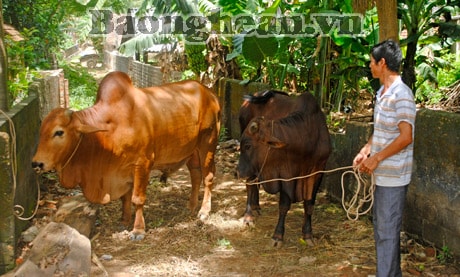
The cattle are raised by Mr. Nguyen Van Nam's family.
Mr. My said that the calves are bought by people from other places, and after raising them for 25 months, or even a year, they are sold. Some people buy a calf, and as soon as they bring it home, if a customer comes to inquire about buying it and they see a profit of 3-4 million dong, they sell it immediately. A 6-7 month old calf costs about 20 million dong, and after a year of raising it, it can be sold for 40 million dong. Families with sufficient manpower, like Nguyen Van Chien, Le Minh Hong, Nguyen Van Nam, Pham Van Tung, etc., always keep 3-4 cows in their barns. With more cows compensating for fewer, they are sure to earn a profit of 50-60 million dong per year. Raising buffaloes is just as profitable as raising cows, and now nearly 40 households in the village have switched to raising buffaloes.
Upon arriving at Mr. Nguyen Van Nam's house, we saw two large, tall, glossy-haired Sindhi crossbred cows tied up at the base of a jackfruit tree. When we inquired, Mr. Nam cheerfully explained: "They look big, but they're still calves, not yet fully grown, because they haven't lost any teeth yet. Each one weighs about 300 kg. By the end of this year, they'll be fully grown, weighing 500 kg each. If prices remain stable, they could sell for over 40 million VND each." Mr. Nam bought these two calves three months ago for 17 million VND each.
Whatever profession you pursue, you must be dedicated to it. In the commercial cattle farming industry in Dien Nam, farmers must dedicate land to growing grass and utilize agricultural by-products such as straw, peanut stalks, and dried corn stalks, storing them in the barns as feed for their cattle. Therefore, year-round, even during storms, farmers don't have to worry about feed for their cattle. As a result, the cattle raised here grow quickly, become fat, and have high weight, yielding a lot of meat. The main buyers of Dien Nam's cattle are traders from Yen Thanh, Dien Chau, Do Luong, and especially from Nam Nghia and Nam Cuong communes (Nam Dan district). They buy them to slaughter and sell the meat, so everything sells out...
Thanks to commercial buffalo and cattle farming, the people of Dien Nam hamlet have a relatively good income. In 2012, the average per capita income was 24 million VND/year; only 8 households remained poor in the hamlet. The price of buffalo and cattle has been relatively stable for a long time, making it easy for farmers to do business, and the commercial buffalo and cattle farming industry in Dien Nam has continued to develop.
Xuan Hoang


