
The mystery of the bronze drums of Nghe An
For a long time, when people talked about bronze drums, they usually mentioned northern provinces like Phu Tho, Son La, Thanh Hoa, Cao Bang... very few people knew about the bronze drums of Nghe An. Therefore, the collection of more than 40 bronze drums found in Nghe An over the years is truly a surprise.
(Baonghean)For a long time, when people talked about bronze drums, they usually mentioned northern provinces like Phu Tho, Son La, Thanh Hoa, Cao Bang... very few people knew about the bronze drums of Nghe An. Therefore, the collection of more than 40 bronze drums found in Nghe An over the years is truly a surprise.
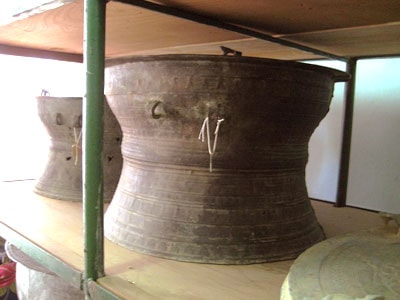
Bronze drums are preserved at the Nghe An Museum.
The first bronze drum was discovered in Nghe An in 1959 in Chau Cuong commune (Quy Hop district). That same year, not far from Quy Hop, another drum was discovered in Dong Hieu commune, Nghia Dan district. Following this event, it took 11 years (continuously from 1971 to 1973) for Nghe An to find more bronze drums. Notably, during the excavation at the Lang Vac archaeological site alone, nine bronze drums were discovered, including five Dong Son bronze drums of the Minh Khi lineage. Subsequent discoveries included drums in Con Cuong, Tuong Duong, Dien Chau districts, and Vinh City. The most recent discovery was in July 2008 in Dong Hop commune, Quy Hop district, a drum classified as a Type 1 Dong Son drum.
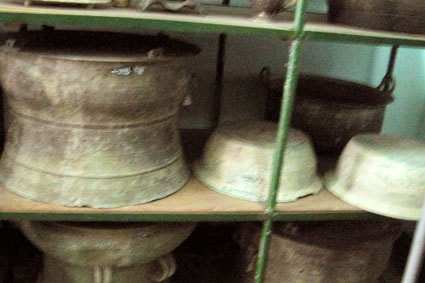
A basin-shaped drum (with its right side facing down) was found in Dien Chau district.
What is particularly noteworthy about the 41 bronze drums found in the province over the past half-century is that the majority were discovered in mountainous districts. Besides the 14 drums found at the Lang Vac site, the remaining drums found elsewhere further confirm that Lang Vac and the western region of Nghe An were once major cultural centers during the Dong Son culture period, contributing significantly to understanding the Hung King era and the founding of the nation. In addition, the three unique bronze drums found so far in the Quyet mountain area of Vinh City in 1979 (collected and transferred to the Nghe An Museum in 1996) also raise many questions for researchers. Currently, the drum surfaces still retain images of the sun, comb-like patterns, and images of mythical birds flying counterclockwise. The drum considered the most intact, with only one-third of its body remaining, includes a part of the drumhead and a part of the drum body. The patterns on the drum's body are divided into two parts: the upper part has two rectangular frames with parallel diagonal lines inside, and the lower part has concentric circles with dots in the center. Based on the drawings on the drum's surface and body, experts estimate that these three drums date back to approximately 2000-2500 AD. However, why these bronze drums were discovered only in Vinh City remains unexplained. Many researchers suspect that these drums are related to the Tay Son Dynasty - Nguyen Hue (especially regarding the question of whether or not the tomb of King Quang Trung is located on Dung Quyet Mountain), as according to ancient customs, the deceased were often buried with rare and valuable items.
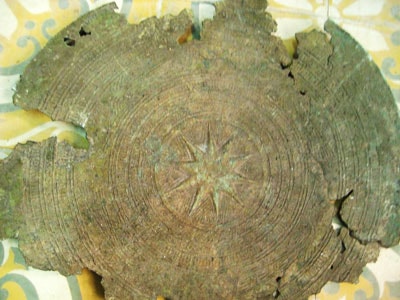
The bronze drum face was found at Quyet Mountain (Vinh City).
The collection of bronze drums currently housed at the Nghe An Museum also contains other interesting details, including two basin-shaped drums found in Dien Phuc commune, Dien Chau district. Unlike bronze drums, basin-shaped drums are smaller and resemble modern-day basins. According to museum staff analysis, it is highly likely that: Although the period from the 1st to the 10th centuries was under Northern domination, the Vietnamese people's resistance against the Northern invaders remained strong, especially in the struggle to protect and develop their culture. Historical records recount that during the Later Han dynasty, Ma Yuan plundered bronze drums to cast horses, plotting to destroy Vietnamese culture. By casting bronze drums in the shape of basins (similar to Han bronze basins)... the Vietnamese people deceived the invaders and found ways to preserve their cultural values through the patterns printed on the drums, which resembled those of the Dong Son bronze drums.
The 41 bronze drums currently housed at the Nghe An Museum are truly an invaluable treasure of Nghe An province and the entire country. It's regrettable that over time, due to war and years of the drums being scattered among households, many are no longer intact. If the collection were more widely accessible to the public, it would undoubtedly become an attractive destination for tourists from all over the country visiting Nghe An, and an interesting place for schools and students to learn about the history of their homeland.
My Ha



;)