
What helped Nghe An reverse the country's trade deficit trend?
In the first seven months of 2026, Vietnam's trade volume continued to accelerate, with total import and export turnover reaching nearly 660 billion USD, an increase of over 28% compared to the same period. However, the trade balance tilted towards imports, resulting in a trade deficit of over 20 billion USD for Vietnam.
.png)
Nghe An's import-export picture is moving in the opposite direction. In the first seven months, the province exported approximately $3.69 billion and imported $2.95 billion, resulting in a trade surplus of about $730 million. Looking solely at the trade surplus figure, the story seems quite simple, but when considered over a longer period, a profound shift emerges behind the trade balance.
In 2021, Nghe An's export turnover reached approximately 2.11 billion USD, while imports reached 994 million USD. By 2025, exports are projected to increase to approximately 4.52 billion USD, and imports to 2.73 billion USD.
After five years, the province's export volume more than doubled, while the trade balance maintained a surplus. This is noteworthy because export growth occurred simultaneously with a strong expansion of imports to support production.
The key lies in the structure of the export flows. Approximately 90% of export turnover in 2025 will come from two groups: light industry and handicrafts, and heavy industry and minerals. Specifically, the light industry and handicrafts group is projected to increase from approximately US$977 million in 2021 to US$2.28 billion in 2025. The heavy industry and minerals group is expected to increase from US$845 million to US$1.77 billion.
The above figures show that Nghe An's export momentum is shifting more clearly towards processing and manufacturing industries. This process is also closely linked to foreign direct investment (FDI), as this capital contributes to the formation of new production capacity, expansion of production capacity, and connection of Nghe An's products with international supply chains and markets.
Conversely, Nghe An's import structure is relatively consistent with the industrialization process. The province imports raw materials, components, machinery, equipment, fabrics, accessories, and many types of intermediate goods to serve production.
The disparity in growth rates between output and input is helping Nghe An maintain a trade surplus. In the first seven months of 2026, exports increased by 52%, while imports increased by 35%. The scale of output is growing faster than input, thereby expanding the trade balance in a way that benefits exports.
This also highlights the difference between an export-oriented economy that relies primarily on resources, raw materials, and semi-processed goods, and a manufacturing economy that is forming industrial chains.
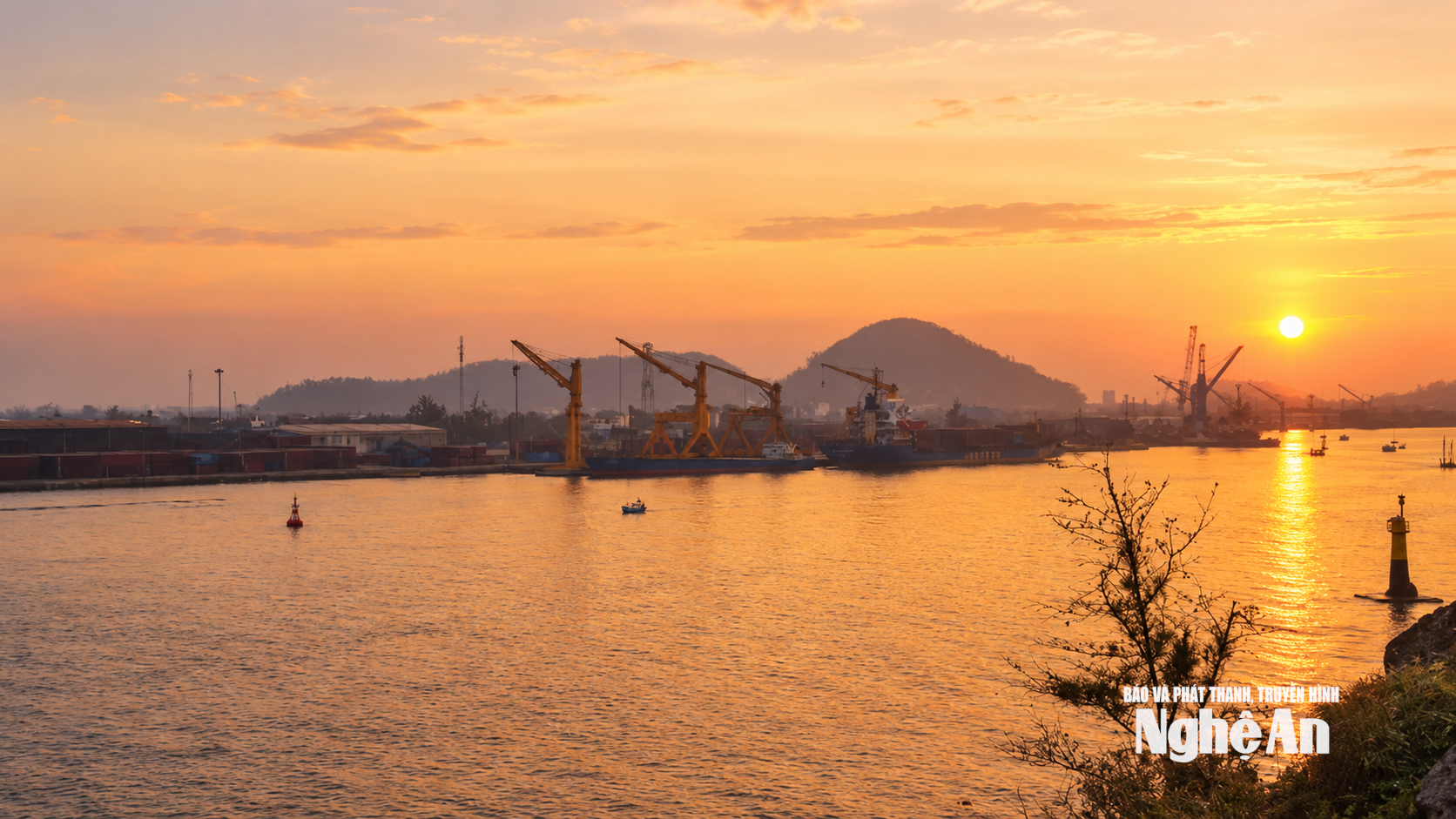
However, a trade surplus does not necessarily mean a corresponding increase in value added within the economy. A factory might export hundreds of millions of dollars but still have to import a large portion of its raw materials, components, machinery, or auxiliary materials. In that case, the large export value does not fully reflect the actual value retained within the local economy.
Therefore, in addition to the question of how much exports will increase, we need to ask: How much value is created and retained within Nghe An? The answer depends on the level of participation of local businesses in the supply chain, the localization rate, the capacity to supply raw materials and components, the level of technology, and the ability to create products with higher added value.
This is also a crucial factor determining the quality of exports in the next phase. Nghe An is aiming for $9 billion in exports by 2030; meaning the export volume must be nearly double the approximately $4.5 billion of 2025.
To achieve this goal, in addition to improving the effectiveness of investment attraction and developing more key export products, logistics, industrial park infrastructure, energy, human resources, and domestic supply capacity will become decisive factors.
More importantly, it is necessary to establish a network of domestic enterprises capable of supplying raw materials, components, and services to FDI factories. Only then will the impact of FDI not be limited to generating more export turnover but can spread more broadly into the provincial economy.
Overall, Nghe An's current trade surplus reflects a noteworthy trend: production capacity is expanding faster than the demand for imported inputs, with the processing and manufacturing industries playing an increasingly significant role. If this trend continues, the trade balance could continue to be a pillar for double-digit growth.
The challenge now is for Nghe An to transform its export surplus advantage into a competitive advantage, turn FDI into a production ecosystem, transform imported raw materials into higher value-added products, and turn each USD of exports into more value for the economy.


