
Anti-dumping investigation: The right decision.
Vietnam has joined the WTO, and applying trade defense measures is a legitimate right. However, for a long time, Vietnam has rarely used this measure.
On July 2, 2013, the Ministry of Industry and Trade issued Decision No. 4460/QD-BCT on the investigation into the application of anti-dumping measures against imported cold-rolled stainless steel into Vietnam. Prior to this, on May 6, 2013, the Competition Management Department (Ministry of Industry and Trade) received a valid application requesting the application of anti-dumping measures against the aforementioned product from POSCO VST Co., Ltd. and Hoa Binh Stainless Steel Joint Stock Company.
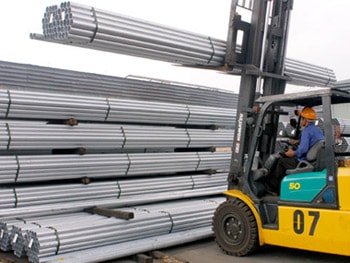
Vietnamese businesses face many difficulties in filing anti-dumping lawsuits.
The Ministry of Industry and Trade's decision is entirely correct. Because Vietnam has joined the WTO, applying trade defense measures is a legitimate right. However, for a long time, Vietnam has rarely used this measure. Meanwhile, the phenomenon of foreign imports being dumped on the Vietnamese market continues to occur, significantly impacting domestic production.
On April 29, 2004, the Ordinance on Anti-Dumping of Imported Goods into Vietnam was promulgated.
Subsequently, the Government issued Decree No. 90/2005/ND-CP dated July 11, 2005, detailing the implementation of several articles of this Ordinance. These are the two most important legal documents regulating anti-dumping in Vietnam, clearly stipulating the procedures for anti-dumping investigations and the time limits for each step in the case resolution process. According to the Ordinance and international commitments, the most important thing that the initiating enterprise and the investigating authority need to do is to investigate and gather documents and evidence to prove that: the volume, quantity, or value of dumped goods from one country exceeds 3% of the total volume, quantity, or value of similar goods imported into Vietnam, or the total volume, quantity, or value of dumped goods from multiple countries meeting the specified conditions exceeds 7% of the total volume, quantity, or value of similar goods imported into Vietnam. In addition, when a company initiates a lawsuit, the investigating agency must work with relevant parties on various other issues.
| In anti-dumping cases, we face a major difficulty: we need evidence of the total volume, quantity, or value of similar goods imported into Vietnam. |
Even before the investigation began, many manufacturing companies that use stainless steel as a raw material had already submitted written objections. However, if those companies cannot prove that the two companies that filed the anti-dumping request are not representative of the domestic industry, the investigation will proceed as normal.
It is difficult to conclude whether Vietnamese businesses will win or lose. However, it is evident that in anti-dumping lawsuits, we face a major difficulty: we must provide evidence that imported goods account for more than 3% (in the case of goods imported from a single country) or more than 7% (in the case of goods imported from multiple countries) of the total volume, quantity, or value of similar goods imported into Vietnam.
In many cases, the total quantity of goods imported into Vietnam is less than 3%, because a large amount of goods imported through unofficial channels have not been managed or updated. This is common for goods imported from China, Thailand, and Laos to Vietnam.
Another difficulty is that we lack experience in anti-dumping cases. However, whether successful or not, initiating legal action and investigating dumping is necessary so that we can gain experience in using trade defense measures and handling future anti-dumping cases.
According to baocongthuong -PH


