
Dinh Chu - a prosperous countryside
(Baonghean) - Located on the left bank of the Lam River, Dinh Chu village, Thanh Tuong commune (Thanh Chuong district) is a picturesque rural area rich in cultural and historical traditions…
According to the Nguyen Quang family genealogy, the ancestor Nguyen Quang Do was the founder of the village, transforming the area of six mountains – "Luc Chu islet" – into Vinh village – Dinh Chu village 500 years ago. The village has seven hamlets, clustered along a fertile stretch of the Lam River, and was once mentioned in a folk poem by the ancient poet Tu Con: "The land of the green dragon faces left/The earth and the pig's vein flow in/The pavilion and the rain are peaceful/The people are strong and prosperous/The old are leisurely/The young poets are joyful/Scholars study day and night/Farmers cultivate fields and cultivate rice paddies/Traders sail boats with great fanfare/Those who carve dragons and clouds."
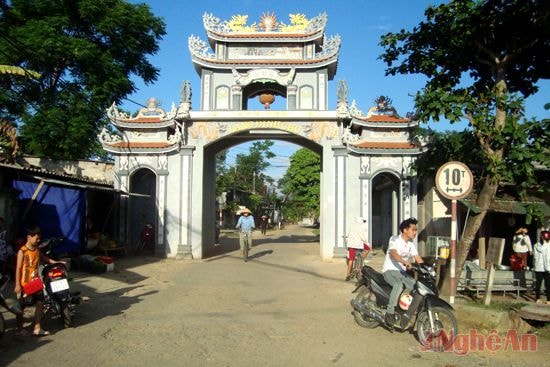 |
| The gate of Dinh Chu village (Thanh Tuong, Thanh Chuong). |
According to Mr. Nguyen Quang Nhi (81 years old), the village has Dinh Chu communal house hidden under an ancient banyan tree, dedicated to the tutelary deity, the ancestor of the Nguyen Quang family. The communal house has three bays and two gables, elaborately carved; the rear chamber has one bay with many ceremonial objects. Every year, the literary, martial, and agricultural associations all hold ceremonies at the communal house; on the 15th day of the 10th lunar month, the whole village gathers here for the Ancestor Worship Ceremony. The communal house was once a meeting place and propaganda center for those involved in clandestine activities. During the war and revolution, the communal house was where villagers gathered to seize power; where they bid farewell to their sons and daughters going to war; where conferences and accelerated cadre training courses of Military Region IV were held (1947-1952); and where Prince Souphanouvong visited Military Region IV (1953). During the years of building cooperatives, the communal house was damaged by termites and had to be dismantled. Today, the two foundation pillars of the old temple gate still remain in the temple courtyard, reminding the villagers of a bygone era and their concerns and desires to restore the old temple.
On But Son mountain, there is a sacred house (shrine) where Confucius and the village's learned sages and scholars are worshipped. After the revolution, Japanese soldiers helped the local militia and guerrillas train here. In front of the sacred house, on the Cua Thanh field, the ancients once built two large mounds of earth, shaped like a pen and an inkstone, symbolizing the village's tradition of studiousness. Today, the pen and inkstone mounds no longer exist, and the sacred house has been restored and renovated by the villagers, including a three-arched gate, a majestic shrine, and a clean and beautiful park (2012). The sacred house has become a center of cultural and spiritual activity for the village; where families and clans often come at the beginning of spring to pray for peace and for their children's academic success.
On Mount Phật Sơn, there once stood the Phật Sơn Temple – the most magnificent structure in the region, dedicated to Cao Sơn Cao Các. The temple featured a triple-arched gate, kneeling elephants, standing horses, an incense offering hall, and three majestic halls: lower, middle, and upper. Today, the former temple exists only in memory; the Nguyễn Gia family's ancestral temple stands on its site, surrounded by residential houses; and at the foot of Mount Phật Sơn, a grand village gate has sprung up.
The village has the ancient Vịnh Market, which used to be held on the alluvial plain along the river, next to the main road leading to Lường and Rạng regions. Near the market is the bustling Vịnh wharf with many boats, attracting people from all over to trade and do business. In the middle of the market is the Giang Đình martial arts temple with two buildings, upper and lower; a place of worship for the village's officials, soldiers, and generals. During the war years, the market had to move to several locations and has now been relocated to the neighboring village. In the old folk song, the image of the prosperous riverside village still remains: "The market is crowded from morning to evening / There is the Giang Đình martial arts temple / There is the village society and soldiers / There are officials and musicians / Below, boats are bustling / People trade upstream and downstream."
Blessed by nature, Vinh village is known for its "white rice and clear water," and its people are skilled craftsmen, making many of the village's products famous far and wide. The carpentry trade here has existed for hundreds of years and is still preserved and developed by the villagers. Dinh Chu carpentry is not only known for its "perfect ink, sturdy planks, and durable joints," but also for its exquisite and vibrant carvings and patterns. The village's noodle and rice cake making tradition dates back to ancient times, with its most famous product being "Vinh Market rice crackers," which are round, thick, fragrant, and delicious with a distinctive flavor. Vinh Market rice crackers are not only a delicious food and a favorite local gift for many tourists, but also a well-known product in many places in Nghe An province, and even in the South such as Vung Tau and Ho Chi Minh City. The traditional crafts here have contributed significantly to the village's new appearance and have been recognized as a craft village by the Provincial People's Committee since 2007 and 2009.
"A good land attracts good people," and many families have settled here, fostering many glorious traditions for the village. The Nguyen Quang family has an ancestor who was the founder of Dinh Chu, and was awarded the golden plaque "Khai - Tat - Tien" by the imperial court; there was General Nguyen Quang Mao during the late Le dynasty with many meritorious services in "protecting the nation." The Luu family has a 300-year-old ancestral temple and is famous for Luu Si Chuong (1884-1930), a scholar of the Han Lam Academy. The Nguyen The family spans 20 generations over 400 years, famous for Nguyen The Cat (1855-1937), a scholar of the Han Lam Academy, commonly known as "Mr. Thi," who served as the head of education in Thanh Chuong and Can Loc... After retiring from his official position and returning to the village, he opened a school, and many of his students achieved success in their academic careers. When he passed away, his students erected a memorial stele in his garden. Currently, in Duc Nghia hamlet, right in front of the ancestral temple, the Vinh Am Tien Sinh stele (the stele of Mr. Thi) is still preserved and beautifully maintained by his descendants, further affirming their pride in an ancestor who brought glory to the family lineage.
From the village gate, traversing Nghinh Than road and walking along the embankments, one can admire the complete and beautiful rural landscape. Dinh Chu captivates visitors not only with its scenery of the Lam River and its ancient charm, but more impressively, its age-old traditions serve as a driving force, empowering this rural area to thrive.
Huy Thu


