The image of the banyan tree, the riverside, and the village communal house has been used by many musicians, poets, and writers as a beautiful symbol of the Vietnamese countryside. However, due to various factors including weather and human behavior, only 71 communal houses remain under the province's management. Many of these are in serious disrepair. Who is responsible?
Current situation regarding village communal house relics.
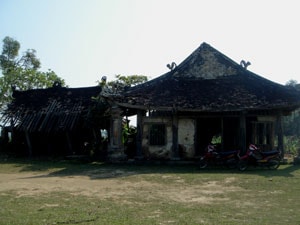 |
Dong Vien Temple
(Nam Phuc Commune - Nam Dan District). |
Like most Vietnamese villages, Nghe An province has a communal house (dinh làng). According to research, the province currently has 71 communal houses under its management (including 14 recognized as National Monuments and 5 classified as provincial-level monuments). Some communal houses are being preserved, repaired, and restored in rural areas, operating in the spirit of cultural renewal (mainly those classified as national or provincial monuments). For example, the Quynh Doi communal house (Quynh Luu district) has become a traditional house of the commune, preserving artifacts, paintings, and documents related to the village's development from the past to the present. Similarly, the Trung Can - Nam Trung and Hoanh Son - Khanh Son communal houses (Nam Dan district) have been restored, protected, and become tourist attractions. Lien Tri communal house (Lien Thanh - Yen Thanh), Long An communal house (Dien Truong - Dien Chau), Quang Thai village communal house (Nam Trung)... due to their historical significance and the people's awareness, these communal houses have been preserved through public donations and the commune's budget, serving as community centers. However, many communal houses in our province are now severely degraded due to time, war, natural disasters, and even the local people's own negligence: roofs have collapsed, they are infested with termites, and some have completely collapsed, leaving only the structural components, such as Khai Long communal house - Trung Son; Nhan Trung communal house - Lam Son (Do Luong). Even more perplexing, some communal houses are used by local villagers to keep their cattle, causing filth and unsanitary conditions, significantly affecting the beauty and sacredness of the communal house.
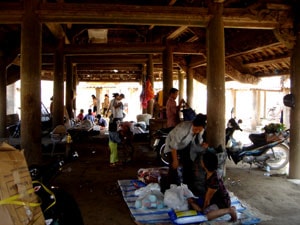 |
Dinh Cot But
(Nam Lac Commune - Nam Dan District) |
Dong Vien Temple (Nam Phuc - Nam Dan), situated on a beautiful, elevated piece of land in the middle of the village, still stands as an ancient temple built in the year of the Rat (1786), during the Le Trung Hung era, dedicated to the village's guardian deity, Nam Phuc. Mr. Le Van Nam, from Hamlet 3, Nam Phuc, saw us entering the temple to take photos and, while working in the fields nearby, came over to ask about our situation. Through him and many other villagers, we learned that the people have repeatedly proposed to the commune government the restoration and renovation of the temple, but time has passed, the temple has deteriorated, and the commune government has remained silent. According to Mr. Nam, the temple is very sacred; if anyone brings their buffaloes or cows inside, they will inevitably die a few days later. Now, half of the roof has collapsed, the rear hall is dilapidated, and weeds have grown everywhere, yet people still bring straw and hay to fill the temple during harvest season. For a long time, Dong Vien Temple has become a place for children to play hide-and-seek with their buffaloes. Visiting Nam Lac (Nam Dan) and the Cot But communal house, I was delighted to see that it was still intact, but the communal house had long since become a market. Ms. Hoang Thi Thanh (Hamlet 4, Nam Lac), who has been doing business at the market for over 17 years, said: The market mainly meets in the mornings, and on the 3rd, 6th, and 9th of each month are market days, attracting people from other localities such as Hong Long and Xuan Hoa to trade and exchange goods. Traveling along the Lam River towards the Dan Nhiem communal house (Xuan Hoa), it was truly unbelievable; the old communal house was nowhere to be seen, only a pile of exposed structural components remaining, exposed to rain, sun, wind, and storms, with nothing to protect it! In a conversation with Ms. Tran Thi Nga, Deputy Secretary of the People's Committee of Nam Dan town, I learned that the communal house collapsed on the full moon day, and the local authorities have sent militia to rearrange the structural components. During the period when the communal house was deteriorating, the people of Xuan Hoa repeatedly proposed that the authorities find ways to "save" it, but due to a lack of funding and insufficient attention, this situation persisted.
Which level of authority is responsible?
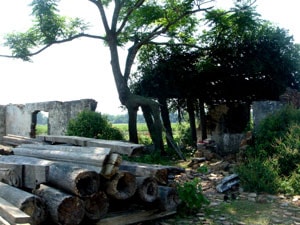 |
Dan Nhiem Village Temple
(Xuan Hoa Commune - Nam Dan District) |
In recent years, Nghe An has received considerable attention from the State, the people, and other social organizations to restore and preserve its classified historical sites and scenic spots. Since 2000, the Provincial People's Committee has issued legal documents on the management, preservation, and promotion of cultural heritage values in Nghe An; and implemented the payment of allowances and responsibilities to officials protecting these sites... However, the deterioration of village communal houses accounts for a large proportion. According to Mr. Phan Van Hung - Head of the Propaganda Department - Nghe An Provincial Management Board for Ethnic Minorities: The primary responsibility for a classified historical site lies with the level of the classification. Thus, in addition to the 19 classified village communal houses (both provincial and national), there are 52 unclassified village communal houses, for which the primary responsibility lies with the local authorities, and these houses survive thanks to the awareness and responsibility of the people. But when working with local authorities, most give the same answer: lack of funding. What about the relevant authorities?
Given the existence of the system of cultural heritage sites in harsh climatic conditions, and the limited funding for restoration, preservation, and conservation of intangible cultural heritage, protecting, preserving, and managing these sites presents significant challenges for our province. The urgent issue now is that the province needs to develop a long-term strategic plan to proactively manage heritage sites. It is necessary to continue conducting a scientific inventory to classify unclassified sites and implement a rational hierarchical management system for these sites. Timely policies and mechanisms are needed to strengthen activities to protect and promote the value of heritage. Serious and timely action must be taken against any damage to these sites. And equally important is that our province needs to intensify the dissemination and promotion of the Law on Cultural Heritage, aiming to further raise awareness among officials and the public about preserving, protecting, and promoting the value of cultural heritage sites.
Text and photos: Thuy - Phuc



