
The resettlement project in Thung Chanh (Anh Son district) remains unfinished.
(Baonghean) - From the center of Tho Son commune (Anh Son district), we passed through several villages and four hills to reach Thung Chanh. The regenerated forest and beautiful valley with the Khe Trang stream were assessed as having many elements suitable for building a resettlement village for the Thai ethnic minority in the commune. In fact, this work started in 2006 and officially began construction in 2009 according to the Provincial People's Committee's approval decision, No. 920/UBND-NN (March 2009). After that, only the gravel road and two spillways across Khe Trang were hastily constructed. To date, the two spillway sections have been almost completely washed away by floods, leaving this resettlement project unfinished.
(Baonghean) - From the center of Tho Son commune (Anh Son district), we passed through several villages and four hills to reach Thung Chanh. The regenerated forest and beautiful valley with the Khe Trang stream were assessed as having many elements suitable for building a resettlement village for the Thai ethnic minority in the commune. In fact, this work started in 2006 and officially began construction in 2009 according to the Provincial People's Committee's approval decision, No. 920/UBND-NN (March 2009). After that, only the gravel road and two spillways across Khe Trang were hastily constructed. To date, the two spillway sections have been almost completely washed away by floods, leaving this resettlement project unfinished.
The "Construction of Thung Chanh Resettlement Village" project in Tho Son commune was assigned by the Provincial People's Committee to the Anh Son District People's Committee as the investor, with a total investment of 12.6 billion VND. Accordingly, on an area of approximately 40 hectares, 54 new houses will be built for the nomadic Thai ethnic minority households from Khe Trang Thuong and Khe Trang Ha villages to settle permanently. The approved infrastructure list includes 3 km of gravel road into the resettlement area, 2 km of internal roads within the resettlement area, a kindergarten, a primary school, housing for teachers, a community center, a water supply system, electricity, and an irrigation system to ensure irrigation for 10 hectares of rice paddies. Construction began in 2009 with the construction of 2 km of internal roads in Thung Chanh village. By October 2011, while this section was nearing completion, a flood swept away two spillways and almost the entire newly constructed gravel road. Consequently, all aspects of the project remained unfinished, and the District People's Committee was slow to inspect and supervise, leading to the Provincial Ethnic Affairs Committee proposing a temporary suspension of funding. The ethnic minority households eligible to benefit from the project repeatedly petitioned the District People's Committee and People's Council, but the project remained stalled. The District People's Council also repeatedly reminded the investor, the District People's Committee, but the response was always "due to lack of funds!".
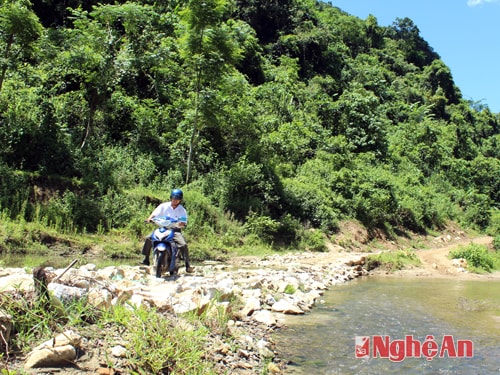 |
| The spillway across Khe Trang stream and the road leading to Thung Chanh valley are severely damaged. |
In fact, only after the village road section was swept away by floods did the project management board realize that the implementation process and survey work were not thorough, leading to heavy losses. On July 9, 2014, observing the site, we saw that only a few concrete slabs of the spillway on Khe Trang stream remained. Twelve beneficiary households are currently clinging on, building temporary shelters to reclaim land in Thung Chanh, using stones from the mountain to build temporary embankments across the stream for transportation, production, and daily life. Mr. Loc Van Hanh's family, one of the first households to reclaim land in the area, lamented: "You see, the road to Thung Chanh is still winding and difficult. During the rainy season, we are almost isolated. We have petitioned many times, but the project has not been implemented. A few months ago, a delegation from the district and province came to inspect, but after the inspection, nothing was done." Meanwhile, Mr. La Van Hoat, Secretary of the Party Committee of Tho Son commune, said: "At every meeting with representatives of the People's Council at all levels, the people and voters in the villages needing resettlement around Thung Chanh have also raised concerns about the project's delays."
Besides the lack of thorough topographical surveys leading to losses during project implementation, another reason for the prolonged delays is that the Anh Son District People's Committee did not survey the land before implementation, resulting in difficulties in resolving compensation issues for 12 households who had cleared land in Thung Chanh 20 years ago. Since the 1980s, due to a shortage of arable land, many Thai ethnic minority families in Khe Trang Ha and Khe Trang Thuong villages cleared land in Thung Chanh to cultivate rice and develop livestock farming. For decades, some families have been connected to this valley for three generations. However, before starting the project, the investor and relevant parties did not conduct surveys, calculate compensation options, or effectively carry out public relations work, thus failing to acquire land for the resettlement project.
Until early 2014, the Ethnic Affairs Committee of the Provincial People's Council conducted on-site monitoring and recommended that competent authorities address the project's outstanding issues. Only then did the investor, the District People's Committee, begin to restart the process. This meant conducting a new field survey, calculating adjustment options, organizing mobilization efforts among the affected ethnic minority communities, calculating compensation, designing appropriate components, proposing investment levels, and allocating funds to relevant authorities. These stages were discussed and agreed upon by the Provincial Ethnic Affairs Committee, the Department of Planning and Investment, the Anh Son District People's Committee, and the Tho Son Commune People's Committee at a meeting in mid-February 2014. On March 25, 2014, the Anh Son District People's Committee submitted a proposal to higher authorities requesting continued funding to restart the project. However, to date, the project remains under inspection and review. Speaking with us, Ms. Vo Thi Hong Lam, Chairwoman of the Anh Son District People's Committee, acknowledged: “After reviewing and evaluating the project, we found shortcomings in the survey process. Project management was also not thorough enough. The District People's Committee has rectified the Project Management Board and proposed that the Central and Provincial governments allocate funds to continue implementation. We are determined to complete the important components of the project by the end of 2015…”
Nguyen Nguyen


