
Do Luong - Looking back to move forward
(Baonghean)Currently ranking second in rice production in the province, and with relatively good commercial services compared to other midland and mountainous districts, Do Luong still lacks the confidence to pursue its goal of becoming the development center of the southwestern region of the province...
Do Luong was an early urbanized and bustling area, famous for its Luong region. After the war and during the period of reform, before the Ho Chi Minh Highway existed, Do Luong was considered for a long time a bustling gateway to the vast southwestern region, encompassing Ky Son, Tuong Duong, Con Cuong, Anh Son, and Tan Ky.
For many years, Do Luong's major goal has been to strive to meet the criteria for becoming a town by 2015. Considering its spatial area and key development points, Do Luong's current advantages in achieving town status are evident: the planned expansion of the district town to double its size (from 231 hectares to 450 hectares), which is currently awaiting approval; the positive impact of the planned industrial clusters in Thuong Son, Lac Son, Giang Son Tay, My Son, and Thuan Son; the planned cement industrial zone; the Truong Bon Historical Relic Site Project; the Giang Son Hot Spring Tourist Area Project...; and most importantly, Do Luong possesses a system of scenic spots and historical and cultural relics with great potential for tourism development as well as the creation of an urban cultural space.
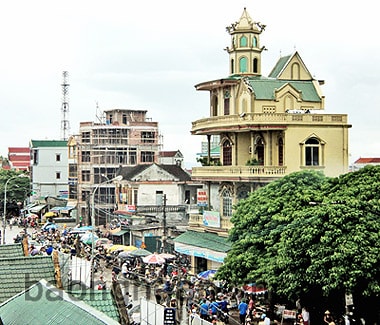
A corner of Do Luong town
The core of the criteria for establishing a town is Do Luong District Town. Besides being the intersection of National Highway 7 and National Highway 15, the State recently opened an additional section of Road 7B from Yen Son Commune to Luu Son Commune, passing through the outskirts of the town center, creating a rich road transport system for Do Luong Town. Along with the Lam River flowing through the area, Do Luong Town has very favorable conditions for both water and land transport, giving the locality an important position in the region. Historically, the area that is now Do Luong Town was a district capital; the town's people have a tradition of trade and business.
The former Luong Market and the present-day Do Luong Commercial Center are important trading and exchange points on National Highway 7 and the entire southwestern region of the province. In addition, the town also has a cattle market; and the Cong Da Market, specializing in the production and sale of rice crackers and peanut candy for distribution throughout the district and other parts of the province. These strengths enable the town to strive to become a dynamic economic zone, developing rapidly in cultural and social fields. Currently, besides the bustling central market, the town's streets are equally vibrant. The town also has a small industrial zone and plans for the construction of a new, modern urban area...
It can be said that the development of industry, handicrafts, and traditional craft villages is a promising direction that needs attention in Do Luong to create a real breakthrough in the district's economic development. During this period, it is noteworthy that the processing of agricultural and forestry products based on the traditional crafts of the ancient Luong region, such as the processing of rice noodles, sausages, tofu, and the famous peanut candy making in Vinh Duc Craft Village, is particularly important.
Do Luong's agricultural production has the conditions to develop the animal feed processing industry, utilizing both crop products and contributing to the development of concentrated farm animal husbandry to ensure raw material supply, aiming to apply technical advancements to increase productivity, quantity, and quality of livestock for the development of the food processing industry. Nine communes along the Lam River (Ngoc, Lam, Boi, Bac, Dang, Da, Trung, Thuan, and Luu Son) have mulberry cultivation, silkworm rearing, and silk reeling industries to develop the textile industry; the proposed direction is to reorganize them into new-style cooperatives to create craft villages, investing in modern silk reeling machines to increase productivity and quality of silk products, reviving the traditional silk weaving craft, and creating traditional products. At the Giang Son hot spring resort project, investment could be attracted to build a bottled water factory to meet the growing consumer demand...
Unfortunately, these advantages have not been fully utilized and developed by the district, hindering its rapid and sustainable growth. The primary and subjective reason, arguably, lies in its limited economic mindset. This is a reality that the current district leadership is grappling with and working to overcome. Striving to meet the criteria for a town aims to create a new era of rapid, strong, and sustainable development based on creating and seizing opportunities. This, in turn, demands great dynamism and decisiveness from the district's officials.
From the district Party congresses during the early stages of the general reform process from 1989-2000, the district quickly focused on two major programs, with particular emphasis on training, fostering, and assigning cadres from the district to the grassroots level. The approach involved conducting surveys of the current state of existing cadres, researching and developing succession plans, identifying potential cadres, and unifying training plans; allocating 1-1.5% of the budget (both district and commune) as a fund to partially support cadres sent for training; and sending young cadres from the succession or potential pool to full-time training programs at universities and some vocational schools suitable to local needs. This approach was initially highly regarded and had a positive effect. However, the problem was that the quality of the surveys and selection of cadres for training lacked professionalism, necessary assessment, and timely verification of post-training quality through practical experience.
Thus, when it is said that Do Luong is not yet confident in its goal of becoming the development center of the southwestern part of the province, it is primarily due to the fact that the practical effectiveness of leveraging the local potential and strengths is not high; and the main reason is that the quality of the cadre has not kept pace with and met the new situation. This necessitates the recruitment and development of a younger cadre, one who is not only "good in demeanor" but also possesses high competence and qualifications, and is appropriately assigned to ensure "deep engagement, democracy, and unity," thus advancing the movement as set forth in the Resolution of the District Party Congress. Looking back at the current reality to move forward is also the first requirement for the cadres at all levels here as an immediate solution for the locality.
Text and photos: Dinh Sam


