
Businesses are desperately searching for high-quality talent.
The shortage of high-quality human resources continues to be a difficult problem for many businesses. Despite setting recruitment criteria with attractive salaries, these companies have struggled to find suitable employees for a long time.
It is difficult to recruit highly skilled workers.
Recently, Goertek Vina Company - Que Vo 1 Industrial Park - Nam Son - Bac Ninh, through the Nghe An Employment Service Center, registered to recruit more than 20 employees in the following fields: Quality Improvement Engineer, Human Resources Specialist, Accountant, Logistics, Project Coordinator (PC), CNC Machining Engineer, Plastic Injection Molding Technician, and Mechanical R&D. The employer required at least one year of relevant experience and good communication skills in Chinese. However, after a period of advertising, the company was unable to find enough candidates to meet its needs.
A representative from the company stated: "We are always short of skilled and qualified personnel, not only for key positions but also for positions requiring highly skilled workers, graduates from vocational schools, universities, and colleges. We never manage to recruit even a third of the required number." According to this representative, most new employees who pass the interview process require significant additional training before they can fully meet the company's needs.
Similar to Goertek Vina, a 100% foreign-owned company based in Ho Chi Minh City is looking to hire import/export staff with salaries ranging from 15 to 20 million VND per month. The company requires candidates with experience working with foreign partners, preferably with experience in manufacturing companies adhering to ISO standards. However, despite posting job advertisements on various forums, the company has been unable to recruit. The company's HR manager stated: "This isn't the only time; in previous years, we've needed a large number of high-quality personnel for many key positions, but we've been desperately searching for suitable candidates."
According to the 2024 Salary and Labor Market Report by Navigos Group (a recruitment agency), over 50% of businesses will continue to recruit additional personnel in the next year, including middle and senior management positions. Businesses prioritize candidates with foreign language skills, problem-solving abilities, effective communication skills, adaptability, and 1-3 years of experience (not necessarily in a management position).
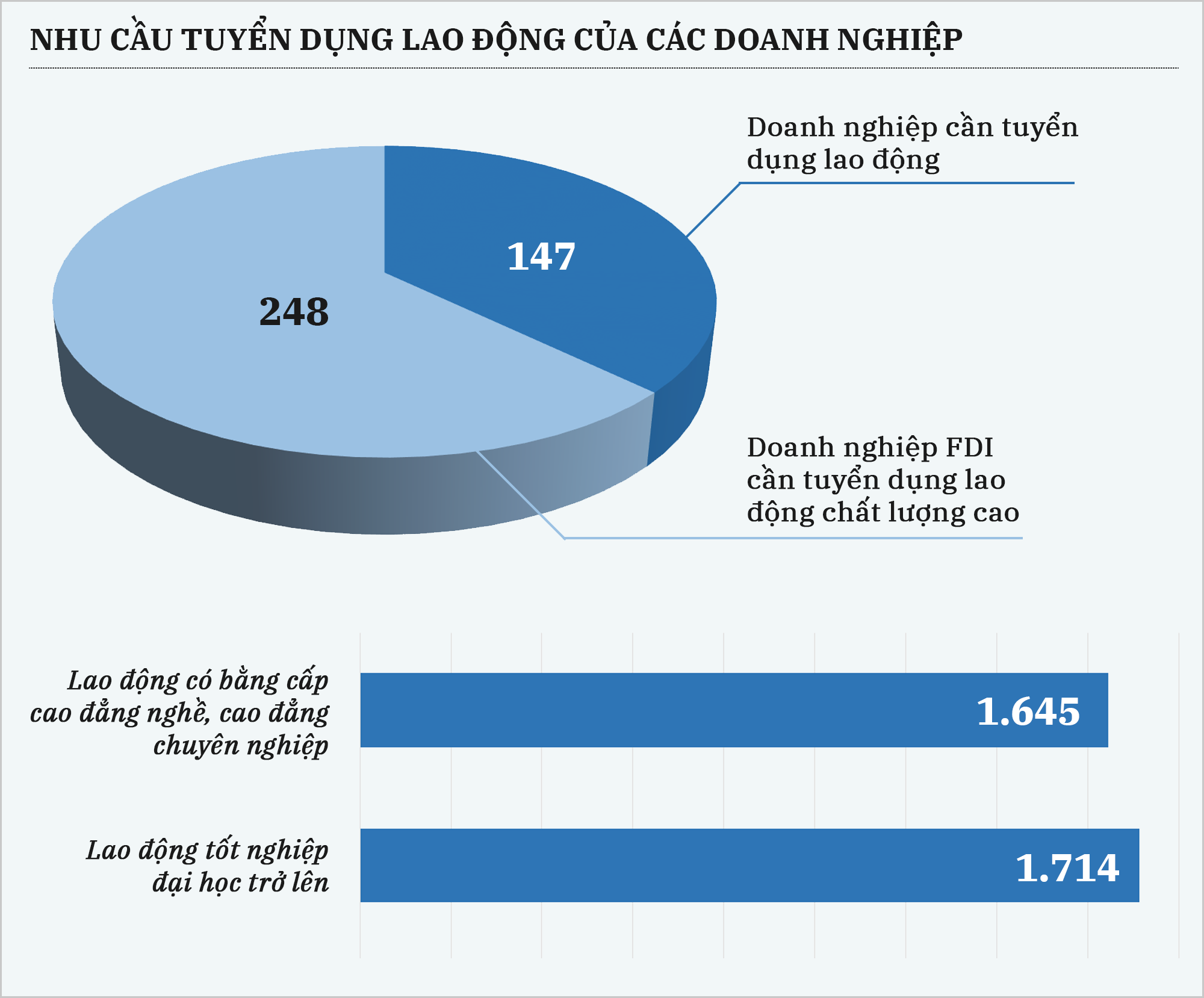
Mr. Tran Huu Thuong, Deputy Director of the Nghe An Employment Service Center, stated: Through the center's channels, in the first seven months of the year alone, 395 businesses sought to recruit workers, including 147 FDI enterprises needing high-quality labor. Specifically, they needed 1,645 workers with vocational college or professional college degrees and 1,714 with university degrees or higher. Notably, companies requiring university and professional college graduates needed 6 months to 1 year of experience in a related field. However, according to feedback from the companies, the majority of applicants lacked experience.
A fundamental mechanism is needed, starting from the training stage.
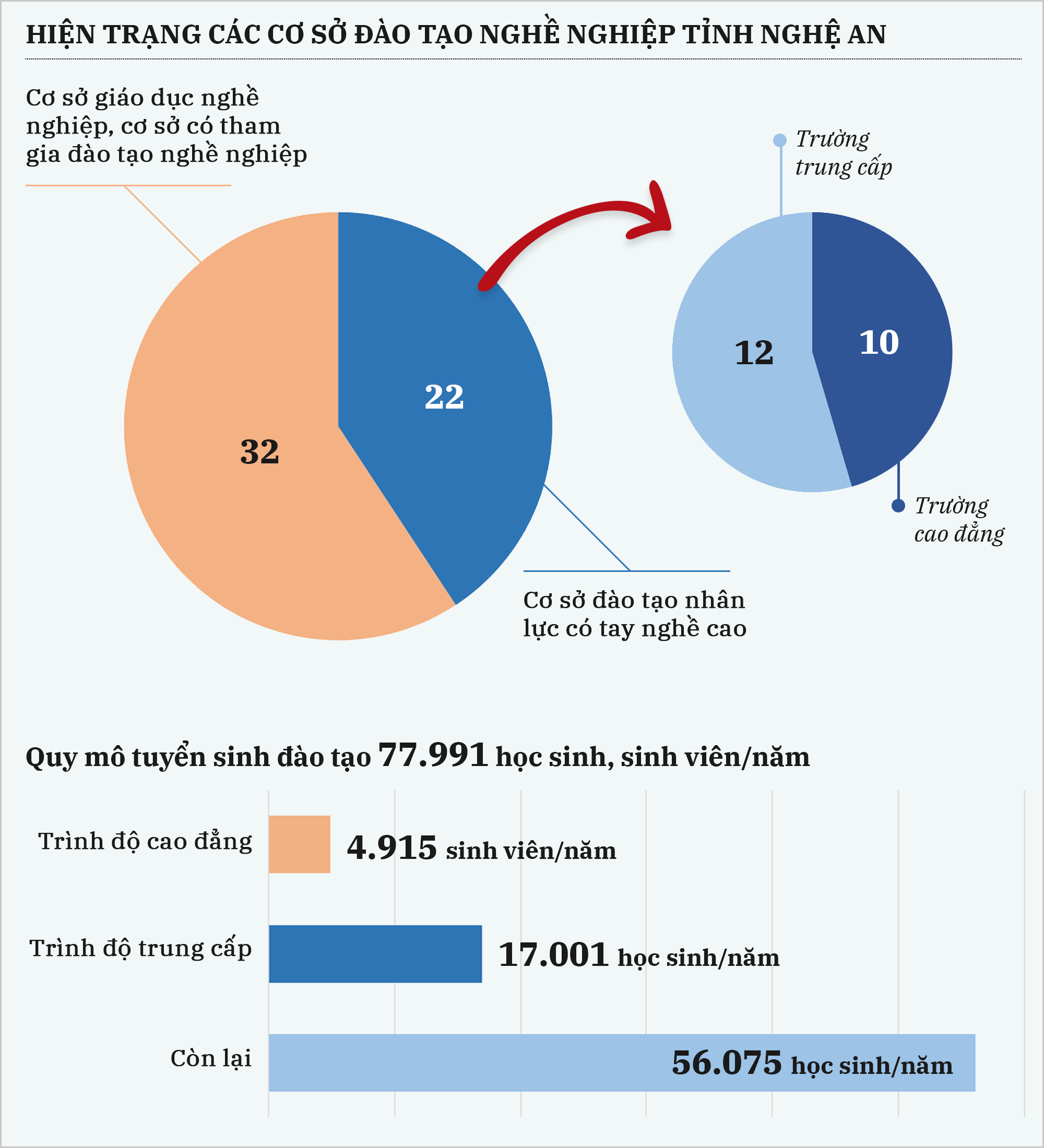
Currently, there are 54 vocational education and training institutions in the province. Of these, 22 are training highly skilled workers (10 colleges and 12 vocational schools). The annual enrollment is 77,991 students, comprising 4,915 college-level students and 17,001 vocational school-level students. The structure of occupations and training levels is gradually meeting the needs of the labor market. Several new occupations have been added to meet the demand for highly skilled workers from businesses and the domestic and international labor markets. Of these, 39 are public institutions (4 under the management of central ministries and agencies, and 35 under the management of the province) and 14 are private institutions.
To date, 18 vocational education institutions training highly skilled human resources have conducted self-assessments for quality accreditation, and 2 institutions have achieved quality accreditation. Through this process, these institutions have become aware of the importance and role of quality accreditation in vocational education; on the other hand, it helps state management agencies at all levels develop appropriate policies for the development of vocational education; and at the same time, it identifies achievements, shortcomings, and limitations in the leadership and direction of vocational education in general and the training of highly skilled human resources in particular within the province.
Director of the Department of Labor, War Invalids and Social Affairs, Doan Hong Vu
Vocational education institutions prioritize and regularly implement reforms in the curriculum and content of training for highly skilled human resources. This process involves representatives from several businesses and experts, ensuring compliance with regulations regarding the development, evaluation, and issuance of training programs; and the organization of the compilation, selection, and evaluation of training curricula at the intermediate and college levels. Many institutions have integrated knowledge with vocational skills, soft skills, and foreign languages for learners; and have strengthened education on industrial and professional work ethics and professional conduct for students, especially those in college and intermediate-level training programs.
However, according to Mr. Doan Hong Vu, the reason why the training of highly skilled human resources has not met the needs of the labor market is because units and localities lack medium- and long-term forecast data, have not accurately assessed labor supply and demand, and the need for human resource training; training institutions lack information about labor market needs, so they have not proactively developed training plans according to social requirements. The capacity to train highly skilled human resources of some vocational education institutions is still limited; facilities and equipment do not meet training requirements; although the content and training programs have been reformed, they are not truly suitable for the practical production and business and new technological equipment of enterprises; the teaching staff is in surplus or shortage in some areas, and their skills, expertise, and professional qualifications are still inadequate; and the training of soft skills (foreign languages, computer skills, professional conduct, interpersonal skills, etc.) for learners has not received sufficient attention.
Furthermore, there is a lack of mechanisms and policies to attract, honor, and reward artisans to actively participate in training, nurturing, and developing highly skilled human resources; there is also a lack of motivation to encourage teachers and students to participate in scientific research and creative entrepreneurship. While there are many preferential mechanisms and policies in place for social mobilization, they are not strong enough to attract investment in the development of vocational education...


