
Small businesses can go up to 10 years 'stagnating'.
Assessing the current state of the Vietnamese economy and business structure, economist Bui Trinh stated: The ownership structure of the Vietnamese economy is very fragmented and has hardly changed significantly; small and medium-sized enterprises (SMEs) have remained unable to develop, showing no change in added value or growth over the past 10 years.
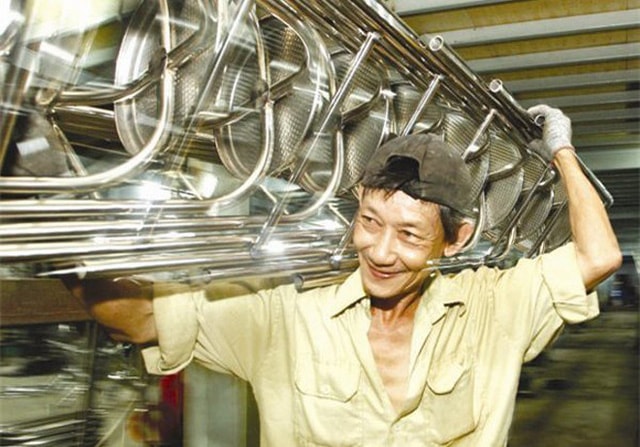 |
| Small and medium-sized enterprises (SMEs) are still unable to develop; the share of value added from this sector in GDP is very low and has remained unchanged for the past 10 years. |
In a recent analysis of Vietnam's economic structure, economist Bui Trinh stated that, during the period 2005-2015, Vietnam's average GDP growth reached 6%, a relatively high rate compared to other countries in the region.
Small businesses don't grow.
However, according to expert Bui Trinh: Looking closely at the GDP ownership structure, the contribution to GDP is primarily from the individual sector. Throughout the 10 years from 2005 to 2015, the value-added ratio of this sector remained stable at over 31% of GDP.
According to Mr. Trinh's research and analysis, the structure of the Vietnamese economy is very fragmented and there has been virtually no significant structural change. Small and medium-sized enterprises (SMEs) have remained unable to develop, with no change in added value or growth over the past 10 years (2005-2015).
This explains why the increase or decrease in the number of domestic businesses is only quantitative, while their value seems to remain unchanged, and GDP growth is only superficial. Regarding the sectoral structure, Mr. Trinh stated that both the production value and added value of the agricultural and industrial sectors declined during the period from 2007 to 2015.
The industrial sector's share decreased from 34.7% (in 2007) to only 21.7% (in 2015), indicating a shrinking portion of the economy's value-added contribution. This also demonstrates that Vietnam's industrial production is increasingly focused on processing and assembly. While the agricultural sector's share did not decline sharply, it also showed a downward trend, from 68% (in 2007) to 63% (in 2015).
Mr. Trinh asserted: With such an industrial structure, it shows that the production efficiency of Vietnam's material production sectors is increasingly poor; despite high production and high exports, Vietnam's share is getting smaller and smaller.
"The current understanding of industrialization may be ineffective, leading to inefficient land use, resource depletion, and environmental degradation," the expert said.
FDI's contribution is disproportionate.
Based on calculations from the general equilibrium model over the periods, Mr. Trinh argues that: In 10 years, although exports increased production by about 12%, the spillover effect on added value in GDP decreased (negative 13.3%), and more worryingly, it caused a very strong increase in imports (52%).
"This confirms that exports at present are basically raw materials, resources, and processed products, which also cause a significant trade deficit. Considering the period from 2000 to the present, the Vietnamese economy has always been in a state of high trade deficit," Mr. Trinh analyzed.
According to Mr. Trinh, the peak was in 2008, when the total trade deficit was over $18 billion. Imports for the FDI sector mostly consisted of machinery, equipment, and raw materials. However, exports were heavily reliant on assembly and processing, with low added value and low economic efficiency.
From 2000 to 2015, FDI consistently generated a trade surplus, while the domestic economic sector consistently experienced a trade deficit. The export share of the FDI sector increased rapidly from 57% to 67%. However, the contribution of FDI to GDP in terms of added value only increased by 3% over the 10 years.
"Increasing exports without increasing added value in the economy demonstrates that the FDI sector's contribution to the economy is disproportionate and also shows that they are facing difficulties," economist Bui Trinh commented.
According to dantri.vn


