
Do businesses still have to rely on tax officials?
Many experts continue to view the attitude of tax officials as one of the major obstacles for businesses.
At the seminar "Entrepreneur's Day: Discussing the Removal of Business Barriers" organized by the online magazine Investment Forum on October 11th, Mr.According to Mr. Doan Duy Khuong, Vice Chairman of VCCI, for many years, Vietnam has had one of the highest GDP growth rates in the region and the world, but this is trending downwards due to increasing competition.regions and countries, between businesses and from the product itself.
However, according to Mr. Khuong, research conducted by VCCI in collaboration with the ASEAN Business Council shows unfavorable information for Vietnam. Criteria such as the financial environment and infrastructure indicate that Vietnam ranks last among ASEAN countries. The question is how to remove barriers and promote business development.
Twelve experts representing regulatory agencies and businesses present at the seminar presented various aspects of business barriers related to numerous sectors.However, within that, theComplaints regarding administrative procedures with tax authorities continue to receive widespread attention.
Ms. Huong Vu, Deputy General Director of Ernst & Young Vietnam, believes that Resolution 35 on supporting and developing businesses until 2020, issued in May, clearly demonstrates the government's stance. She also stated that manyThe previous meeting discussed policies to transform Vietnam into a country that supports small and medium-sized enterprises (SMEs) as well as foreign-invested businesses.
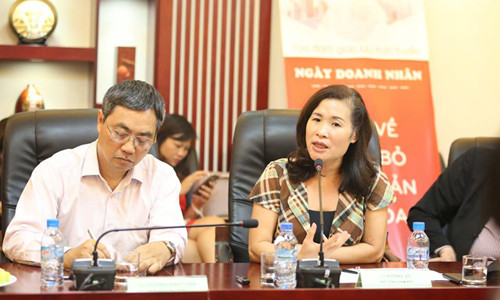 |
Ms. Huong Vu believes that barriers from the tax authorities still significantly affect the business operations of enterprises. Photo: Bizlive |
However, as an organization that has contributed opinions to numerous draft laws and circulars, and has worked alongside foreign-invested enterprises in Vietnam, Ms. Huong believes that the challenge of concretizing the resolution into practice is very difficult. After the resolution, further circulars, sub-licenses, and other regulations continue to be issued.
The auditing firm representative gave an example in the field of tax collection and refunds, where manyMultinational corporations have entered Vietnam, but accounting records still have to be printed out.
"Meanwhile, for a company that performs 20,000-30,000 transactions per day, where would they find the space to store all those transaction records in a year?""When we request soft copies, the tax authorities don't listen. If businesses don't pay in full, they don't get a tax refund, forcing them to run around trying to obtain hard copies of the documents. This is a right that businesses are entitled to, yet they have to beg and plead," Ms. Huong shared. She added that the tax collection process also faces a similar situation.
Agreeing with this viewpoint, Mr. Phi Ngoc Trinh - Deputy General Director of Ho Guom Garment Joint Stock Company - acknowledged that there is a situation where tax officials make demands.He believes that the company is unable to retain hard copies of records from 7-8 years ago. He argues that this situation is due to...Tax officials often have a nitpicking attitude, looking for faults in businesses.
"They think that I only come because the business is doing something wrong, and if I come, there must be 'something'. Currently, our company operates in 9 provinces with 9 tax collection teams, and each team has a different attitude," the business representative expressed.
He also noted that the attitudes of tax collectors have changed in recent years, butBusiness owners are still not satisfied with this."Tax officials must provide advice and approach businesses with a supportive mindset.""But to change the ethics of civil servants, their income must be changed," he stated.
Ms. Thai Huong, Chairwoman of the Board of Directors of TH True Milk, also recounted a story about facing difficulties due to differing opinions on the application of tax rates. This led her to once go to...She was at the airport to depart but was detained by customs officials on the grounds that she had not paid all her taxes. According to the tax regulations at the time, she was a tax evader.
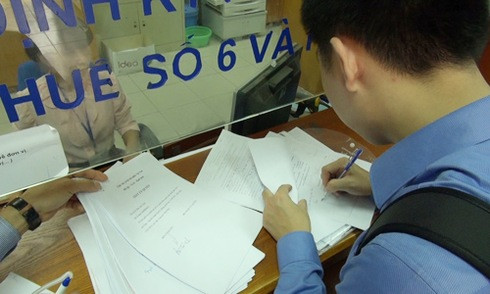 |
| Illustration. |
Lawyer Truong Thanh Duc - Chairman of Basico Law Firm - believes that, in addition to the attitude of officials, the way laws are drafted also has many shortcomings that create difficulties for businesses.The drafting team is sometimes assigned by the management agency.It took quite a long time to complete this task, but then things got delayed, and in the end, we had to rush to finish it very quickly.
"Only a few decrees that actually changed the regulations were implemented by research institutes. If we let the ministries and departments handle it, it would be even stricter, not more flexible. For example...""The amendment to the Investment Law in October proposed removing 67 business conditions. Hearing that was very encouraging, but in reality, very few were removed, while many more were added," Mr. Duc expressed.
This expert also argued that the views on innovation are only at the government level, with the issuance of documents that haven't brought about much change, while many ministries and officials are still trying to create barriers for businesses.
"The changes in tax officials are not genuine. The tax collection habits of these officials for many years have been authoritarian and questionable, possibly stemming from other motives," Mr. Duc commented.
According to Ms. Huong, to solve this problem, it is necessary to change the mindset of tax officials from one of suspicion and imposition to one of support and cooperation with businesses.
"Tax collectors today are quite confrontational. The Director of the Hanoi Tax Department told me, 'When I collect taxes, I'm collecting the people's hearts as well.' However, the problem is how you convey that viewpoint to your staff," Ms. Huong remarked.
To dispel the suspicions of tax officials, she believes there should also be a more accurate understanding of the issue of transfer pricing.""Transfer pricing is just a financial tool to increase profits; there's nothing inherently wrong with it. The question is whether Vietnam accepts transfer pricing and to what extent," this expert said.
Sharing this view, Dr. Vo Tri Thanh also stated that tax evasion is a violation, but tax avoidance is not.
"Transfer pricing is a tool to optimize operations between large corporations and their subsidiaries. Recently, the G20 summit held a meeting on this issue. The G20 itself has not yet made any common commitments on transfer pricing. However, they have outlined some methods."First, adjust legal regulations to reduce tax disparities between Vietnam and other countries. And second..."This involves sharing information and coordinating between countries to prevent tax evasion as mentioned," Mr. Thanh said.
The issue of curbing corruption among tax officials, as well as measures to reform administrative procedures in the tax and customs sectors, has been raised by the Government since mid-2014.This directive was issued by the Prime Minister in the context of the 2013 Doing Business report published by the World Bank (WB) in the middle of that year, which showed that Vietnam had one of the highest time spent on tax filing in the region, at 872 hours per year. This figure is four times higher than the average for Asia-Pacific countries.TThis delay has significantly impacted business operations and the competitiveness of the economy. More than a year later, the World Bank report revealed that,The number of hours spent on tax and social insurance payments in Vietnam in 2014 was 770 hours. This figure decreased by more than 100 hours compared to the end of 2013, however, it still remains relatively low.It ranks second in Asia-Pacific. A World Bank representative also stated that...tax sector innovation policiesAlthough the research was conducted from the end of 2014, the results were only calculated and presented in detail in the 2015 report. |
According to VNE
| RELATED NEWS |
|---|


