
Innovating production methods in agriculture
(Baonghean) - In nearly 30 years of national renewal, agriculture, farmers, and rural areas have been the foundation and important force for sustainable socio-economic development, maintaining political stability, ensuring security and national defense; preserving and promoting national cultural identity and protecting the environment... However, to continue to play that role, reforming production organization methods is considered a decisive factor for comprehensively restructuring Vietnam's agriculture, not only with the New Rural Development program.
Addressing dual risks
According to Dr. Tran Du Lich, a member of the National Assembly's Economic Committee, if we look at the achievements after 30 years of reform, the achievements in the agricultural sector remain outstanding. The successes of Vietnam's agriculture have not only been economic but have also made a very important contribution to political and social stability. However, a question remains: can we industrialize the economy from the foundation of an agricultural economy and can we become wealthy from agriculture?
According to Dr. Tran Du Lich, to answer the above question, it is necessary to address many issues simultaneously, including the model of household economic production organization and the supportive role of the State in accordance with the operating mechanism of the market and integration with the world market. There are very large issues of modern agriculture such as resolving the double risks for producers (impacts of natural disasters, diseases and market prices, exchange rates)... but above all, Dr. Tran Du Lich identified the most crucial issue as “innovating the model of agricultural production organization to absorb the achievements of science and technology and adapt to the operation of the market mechanism. It is necessary to innovate thinking about the model of industrialization of the Vietnamese economy, that is, industrialization on the foundation of agricultural industrialization, and first and foremost, to correctly understand that agricultural industrialization must be based on goals, not means. The goal of agricultural industrialization is to make agricultural production produce products of uniform quality, as in industrial production. Technology is the decisive factor. Mechanization, irrigation, electrification... are merely means.”
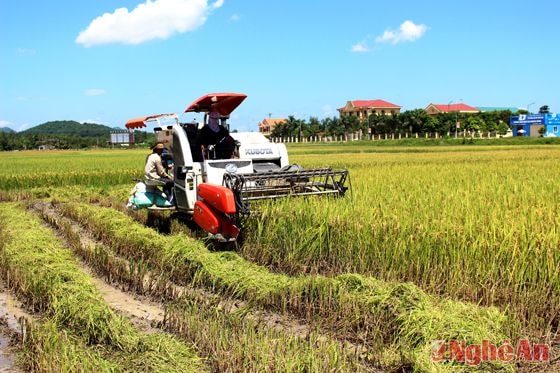 |
| Farmers in Nghia Dan town use combine harvesters to harvest the summer-autumn rice crop. Photo: Thai Truong |
Next, Dr. Tran Du Lich stated that, in order to shift the agricultural structure, the focus should be on the labor structure, not the value structure. “Agriculture must truly serve industrialization in three aspects: capital accumulation, raw material supply, and labor for the economy. Therefore, it is necessary to clarify major viewpoints such as: Should we maintain the household farming model or develop large-scale farming for maximum efficiency? What are the methods of organizing production? What are the policies to minimize risks in agriculture under market conditions? Should we abandon the provincial economic structure mindset and instead build regional-scale “agricultural-industrial hubs” to enhance the value of agricultural products? Should we organize agricultural production according to production models suitable for market mechanisms, with cooperatives and farm economic models remaining the most common? Furthermore, should land limits be maintained through administrative or economic-financial measures? How can we consolidate land to suit optimal production scale without farmers losing their land? These are open questions that require official and accurate answers.”
According to expert Tran Huy Tuan (Ministry of Planning and Investment), among the issues raised during the industrialization and modernization of agriculture and rural areas that need to be addressed in the future, attention should be paid to distributing growth to rural areas, avoiding inadequacies and increasingly clear disparities between rural and urban areas. According to expert Tran Huy Tuan, promoting the implementation of the New Rural Development Program is a specific content in the process of economic restructuring in rural areas; restructuring agriculture, and achieving social progress and equity. In the coming period, it is necessary to continue reviewing, researching, adjusting, or supplementing guidelines and criteria to suit the reality, especially for difficult and special areas, without lowering the standards and quality of the criteria.
Reduce input costs, create sustainable outputs.
According to expert Tran Huy Tuan, in addition to actively promoting and mobilizing the entire political system and all strata of the population to participate in the movement, changing production relations and creating an attractive investment environment, institutional reform needs to focus on the State playing a supporting role, creating a favorable environment for the activities of all economic sectors. The State must implement sound policies to reduce input costs, improve the quality and competitiveness of agricultural products, and create sustainable outputs; marketize the factors of agricultural production; and allocate resources according to market mechanisms to encourage the economical and efficient use of resources and state support.
To create a transparent and open business environment, in addition to effectively managing production, it is necessary to continue improving mechanisms to attract businesses to invest in agriculture and rural areas. The import and transfer of science and technology should also be considered a primary method for developing science and technology in agriculture. At the same time, the quality of the workforce must be improved; emphasis should be placed on developing small and medium-sized enterprises in rural areas that are suitable to local conditions and production levels, creating local jobs for rural workers and reducing the pressure of rural-to-urban migration.
A strong shift in vocational training for rural workers is needed, moving from training based on the existing capacity of training institutions to training based on the vocational training needs of rural workers and the requirements of the labor market. This should be linked to the socio-economic development plans of localities and the needs of businesses employing workers. Furthermore, it is necessary to innovate forms of production organization, linking production with the market by restructuring and privatizing state-owned enterprises and state-owned agricultural and forestry farms to improve their operational efficiency; gradually forming high-tech agricultural and industrial complexes and service centers, closely connected with farmers, aiming for sustainable production – added expert Tran Huy Tuan.
...During the 30 years of implementing reforms, especially the period of accelerating industrialization and modernization, agriculture and rural areas have always played a crucial role. The achievements of industrialization and modernization of agriculture and rural areas have contributed to promoting economic growth, ensuring social security, and the cause of industrialization and modernization of the country. Policies and guidelines on agriculture and rural areas are fundamentally comprehensive and complete, but the implementation is weak due to many reasons. Thoroughly and synchronously addressing these causes, fundamentally reforming production relations and production organization towards gradually increasing land consolidation, increasing labor productivity in agriculture, attracting businesses, promoting economic linkages to support reduced production costs, increasing competitiveness, linking production with the market, and building a modernized Vietnamese rural area.
Hong Ha


