
The Recovery Team and Stories of Compassion
(Baonghean) - The Team for the Collection of Martyrs' Remains under the Nghe An Provincial Military Command was established on April 18, 1984. With its main area of operation in neighboring Laos, after more than 30 years, the Team has searched for, exhumed, and brought 11,800 remains of martyrs back to their homeland. This achievement is thanks to the sincere and dedicated assistance of the people of various ethnic groups living west of the Truong Son mountain range.
Phai Da Giang is a name that always evokes beautiful images in my mind when I remember Xieng Khouang in mid-May 2011. That day, I accompanied the team from the Nghe An Provincial Military Command in Laos to collect the remains of fallen soldiers. The three-axle Zin truck carrying us jolted constantly whenever we climbed hills or crossed potholes. At such times, everyone in the vehicle cried out in pain. But he remained silent and pensive. Perhaps the cultural and linguistic barriers created a distance between him and those from the eastern side of the majestic Truong Son mountain range. Only when the makeshift camp was set up in the forest and the map was spread out did a different Phai Da Giang appear – dynamic and agile. Even in his furrowed brows, there were fleeting glimpses of sharpness.
Phai Da Giang was a soldier under the puppet regime of Vang Pao during the years when Vietnam and Laos fought side-by-side against the American imperialists. He had been to notorious places like Bom Loong and Long Cheng. Therefore, people like Da Giang have a very thorough understanding of the terrain and geography, which is of great significance to the search and repatriation of the remains of Vietnamese martyrs who died in Laos.
Thanks to Phai Da Giang, in 2011, the recovery team was able to recover the remains of six martyrs who died in Loong Cheng - the former capital of the Vang Pao puppet regime. After the war, leaving behind a past filled with mistakes, Phai Da Giang and his family moved to Lat Huong village, Muong Pet district, Xieng Khouang province. There, he has repeatedly assisted Vietnamese soldiers in searching for and recovering the remains of martyrs.
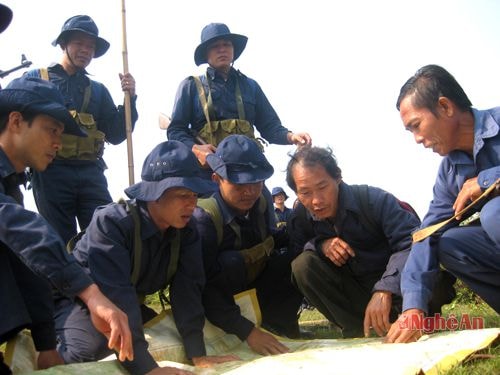 |
| Mr. Phai Da Giang (second from the right) identifies the support diagram for the team searching for the remains of fallen soldiers in Laos. |
The story of Phai Da Giang is one of many stories about the affection that the Lao people have shown and continue to show towards the Search and Recovery Team of the Nghe An Provincial Military Command. Lieutenant Colonel Pham Xuan Tam, Political Officer of the Search and Recovery Team, said that the officers and soldiers of the unit have endured countless hardships and difficulties during the months of searching for and recovering the remains of fallen soldiers in their neighboring country. Without the sincere and loyal support of the Lao government and people, the Search and Recovery Team could not have completed its mission. That affection has been inherited and continuously nurtured by the Vietnamese army through generations and stages of development.
During the years of resistance against the American imperialist invasion, the provinces of Vientiane, Xieng Khouang, and the Xaysomboun Special Zone (now Xaysomboun Province) were strategically important areas. Here, from the 1960s onwards, the CIA and the US military established a puppet regime led by Vang Pao, a Hmong leader. The US imperialists aimed to destroy the Pathet Lao armed forces, sever ties between Vietnam and Laos, and prevent reinforcements from the West and Southwest to the battlefields of South Vietnam.
With the backing of the US military, the CIA and Vang Pao established a military base in the Long Cheng (Xay Som Bun) valley and sought to obstruct the Lao movement from Vientiane, Xay Som Bun, Xieng Khouang provinces all the way to Southern Laos. Many fierce battles took place between Vietnamese troops fighting alongside the Pathet Lao Liberation Army and Vang Pao's aggressive forces, backed and manipulated by the US. During those brutal days, thousands of Vietnamese volunteer soldiers sacrificed their lives on Lao soil.
Since 1984, implementing the military's rear-area support policy, the Search and Recovery Team (now the Search and Recovery Unit) was established with the purpose of searching for, excavating, and bringing the remains of fallen soldiers back to their homeland in Vietnam. To date, 11,800 remains of fallen soldiers have been found and brought back to their hometowns. But finding even one set of remains is not a simple task. Major Dang Van Dong - Deputy Commander of Team 1 - Search and Recovery Unit, said that it is impossible to recount all the hardships and difficulties that the soldiers of the Search and Recovery Unit have gone through. Five years of dedication to Phu Moc, Bom Loong, Long Cheng, the Plain of Jars...
Major Dang Van Dong understands all too well the hardships that the officers and soldiers of the repatriation team have to endure. He said that based in Phonsavan town (Xieng Khouang), the repatriation team is divided into five groups: one command group and four sub-groups responsible for different areas. Major Dang Van Dong's group, specifically, is assigned to work in two provinces: Vientiane and Xaysomboun. “Each trip to a different area lasts at least 10 days, sometimes extending to 15 to 20 days. The weather is unpredictable, the terrain is complex, and there are all sorts of challenges to overcome. But the team members always encourage each other to persevere until the end, determined to find and bring our comrades back to their comrades and homeland,” Major Dong shared, adding that on such trips, the officers and soldiers of the repatriation team always receive great support from all levels of government, the armed forces, and the people of Laos. When Vietnamese soldiers arrived at remote villages, the locals offered them shelter in their homes, where they ate, slept, and searched together.
One person the officers and soldiers of the First Task Force – the repatriation team – will never forget is Mr. Phu Vong, former operations assistant to General Vang Pao. Putting the past behind him, Phu Vong opened his heart to the Vietnamese soldiers, guiding them through forests and mountains on numerous occasions in their search for the remains of fallen soldiers. Thanks to Phu Vong, the repatriation team found many locations where Vietnamese volunteer soldiers died in the Long Cheng area. In one area, they recovered 35 sets of remains, and in other areas, 5-6 sets. The affection shown by the Lao people, as well as those who were once on the "other side of the battle lines," is immeasurable.
Captain Tran Van Quang, from Team 4 of the repatriation unit, affirmed that this is also an expression of gratitude from today's generation to history. "We know that as long as there are martyrs who have not been brought back to their homeland, they will not rest easy in the afterlife, and their families will not cease to feel remorse. That is why, even though we have to be away from home for a long time, enduring the hardships of high mountains and deep forests, we strive to find and bring them back to their ancestral land," Captain Tran Van Quang emotionally shared. Thanks to such dedication, for over 30 years, generation after generation, the officers and soldiers of the repatriation unit have continuously remained in Laos to warm the core values of humanity and help alleviate the pain of war.
Lieutenant Colonel Pham Xuan Tam, Political Officer of the Remains Collection Team, stated that the key areas where Vietnamese volunteer soldiers made significant sacrifices are Vientiane, Xaysomboun, and Xieng Khouang. However, locating the remains of fallen soldiers is extremely difficult. According to Lieutenant Colonel Pham Xuan Tam, due to the rugged mountainous terrain, rivers, and streams, the distance from populated areas, the scattered graves of fallen soldiers, the significant changes in the landscape over time, and the prolonged rainy season, fewer and fewer people know about the locations of the soldiers' graves... All of these factors significantly impact the search, excavation, and collection of the remains of fallen soldiers. Overcoming all difficulties and carrying out outreach and propaganda work among the Lao people, during the dry season of 2013-2014, the Remains Collection Team found and excavated 88 sets of remains of fallen soldiers (9 of whom were identified). During the 2014-2015 dry season, 77 remains of fallen soldiers were exhumed and collected (9 of whom were identified). To date, 11,800 remains of fallen soldiers have been brought back to their homeland, including 10,606 buried at the Vietnam-Laos Cemetery (Anh Son district), 1,172 buried at the Do Luong Martyrs' Cemetery, and 908 buried in local cemeteries.
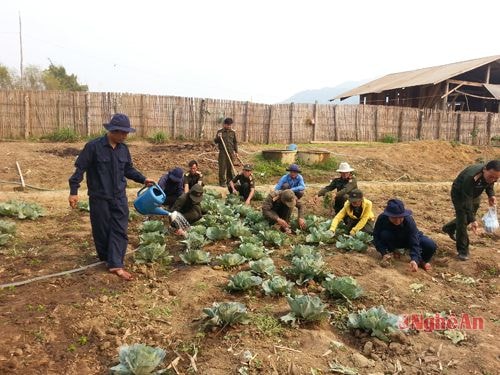 |
| The recovery team helped the people of Laos increase their agricultural production. |
Lieutenant Colonel Pham Xuan Tam said that the reason the Lao people always wholeheartedly help Vietnamese soldiers search for and collect the remains of fallen soldiers is because they deeply understand the affection and loyalty of the Vietnamese people. In Laos, the repatriation team not only carries out the task of searching for the remains of fallen soldiers but also plays an important role in fostering the tradition of solidarity and friendship between the two countries and two peoples. The Repatriation Team of the Nghe An Military Command regularly advises the Xieng Khouang Provincial Command on developing plans to maintain political security and social order; coordinates with the neighboring province to implement social welfare programs, build national unity, develop the economy, and combat the re-cultivation of opium poppies...
In 2014, the Search and Recovery Team invested in and assisted 9 units under the Xieng Khouang Provincial Military Command in developing vegetable gardens totaling 4,850 square meters. They also purchased and installed 9 water pumps and pipeline systems for irrigation. They provided 37 breeding cows, 26 goats, 7 pigs, and 60 chickens and ducks. In addition to infrastructure support, the Search and Recovery Team donated 2 televisions, 9 desktop computers and printers, 3 laptops, 40 filing cabinets, and numerous other office equipment and supplies to Xieng Khouang province. Furthermore, in 2014, officers and soldiers of the Search and Recovery Team contributed over 550 man-days to assisting local people with harvesting crops, repairing houses, and building environmental sanitation facilities. The organization provided free medical examinations, treatment, and medication to 308 people, and regularly assisted the people when needed. This fostered affection and trust among the Lao people towards the Vietnamese soldiers. And for that reason, the work of collecting the remains of fallen soldiers received dedicated support from the local people.
Many Vietnamese volunteer soldiers who sacrificed their lives still lie buried in Laos, so today's officers and soldiers will continue to silently search for and bring them back to their homeland. All of this demonstrates unwavering loyalty and gratitude to the generations who sacrificed their lives and blood for the independence and freedom of the nation, and reflects a pure and sincere international spirit.
Dao Tuan


