
Life of the mudworm
(Baonghean.vn) "Why choose a day with torrential rain just to go eat mudworms!" – Despite the reproach, my friend still braved the rain with me, slinging over his raincoat as we rode our motorbike to the mudworm-growing area of Hung Nhan (Hung Nguyen).
It's only during the rainy season that you can find them; on sunny days like these in October, there's no shortage of mudworms in the city markets. Restaurants of all sizes in Vinh have proactively added fresh mudworm dishes to their menus to attract customers. However, compared to discerning foodies who have traveled from North to South, the mudworm dishes in Vinh fall far short of the preparation methods in Hanoi and some other areas of the Red River Delta. Therefore, going to the mudworm-growing rice paddies in our country to enjoy mudworm dishes is the real treat. I reasoned this way to stop my friend from grumbling all along the road from Cua Tien Bridge through Hung Nhan, which had many muddy stretches.
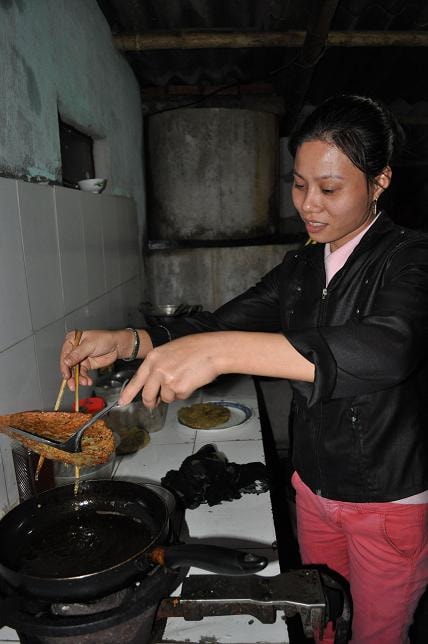 |
| Preparing the "ruoi duc" dish in Hung Chau. |
While waiting for some friends from town to arrive later to enjoy the mudworm dish, I took the opportunity to run to the low-lying area of Hung Nhan. The mudworm harvesting in the rice fields here is mainly done by people from Hamlet 1. Mudworms in Nghe An province are generally distributed throughout the lower reaches of the Lam River, including Xuan Hoi, Xuan Hai (Nghi Xuan - Ha Tinh), Hung Hoa (Vinh City), Hung Long, Hung Chau, and Hung Nhan (Hung Nguyen)... For farmers in the flood-prone Hung Nhan area, the mudworm season is a "golden" season for income if they own a lot of rice fields. A few acres of rice fields, on a lucky day, can yield 50 kg of fresh mudworms to sell right in the field, bringing in 17-20 million dong. For example, Mr. Hanh in Hamlet 8, Hung Chau commune, whose family owns an acre of rice field, can harvest over 100 kg of mudworms in a single night, earning over 35 million dong (350-370 thousand dong per kilogram); holding the money, he felt like he was dreaming.
The rain was falling heavily. At dusk, the rice fields of Hung Nhan were covered in a white sheet of water, completely deserted. The owner of the shop at the beginning of the village cheerfully said, "Buying mudworms at this time of day is a mistake, sir! If you want some, leave a deposit and your phone number, and I'll call you to pick them up when the rain subsides at the end of the month. We have any quantity you need!" As she spoke leisurely, she explained that harvesting mudworms usually takes place around midnight or early morning, when the high tide recedes and the water level of the Lam River drains the fields. The peak days for mudworm harvesting are usually the 1st and 15th of the lunar month, starting from the end of September until the end of the year. On those nights, the village is bustling with activity; old and young, men and women, all dressed up like falling stars, flock to the fields to harvest mudworms—people as numerous as the mudworms themselves. Each family sets up nets and embankments to catch mudworms. There are two ways to catch them: firstly, by setting traps (a type of trap) to scoop the mudworms along the strong current in the fields; secondly, by digging holes in the embankments and setting up thick nets or cloth nets to catch the mudworms. In addition, women and children who are not yet "skilled" at it can use basins, pots, and baskets to scoop up the worms in the rice fields. On rainy days like these, about a dozen households can only gather a few kilograms of worms to sell sporadically each night, and the initial excitement subsides considerably, even though the price of worms has skyrocketed to 400,000 VND per kilogram.
According to elderly residents in Hung Nhan, the "rươi" (a type of worm) has only become popular here in the last thirty years or so. Previously, people mainly collected them to make rươi fish sauce. Later, it became a specialty with many popular dishes, so the harvested rươi were sold immediately, and the rươi fish sauce making craft gradually faded away. Whether the rươi are easy or difficult to care for is unknown, but compared to before, they are much scarcer. The price of fresh rươi is now very volatile; during the season, the price can fluctuate daily or even hourly. However, during the rươi season, farmers still have a significant additional income to cover many daily expenses, both named and unnamed, in a life still fraught with difficulties. That's all, because while some households earn hundreds of millions of dong in a single rươi season, achieving that requires a large area of land; and that land, to produce rươi, must definitely only be used for one rice crop, and no herbicides or chemical fertilizers can be used, resulting in low yields and production. After recalculating, the "profit" was only a few tens of millions of dong! Nevertheless, we are grateful to nature for bestowing upon this poor rural area this abundant yet peculiar specialty.
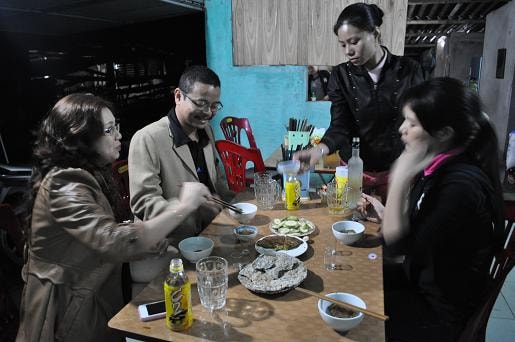
Diners were delighted to enjoy the rustic dishes made with mudworms.
I went online and checked the information, and it turns out that mudworms are found in Vietnam.
According to cookbooks, besides being used to make fermented fish paste, the sea worm is also an ingredient in many delicious dishes such as: sea worm patties, steamed sea worms, sea worm spring rolls, braised sea worms, sea worms stir-fried with water chestnuts, bamboo shoots or radishes, and in some places even sea worm soup. Here's an excerpt: “The most famous delicacy made from the rươi worm is rươi patties. Although rươi worms didn't originate in Hanoi, rươi patties are a very Hanoian 'specialty.' Many other places also make rươi patties, but the best and most unique ones are found only in Hanoi. There's much debate about the origin of this specialty dish; however, going back in time, near Dong Xuan Market, there was a street called Hang Ruoi (Rươi Street). In the past, this street was located near the Red River bank, and during the rươi season (around September in the lunar calendar), many people brought rươi worms here to sell. During the French colonial period, the street was named Hang Ruoi, and after 1945, the name Hang Ruoi was officially adopted. So, from ancient times, rươi worms have been present in the capital. Hanoians are famous for their skill and sophistication in cooking, so surely, under the skillful hands of women, those tiny rươi worms become an irresistible delicacy – rươi patties.”
But anyway. Back to our local sea worms. The rain was still pouring down. Restaurants were lit up, and diners flocked to Hung Chau to enjoy the sea worm dish. Cars and motorbikes were everywhere. Of course, most of them were from Vinh. After settling down around a table, the owner lit the fire to prepare the dish. I'd never tasted the "Hanoi delicacy" (Vu Bang's poem) sea worm patties, so it's hard to compare. But in this rural setting on a rainy night, with a few close friends from the countryside living in the city, savoring this rustic, fragrant, sweet, and not-too-greasy sea worm dish with its diverse flavors, it must have been absolutely wonderful! The owner, Mr. Nguyen Van Huong, said: Here, we mainly prepare sea worms in three ways: stir-fried, deep-fried, and sea worm soup. The preparation method isn't complicated; we only focus on the quality of the sea worms. The presentation isn't fancy, but we prioritize the "on-site" quality to satisfy the discerning palates of our customers. It's delicious, but I noticed that the mudworm patties here lack the essential dill, which is characteristic of mudworm patties, and they need to add more tangerine peel to reduce the indigestible protein in the mudworms. As for the mudworm soup and mudworm stew, they both use fresh bamboo shoots as the main "additive." The good thing is that they're served with fresh herbs picked from the family's fields, green bananas with fermented crab paste, shrimp paste, and rice crackers from Hung Chau village, so the culinary enjoyment isn't diminished. I don't know the exact amount of mudworms in each dish, but each plate/bowl costs a hefty 130,000 dong. At that price, a kilogram of prepared mudworms costs nearly a million dong (including rice and... wine). And at Mr. Huong's restaurant, on a busy day, he sells 7-8 kilograms of mudworms, so after deducting expenses, his net profit is almost 2 million dong.
As the restaurant owner "advised," to fully appreciate the taste of the sea worm dish, diners shouldn't go into the kitchen, because fresh sea worms look quite... unappealing when they're still alive. Proof of this is that after seeing live sea worms once, my colleague absolutely refused to touch the sea worm dish. But if you "innocently" enjoy it, I think the sea worm dish is far better than the famous stir-fried clams from the Lam River. The owner of Huong restaurant also said that the sea worms aren't as healthy now, they can't be "kept" for a few days in ice like before, so you have to prepare them immediately after buying them; otherwise, the taste will be unforgettable!
Don't worry about the price, but the portions of the sea worm dishes here are already set, each serving containing a few hundred grams of sea worms, so enjoying sea worms requires savoring them. Eating sea worms definitely requires a little homemade rice wine to enhance the flavor, but only a little, because drinking too much while eating sea worms isn't the mark of a true connoisseur. After preparing the sea worms for customers, the restaurants burn incense in the kitchen to remove the greasy smell. Whether steamed, elongated, or stewed, sea worms should be eaten with vermicelli and fermented crab paste or shrimp paste. There are restaurants in Hung Chau, both large and small, with different preparation and presentation styles. But when you come here, it's best to choose a simple, rustic restaurant with uncomplicated dishes. Only then will you fully experience the sea worm specialty, where each region has its own unique flavor. And the sea worms from Hung Nguyen are no exception.
I don't know how fermented mudworm paste was made in the royal palaces of Bac Ha in the past. But this mudworm season, making a trip to Hung Chau to enjoy the rustic mudworm dishes of our region, like on this rainy afternoon, is truly satisfying. Thank you to the mudworm for its hidden life, dedicating itself to humanity this season. But I still wonder about the lives of the farmers in the mudworm-growing region. Is there a way for poor farmers to earn a more complete income from mudworms in their fields? So that our farmers can fulfill the promise of the folk song: "When will October come? / When will the rice bowl be white and the mudworm bowl full?"
D.S


