
Changes in the fields
Visiting Chau Binh, a key rice-growing area in the mountainous district of Quy Chau, we clearly felt the joy of the farmers after applying the new rice variety to their production for the past two rice seasons. This achievement is largely due to the contributions of the Party committees at all levels and the pioneering and exemplary spirit of the Party members.
(Baonghean)Visiting Chau Binh, a key rice-growing area in the mountainous district of Quy Chau, we clearly felt the joy of the farmers after applying the new rice variety to their production for the past two rice seasons. This achievement is largely due to the contributions of the Party committees at all levels and the pioneering and exemplary spirit of the Party members.
Agricultural officials from Chau Binh commune led us to visit the commune's key rice-growing area, located across the Hat River, with its golden rice fields ready for harvest in Kieng 1 and Xang 2 villages. The peaceful mountain scenery in the afternoon exuded an atmosphere of prosperity. With over 13,000 hectares of natural land, including 460 hectares of agricultural land (226 hectares of which are used for wet rice cultivation), Chau Binh, along with Chau Tien, is considered one of the two communes with the largest rice-growing area in this highland district. Yet, the results at the end of the season seem to betray the potential of this land and the hard work of its diligent farmers. The main reason is the persistence of old production practices, and the concept of commercial rice production has not yet reached the minds of the people. Change only truly occurred in the summer-autumn crop of 2012 when Chau Binh was selected by Quy Chau district to build a large-scale model rice field. On a selected area of 31 hectares in Kieng 1 and Xang 2 villages, the NA2 rice variety was introduced for production with technical guidance and support in fertilizers and seeds from Nghe An Agricultural Materials Joint Stock Company. Evaluating the model, Mr. Lo Thanh Son - Head of the Agriculture Department of Quy Chau district, shared: "The effectiveness of this rice variety is higher than the previous varieties used in the locality. The yield after the 2012 summer-autumn crop reached an average of 57 quintals/hectare."
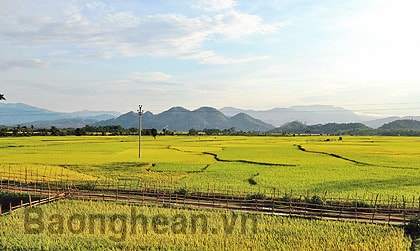
Chau Binh has great potential to implement large-scale model farming.
To achieve these results, the leadership role of Party committees at all levels, especially the pioneering role of Party members at the grassroots level, was crucial. As Comrade Sam Thi Lan, Deputy Secretary of the Chau Binh Commune Party Committee, recalled: “In implementing the large-scale model rice field project according to the district's plan, the Commune Party Committee directed the Commune People's Committee to invite all branch secretaries and village heads to a meeting to receive and implement the plan in their respective branches before mobilizing the people to participate. However, after the implementation at the grassroots level, farmers in Xang 2 and Kieng 1 villages – the chosen locations for the model – still had many doubts, fearing that introducing the new rice variety would not yield the same productivity as the traditional rice varieties.” In this situation, to ensure timely production, the role of Party members in the two village branches was crucial in mobilizing the villagers. For example, in Xang 2 village, the village head, Lang Van Thang – a young man (born in 1982) – had the honor of joining the Party in 2005 while still serving in the military. Upon receiving the directive to develop large-scale model rice fields in the area, he volunteered to cultivate nearly 40 acres, and then encouraged the villagers to follow suit. “At first, the villagers were worried because they had never grown the NA2 rice variety in the area before. I received guidance from higher authorities, so I learned the process. The company also provided seeds, fertilizer, technical support, and guaranteed the purchase of the harvest. I went back to the village to inform everyone about the specific details of the implementation and encouraged them to confidently follow the general directive. My own family also registered to participate, so gradually many villagers felt reassured and followed suit,” Thang said. Finally, in the 2012 summer-autumn crop season, 100% of the households (97 households) in Xang 2 village participated in the large-scale model rice field project, covering an area of 16.7 hectares out of the village's total rice paddy area of over 19 hectares.
Similarly, in Kieng 1 village, village head Mac Van Tung – a young Party member – set an example by being the first to register and mobilize 45 out of 76 households in the village to participate in the large-scale model rice field project. In the 2012 summer-autumn crop, Mr. Tung's family cultivated 10 hectares of NA2 rice variety and achieved higher economic efficiency on the same area of land. He shared: "With this rice variety, the yield is higher, and the quality of the rice grains is also more fragrant and delicious than the old varieties we have been growing in the area for so long. We also received guidance to improve farming techniques, helping the rice plants grow and develop well, and reducing pests and diseases. Thus, farmers benefit in many ways." Regarding Chau Binh commune, assessing the overall results after the 2012 summer-autumn crop, Ms. Sam Thi Lan, Deputy Secretary of the Commune Party Committee, stated: “Through this new approach, the people received guidance from the seed supply company in coordination with the Department of Agriculture and the Agricultural Extension Station on intensive farming, fertilization, and pest control according to the commercial rice production process. The rice produced was purchased directly from the fields. Overall, the initial results were quite high compared to the traditional rice farming methods of the local farmers, and it is also consistent with the direction of the Commune Party Committee's resolution on restructuring crop and livestock varieties to improve economic efficiency in production for farmers.”
The advantages of the new rice variety were embraced by farmers in Chau Binh commune after just one season. Entering the spring of 2013, the area planted with the NA 2 variety in the commune reached 50 hectares, but this was entirely spontaneous on the part of the farmers. This was because, in the spring of 2013, Quy Chau district did not receive any planning or support for the construction of large-scale model rice fields. Therefore, the plan to continue implementing large-scale model rice fields in Chau Binh and Chau Tien communes of Quy Chau district could not be carried out. “The district earnestly hopes to receive support from relevant levels and sectors to implement 2-3 large-scale model rice fields in the area to improve production efficiency for farmers,” suggested Mr. Lo Thanh Son, Head of the Agriculture Department of Quy Chau district. The initial results of building large-scale model fields in Chau Binh, Quy Chau are very promising. It is hoped that the model of building large-scale model fields will continue to be invested in and implemented in Quy Chau in the future, so that farmers can fully enjoy the joy of each bountiful harvest season.
Text and photos: Thanh Duy


