
Land consolidation and reallocation - viewed from Dien Chau
(Baonghean)We arrived in Dien Chau one April day, the sun casting a golden glow over the vast fields of the winter-spring rice crop, which was beginning to flower. Along the straight, wide rural roads, the farmers, their shirts drenched in sweat, still smiled brightly and chatted: "The fields are so green and lush, it's wonderful..."
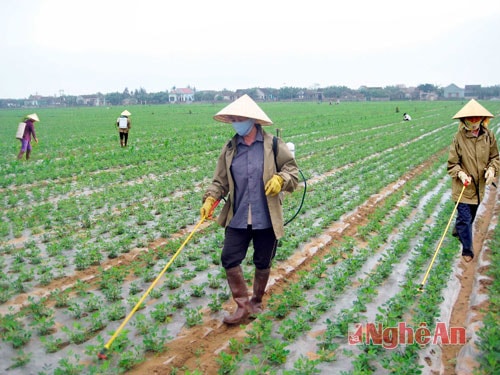 |
| Caring for spring peanuts in Dien Thinh (Dien Chau). Photo: Tran Canh Yen |
Dien Thap is one of the communes in Dien Chau district that has done well in land consolidation and exchange. In 2013, the commune completed the land consolidation and exchange process. Implementing the National Target Program for New Rural Development, Dien Thap has achieved 17 out of 19 criteria to date, with the remaining two criteria being completed in the third quarter of 2014. Ms. Chu Thi Khuyen, Chairwoman of the Dien Thap Commune People's Committee, stated: Land consolidation and exchange is not a specific criterion in the new rural development program, but it impacts criteria such as increasing income and reducing poverty. After surveying and assessing the rural situation, Dien Thap is considered a relatively wealthy commune in the district, with nearly 80% of households being well-off, many multi-story houses, and complete inter-commune and inter-hamlet transportation infrastructure. However, there are still some shortcomings, most notably fragmented land plots, a lack of irrigation water during the winter-spring season, and a severe shortage during the summer-autumn season. Some fields are left fallow, and internal field roads are narrow. Therefore, we have identified land consolidation and reallocation as a breakthrough in building new rural areas. When implementing "Land Consolidation and Reallocation" according to Directive 08 of the Provincial Party Committee, under the guidance of Dien Chau district, the local Party committee and government have recognized this as an extremely difficult task because it involves land, the main means of production of farmers. Failure to do so could easily lead to political instability in the locality. The majority of people do not want any disruption, especially those households cultivating good, nearby fields, so there are also difficulties in the implementation process."
Having identified the difficulties and importance of land consolidation, the local Party committee and government organized propaganda and mobilization efforts, from general village meetings to individual household explanations, thoroughly and clearly analyzing the benefits of land consolidation. The Steering Committee of Dien Thap commune also publicly displayed the land consolidation plan map to solicit public opinion. Poor quality land was given to residents to choose from; families who volunteered for poor quality land received additional land, while good quality land was allocated through a lottery to avoid conflict and disputes among residents. Surprisingly, many families volunteered to choose the less desirable land for themselves.
Ms. Hoang Thi Hoai from Hamlet 8, Dien Thap Commune, said: "Initially, I volunteered to take on the bad land, and my husband agreed, but both sets of parents objected. If everyone was afraid to take on bad land, the land would be left fallow. The commune is very open and transparent; the people take on the bad land themselves, only the good land is divided up. We were the first to take it. For a whole month, my husband and I toiled in the fields, weeding, leveling the land, working day and night, and investing nearly 7 million VND to rent a leveling machine. 'With human effort, even stones can be turned into rice,'" After months of hard work and investment in leveling the 7 sao (approximately 0.7 hectares) of land in a high and poor area, her family now has a 7 sao plot of land with abundant rice, which everyone admires...
In Dien Thang commune – one of the two communes (Dien Thang and Dien Cat) designated by Dien Chau district as a pilot model for land consolidation and exchange – rice fields are beginning to flower, with contiguous plots of land, roads wider than 4 meters, and a straight system of canals running along the fields, full of water. Previously, Dien Thang had fragmented, scattered plots of land, averaging 4-5 plots per household, with some households owning nearly a dozen. Thousands of large and small canals and embankments made access for production extremely difficult. Low income and unpredictable natural disasters like storms and floods led some farmers to feel discouraged and uninterested in farming. Initially, when the "Land Consolidation and Exchange" policy was introduced, the people were not in agreement, fearing high contributions, receiving poor quality land, and feeling burdened by the idea of gain or loss.
Upon receiving the full policies of the province and district regarding land consolidation and exchange, the people went from listening to agreeing and implementing them. Ms. Nguyen Thi Nhung, a farmer in Hamlet 5, Dien Loc Commune, who is tending her 5-sao (approximately 0.5 hectares) rice field, shared: "After the hamlet's leadership committee organized a meeting, analyzed the situation, and publicly and transparently showed the people the detailed planning map for internal transportation and irrigation... the people wholeheartedly responded. My family volunteered to take on 5 sao of poor quality land to improve it, and the first rice crop developed well, making my family very happy..." Sharing the same joy as Ms. Nhung, Ms. Cao Thi Duong (in Hamlet 8) also boldly took on 5 sao of barren, high, and poor quality land. Today, seeing the first spring rice crop on the formerly abandoned fields thriving, Ms. Duong is very happy: "Some people saw me taking on the land and followed suit. Now they are as happy as I am. Now they just need to take care of the crops; the fields are doing well."
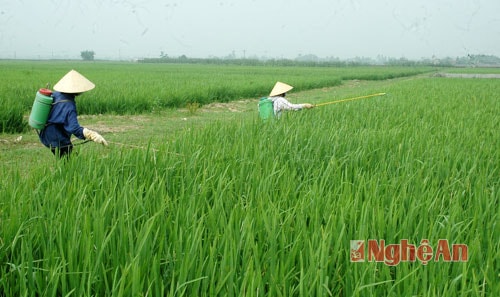 |
| Taking care of the spring rice crop in Dien Loc. |
Not only in Dien Thang and Dien Thap, but also in many other communes such as Dien Cat, Dien Lien, Tho, Dien Loc, Dien Nguyen, Dien Loi, Dien Xuan… the land consolidation and exchange work has been done well. Mr. Le Van Cam, Provincial Party Committee member and Secretary of the Dien Chau District Party Committee, stated: “It is true that ‘Even the easiest task cannot be accomplished without the people's support, but even the most difficult task can be accomplished with the people's participation.’ Thanks to the strength of the people, the solidarity and consensus from the district to the grassroots, and the close guidance from the district to the communes, villages, and even the people themselves, the land consolidation and exchange program has been implemented very well, achieving the target two years ahead of schedule. 35 out of 37 communes (excluding the town and Dien Bich) have completed land consolidation and exchange according to Directive 08 of the Provincial Party Committee. The total area of agricultural land included in the consolidation and exchange program is 131,985.8 hectares. A total of 52,596 households participated in the conversion, donating land and contributing land for irrigation, transportation, and public welfare projects.”
Following the policy on land consolidation and exchange, the Standing Committee of the District Party Committee held a meeting and directed all officials, families, and civil servants with land from the commune to the district level to implement it. Localities that do not perform well will have their key officials (secretaries, chairmen) considered for reassignment in the next term. A steering committee was established, chaired by the district chairman and the commune chairman, and working groups, led by members of the Standing Committee of the District Party Committee, were assigned to oversee the land consolidation and exchange work in various clusters. Quarterly, the Standing Committee of the District Party Committee reviews the progress of the working groups... In addition to implementing the model in two pilot communes, Dien Thang and Dien Cat, completed in 2014, the district will continue to implement and expand the model throughout the district...
Thu Huong


